
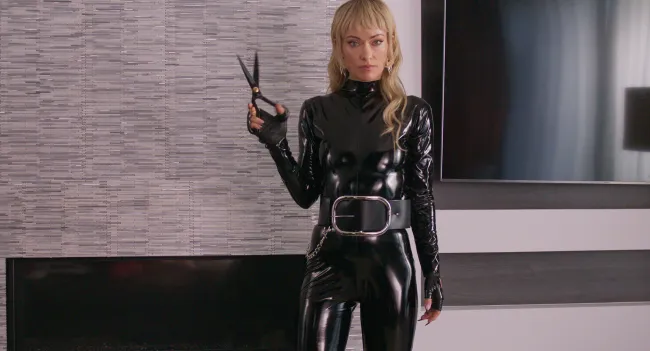
It is a truth universally acknowledged that any modern movie that begins with a dead body in a swimming pool is referencing the first scene of Billy Wilder’s immortal 1950 Hollywood satire, Sunset Boulevard. And writer-director Gregg Araki has no issues with acknowledging that film as the inspiration for the opening sequence of his own ribald art world comedy, I Want Your Sex, starring Olivia Wilde as an S&M version of Norma Desmond who begins the movie face down in a pool.
“That’s 100% Sunset Boulevard,” the mind behind such pioneering ’90s cult favorites as Totally F***ed Up and The Doom Generation confirms to Gold Derby. “It wasn’t in my original script, but then on set I decided that I wanted to have a kind of film noir framework for my movie, and have the audience going: ‘Who is that? What’s happening?’ Sunset Boulevard plays into those kinds of expectations as well, so it was definitely intentional.”

Araki also agrees that any resemblance between Wilde’s sex-positive artist Erika Tracy and Gloria Swanson’s reclusive silent film star isn’t coincidental. “I don’t disagree that Erika is like Norma Desmond,” he says with a grin. “But I also think of her as being an S&M Miranda Priestley, just one of these larger than life female characters. I want drag queens to be her for Halloween!”
“In the script, I describe her as a sex superhero,” Araki adds, comparing her artistic sensibilities to Madonna and famed photographer Robert Mapplethorpe. “She’s a figure who is charismatic, f–ked up, and inappropriate, but also confident and passionate. And, to me, Olivia is an old-time glamorous movie star like Ingrid Bergman or Greta Garbo. I was excited about her doing this movie because she is one of those icons. You can see why the other characters would be mesmerized by Erika and not able to say ‘No.'”
Chief among those mesmerized characters is Cooper Hoffman‘s Elliot, I Want Your Sex‘s answer to William Holden’s down and out screenwriter Joe Gillis from Sunset Boulevard. Just as Joe allowed himself to be seduced by Norma in return for a place to stay and the other benefits of her faded glamor, Elliot willingly becomes Erika’s latest conquest both out of self-interest as well as genuine fascination with her boldly transgressive tastes in art… and sex.
Back in Wilder’s day, Hollywood convention — and the then-enforced Hays Code — meant that Norma and Joe’s sexual relationship had to be kept out of sight, if not entirely out of mind. But I Want Your Sex gleefully puts Erika’s proclivities on full display, requiring Wilde to expose herself in a wild variety of ways. “I love the idea of reclaiming empowered sexuality, and the idea of like you get older and you get better,” the actress and filmmaker said in one recent interview about the experience. “It was such a fun way to express that.”

Wilde’s hypersexual star turn in I Want Your Sex serves as a notable contrast to her recent role in The Invite, the hit indie comedy she directs and starts in alongside Seth Rogen, Edward Norton, and Penélope Cruz. In that movie, the actress is one-half of a married couple whose sex life is non-existent, and her frustrations lead to a near-obsession with their upstairs neighbors (Norton and Cruz) who are down bad for each other. Funnily enough, both movies premiered at the 2026 Sundance Film Festival in January, with A24 ponying up for The Invite while Magnolia picked up I Want Your Sex.
Araki says that Wilde shot his film before she moved onto hers, and then followed both projects up with her supporting role in Tony Gilroy’s Behemoth!, which will have its world premiere at the 2026 New York Film Festival in September. “We finished I Want Your Sex at the end of 2024, and then she shot The Invite in the spring of 2025,” he recalls. “And now they’re both out there this summer, and they make great counterpoints to each other. She’s just having a fantastic year.”
Besides satisfying film buffs with Sunset Boulevard allusions, Araki says he’s also out to satisfy Gen Z audiences who have proven notoriously skittish about coupling sex with filmed entertainment. That’s a radical departure from the Gex X and millennial moviegoers that sought out the filmmaker’s boundary-pushing ‘90s movies to see gay sex (as seen in The Living End), bisexuality (as seen in Nowhere), and threesomes (as seen in Splendor) depicted frankly onscreen. Considering that track record, Araki is unsurprisingly un-shy about intending I Want Your Sex to be a kind of cinematic sex education for the current crop of teens and twentysomethings.
“I call it a sex-positive love letter to Gen Z,” the filmmaker says, laughing. “It’s not my intent to lecture or sermonize, but I do very much relate to Erika in that my work — like her work — is all about sex and sexuality. It’s also controversial and provocative, like her work is. There’s even a scene where Olivia and Cooper are arguing about Gen Z not having sex, and that’s very much her talking for me. While I was writing the script, I read an article about how Gen Z kids aren’t having sex, and this film became my reaction to that. If it had been made five years ago, it would not be the same movie at all.
“Then again, maybe Gen Z is having sex, and just not telling us,” Araki muses. “That’s what we were doing. I had lots of sex growing up, but anytime my parents would ask me, I would just say, ‘No, I’ve never had sex.’ But I do still feel that the phenomenon’s real. The pearl clutching about sex in movies is a very recent thing, and so that became a major theme of this movie.”

Araki suggests that the larger generational trepidation about sex scenes in movies even extends to some young actors, although he stresses that Hoffman was on board with whatever was asked of him. “Anybody who is interested in being in one of my movies knows what they are and what we’re going to do,” the filmmaker says. “There are people that are never going to be interested in being in them, and that’s fine — I’m not going to force anyone.
“Cooper was only 21 when we made the movie, and he was terrified,” Araki recalls. “He’d only just turned drinking age, and had never done a sex scene in a movie before. He told me, ‘I’m really scared, but that’s why I want to do the movie.’ The fact that it scared him is what excited him about it. He went outside of his comfort zone and that’s why he’s a fantastic actor who is going to have a fantastic career. And actors by their nature are exhibitionists, so they’re a very specific subset of Gen Z.”
Not for nothing, but Araki has previous experience launching actors on fantastic career paths by pushing them out of their comfort zones. In 2004, the writer-director cast former child stars Joseph Gordon-Levitt and Brady Corbet in Mysterious Skin, his wrenching drama about two young men who are dealing with the lingering fallout of the sexual abuse they endured as kids. Boldly stylized and sensitively told, the film was overlooked in the major awards races at the time, but remains one of Araki’s finest feature films and opened new doors for both actors. Gordon-Levitt went on to star in movies like Inception and 50/50, and directed 2013’s Don Jon, while Corbet left acting behind to pursue a filmmaking career that culminated in 2024’s The Brutalist, which netted him nominations for Best Director and Best Picture.
As it happens, Mysterious Skin is coming back to select theaters in August in a remastered version that Araki personally oversaw, and you can expect some post-screening reunions with him and Corbet. “We didn’t have the budget to properly finish the movie at the time, but now the tools are so much more sophisticated and advanced,” the director notes. “We remixed Mysterious Skin from the original negative, and it was almost like making it all over again. It’s the same movie — but now it’s exactly what I wanted it to be.”
