Here’s an unfortunate fact: David Fincher hasn’t directed a theatrically released feature film in 12 years. This is because Fincher, one of the finest working filmmakers today, has developed a close partnership with Netflix, a streamer notoriously averse to theatrical exhibition.
This isn’t just a shame because we’ve been deprived of the communal big-screen experience of watching Fincher’s masterful films. There’s also an argument that Fincher’s work is more easily able to connect with viewers when released to theaters, because his last movie released by a non-streamer, Gone Girl, was also his most financially successful effort to date.
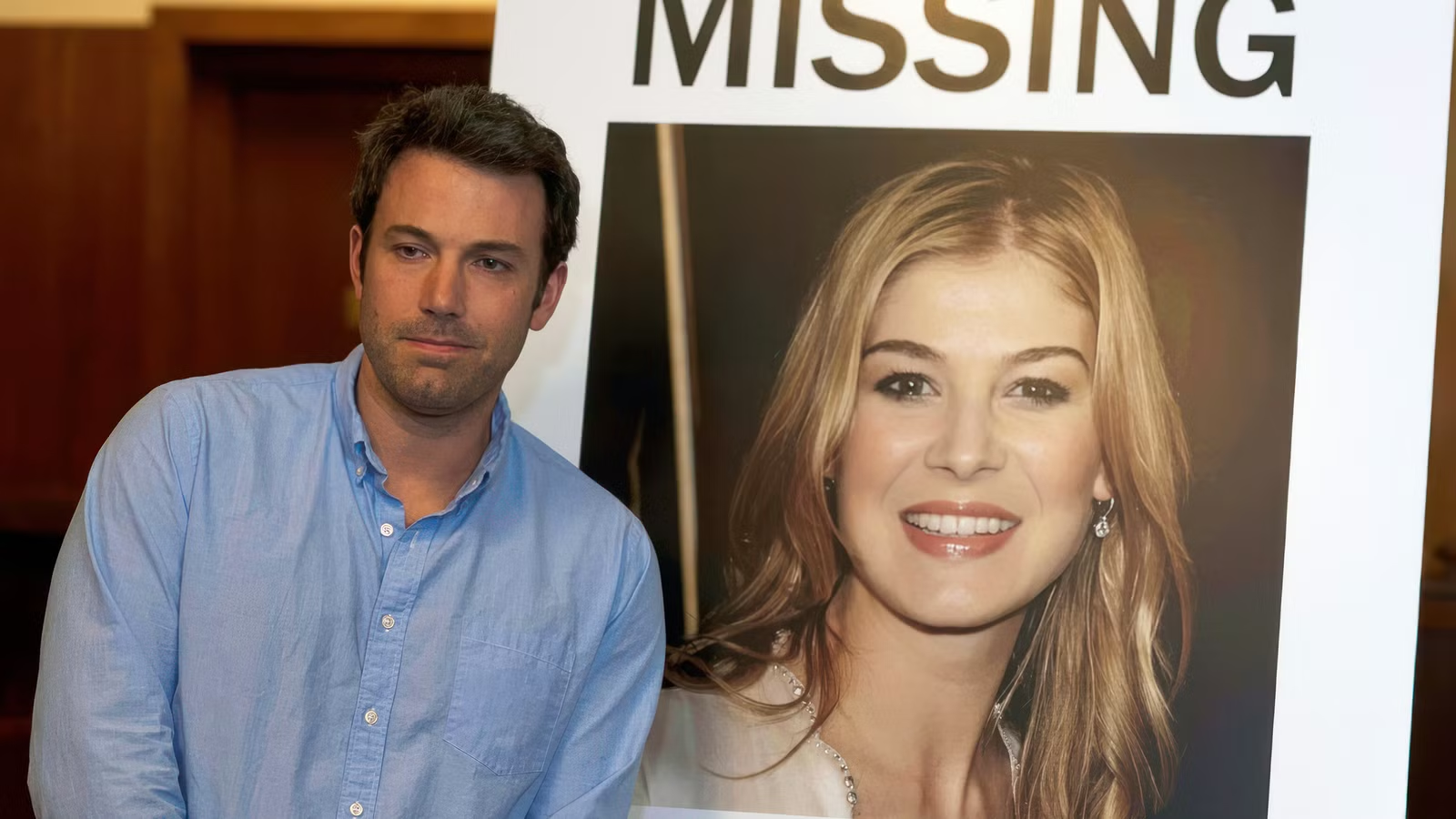
Gone Girl saw Fincher at the center of culture when his buzzy adaptation of Gillian Flynn‘s best-selling novel hit theaters in the fall of 2014 — and it still endures today, as the film has been a recent streaming success, hitting the July top 10 most-watched films list on, ironically, Netflix. Starring Ben Affleck and Rosamund Pike, Gone Girl‘s rip-roaring blast of thrills and pitch-black comedy marks the film as one of Fincher’s crowning achievements, as well as one that also predicted the future of toxic media and our obsession with true crime.
‘Gone Girl’ is Fincher at the Peak of His Powers
By 2014, Hollywood had fully transitioned to prioritizing big-budget, franchise-driven movies and abandoning mid-budget genre movies like Gone Girl. Thanks to the popularity of the source material and public cachet of Ben Affleck, however, the film swam against the current of the moviegoing landscape by playing like a blockbuster, grossing $369 million at the global box office. While it was met with solid acclaim, especially Rosamund Pike’s Oscar-nominated performance as Amy Dunne, Gone Girl, like many of Fincher’s previous works, was more or less viewed as trashy genre fare, one that many critics did not think warranted a celebration of its artistic merit.
Much like Fight Club and Zodiac, time has been kind to Gone Girl, as the film’s virtuosic craft and diamond-cut precision as a black comedy-mystery/thriller represent Fincher at the peak of his powers. Having already established his satirical chops, the director turns Gillian Flynn’s potboiler bestseller into a wry takedown of romantic tropes in movies. Amy and Nick Dunne (Affleck), two members of the journalism/media world, embark on all the stages of an idyllic relationship: the meet-cute, the hook-ups, the marriage — but it’s a veneer that masks how toxic they are as individuals and as a couple.
Watching the film years later, it’s no wonder why Gone Girl dominated the box office. Fincher’s tonal control is unmatched, making the audience feel comfortable laughing and shuddering at the misfortune of Nick, who may or may not be responsible for Amy’s disappearance. On the flip side, Amy is presented as a blond, angelic object of desire, the relatable “girl next door,” as well as a Machiavellian schemer. Fincher’s notorious filmmaking process, defined by his exacting control of the frame and rigorous demand for takes from his actors, speaks for itself in the final product here. Every subtle camera tilt or pan, quick cut, moody color palette, and dynamic camera angle puts you in the hands of a true master, one who is arguably the Alfred Hitchcock of our time.
‘Gone Girl’ is More Relevant Than Ever
In both novel and movie form, Gone Girl quietly became a prophetic text about modern American life. If the Amy Dunne saga occurred in real life (the book is loosely inspired by the Scott Peterson murder trial), it would undoubtedly be the subject of various podcasts, documentary shows, Lifetime movies, and dramatized miniseries. In a media landscape designed to fulfill our endless desire for true crime stories, Amy’s disappearance and suspected murder by her aloof husband would be the cream of the crop. This is reflected in the film’s true villain: the media, which turns this police investigation into a tabloid and talk-show frenzy.
Everyone in the movie is obsessed with consuming the media related to the case and engaging with the limelight, turning this nightmare into a desensitized reality show. Nick and Amy, former stars of the academic and literary worlds, are shown to be stripped of their integrity as they become infected by the poison of trashy cable news. The gruesome content that made Fincher’s Seven so controversial is now ordinary in Gone Girl‘s world.
Gone Girl also features career-best performances by Pike and Affleck, whose particular celebrity persona is perfectly deployed in a film where the dramatic crux stems from the public’s relationship to Nick’s media presence. Even today, viewers are still psychoanalyzing Nick’s demeanor and personal baggage, and we’re still deconstructing what it means to be a modern-day “girl boss,” an archetype David Fincher expertly subverts in his thriller masterpiece. Hopefully, Netflix will sincerely commit to putting Fincher’s next film, The Adventures of Cliff Booth, in theaters, because no one deserves it more than him.

Gone Girl
- Release Date
-
October 3, 2014
- Runtime
-
149 minutes