
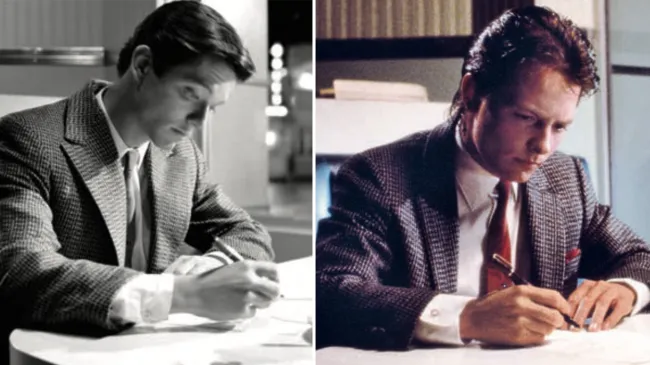
Before they went back to the future, college buddies and writing partners Bob Gale and Robert Zemeckis suffered greatly in their present. “Our screenplay was rejected over 40 times between 1981 and 1984. We were constantly told why the project couldn’t be made,” Zemeckis explains in his foreword to Gale’s new book, Back to the Future: The Complete Screenplay. “I was depressed and worried that my career was over.”
Eventually, assisted by mentor Steven Spielberg, the Bobs landed Back to the Future at Universal. Still, the project was, as Zemeckis puts it, “a movie in trouble.” “The president of Universal hated the title and was convinced no one would see it. After five-and-a-half weeks of shooting, I fired our leading man and replaced him with a television sitcom actor,” the writer-director recounts. “Industry pundits and ‘experts’ completely [wrote] us off.”


Against all odds, however, Gale and Zemeckis managed to catch lightning in a bottle DeLorean. Released over Independence Day weekend in 1985, Back to the Future became the year’s No. 1 film and would go on to spawn two sequels, a cartoon, a comic book series, and even a stage musical. It made Michael J. Fox an international superstar and elevated the profile of the film’s entire cast, notably Christopher Lloyd as Doc Emmett Brown, Lea Thompson as Lorraine McFly, and Crispin Glover as George McFly. The film was nominated for four Oscars — Best Original Screenplay for that much-scorned script, along with Best Song for Huey Lewis’ “Power of Love,” Best Sound, and Best Sound Effects Editing — winning the latter.
For four decades, Gale, who also served as a producer on the film, has remained an ambassador for Back to the Future. Now, he’s inviting fans deep inside the process with the forthcoming release of The Complete Screenplay, which reproduces his annotated script accompanied by a treasure trove of rare behind-the-scenes materials in three configurations (more on those below). “This is going to be really instructional about how movies are made, how scripts are written,” Gale tells Gold Derby. “The mistakes are in there, the deleted scenes are in there, the stuff that we changed, stuff that we thought we were going to do that we didn’t do. It’s chock full of stuff like that.”
In our conversation below, Gale looks back in depth at Back to the Future — from the infamous Eric Stoltz false start and near casting of Jeff Goldblum as Doc Brown to Marty McFly’s sketchy side hustle and other discarded plot points — and also explains why “we don’t need” another sequel, prequel, or spinoff.

Gold Derby: After all these years, what compelled you to revisit Back to the Future and assemble these different editions of the script?
Bob Gale: I was thinking about what things we could do to celebrate the 40th anniversary, and I realized the script hasn’t been published. People can find it, but it hasn’t been officially published. This is my script. My personal script with colored revision pages. You’ll see some handwritten notes throughout, places where there’s extra dialogue that we thought up on the spot, or the morning of, or the night before, and I wrote it in. This is unusual, because most of the time, when you get a script published, they try to conform it to the finished movie.
I thought to myself, “Let’s take the shooting script — the one that everybody had, that we made the movie from. Let’s publish it, and I’ll annotate it and talk about how this scene came to be, or what was going on in this scene, or what the rules of drama are here that we’re abiding by — or violating.” And when I ran out of stuff like that, there were lots of stills, frame grabs. I threw in an ad for Calvin Klein underwear that ran in the early ’80s. This is something Marty McFly would have seen that would have inspired him to get Calvin Klein underwear. So these are nice little touches that put you back in the ’80s, or in the ’50s, because we have period ads from the ’50s as well.

I’ve got reams of stuff. Production reports. Pages of the script supervisor’s line script, which most people have never seen. The idea is that you put the page of the script, and on the opposite page is the line script with the script supervisor’s notes, and the backside of it, which shows added lines that we put in there and how all that works. This is going to be really instructional — fascinating for people, about how movies are made, how scripts are written. The mistakes are in there, the deleted scenes are in there, the stuff that we changed, stuff that we thought we were going to do that we didn’t do. It’s chock full of stuff like that.
You could teach a film class from this book, with all the material in there and the different revisions and the decisions you made for economy of story or for pacing purposes. You also answer questions that fans have been asking for years. Early drafts of the script explain why George and Lorraine don’t remember Marty being at the Enchantment Under the Sea dance. Older George actually leafs through his yearbook and sees a picture of the Marty and the dance and he’s like, “Oh, that’s funny.”
Why explain it if you don’t have to?
Right. In the foreword to the book, Robert Zemeckis says that you rarely throw things away and you’re essentially a one-man Back to the Future museum. Is this all from your personal archive?
Most of this stuff is mine. When I had a reasonably finished draft, I sent it to some of our Back to the Future uber-fans — people who have their own collections. I’ve always tried to keep a good relationship with the fan community, because one of the reasons that any movie survives as long as it might is the fans keep it alive. You want to respect the fans, respect what they do.
Tom Silknitter [author of Build It With Some Style: Unauthorized Tales of the Time Machines From Back to the Future] somehow ended up with the set Polaroids [taken for continuity purposes]. He said, “Well, I’ve got this stuff scanned. You may want to use some of it.” And I’d never seen some of this. It’s like, “Whoa — you’ve got a picture of the toilet that Doc Brown fell off of?” I didn’t even remember that we had that on the set. So of course, that had to go in the book. [See below]


Stephen Clark [executive director of BacktotheFuture.com] had some Eric Stoltz material from slides. I don’t know where he got it from. So we exchanged all this stuff. And I mentioned the line script, which I did not have. I kept asking film editor Harry Keramidas, “Do you have a line script? Could you send me these pages?” And finally, for my birthday last year, he Xeroxed the whole thing and said, “Here, you need to add this.”
I did have a copy of the continuity script — that’s the one that appears later in the book. That’s what the studio does when the movie is finished. It’s actually a literal transcript of what’s on the screen. People have never seen that before, because it’s used as an internal tool.
You mentioned the Polaroids and Doc Brown’s toilet. What was the most surprising thing that was uncovered during this exercise?
That’s near the top of the list. Tom Silknitter had — and this isn’t in the standard edition, this is in the limited edition — a sketch that Mike Fink, who was the first guy we hired to help design the DeLorean, did of what the time displays might look like. I’d never even seen that before.
In the skateboard chase, there’s a sketch that somebody in the art department did of the crate scooter. I’d never seen that before.
This was an interesting story — Marty’s driver’s license. You can go online and Google “Marty McFly driver’s license,” and you’ll get lots of images of this driver’s license. I went and looked at it and said, “This is not what a California driver’s license would have looked like in 1984.” Tom Silknitter said, “I think the guy who has the real prop is a fan named Rob Klein [co-author of the Back to the Future Almanac 1985–2015].” So I emailed Rob — I had worked with him on the Back to the Future Almanac — and said, “Hey, Rob, I’m doing this book. Do you have this?” And he said, “Yeah, I do.” So he sent me a scan of it. And for the first time, people will see what Marty McFly’s driver’s license actually looked like.
Everyone knows that Eric Stoltz had filmed a considerable amount of the script before he was replaced, but there are photos in here of scenes with him that I’d never seen before. What made you decide that you wanted to release those?
This is an important part of the history of the movie. You might replace an actor one or two weeks into the shoot, or an actor dies and you have to replace them and you do a big reshoot like they did on David and Bathsheba. But the idea that you would shoot this much of the movie, and then jettison all of this footage and all this material and start all over again — that is one of the most important elements of the making of Back to the Future, and of the creative process. In terms of film history, you’d say, “Oh my god, they did that, and the movie turned out to be this great classic.”


One discarded plot point I love comes on page one of the book. It’s an alternate version of the script opening with a scene from Close Encounters of the Third Kind. It’s this whole misdirection, and it’s like, “Wait, what’s going on here?” That gag is relevant on a couple of different levels for you, right?
We were rewriting 1941 on the set of Close Encounters. Bob and I were there. We were in that airplane hangar. Of course, there was no mothership there, just a ramp — but we were there for that. So that was fun. And we’re writing this in — God, that version of the script was — it was before 1984. It must have been in the second draft where we said, “Let’s make Marty McFly a video pirate, and let’s have Doc Brown financing his experiments with Marty illegally selling these pirated videotapes.” And that was a big deal back then.

It’s a big deal now, too, except it’s digital piracy.
Right, right. That’s never going to go away.
It’s funny you mentioned that, because some of your main characters have really sketchy backstories. It’s not in the script, but you confirm in the book that Doc Brown was a fraudster, burning down his family mansion for the insurance money — and then you came up with another story for the comic books where he invented cars that run on saltwater and he sold the patent to Standard Oil for cash. These characters that we love, they weren’t always on the up and up.
Think about it. Doc Brown makes a deal with a Libyan terrorist group so he can get plutonium. You don’t get more sketchy than that, right? And that’s what makes these characters so interesting. They’re not all one thing. I think that’s one of the things that people love about the movie — today it would all be homogenized. If we were making this movie today, they would say, “Well, you can’t have Doc Brown be in business with terrorists.” Well, but we did. And nobody has a problem with it, really. Because you just say, “OK, this is how passionate the guy is. He had to get his hands on plutonium somehow, and he was going to do whatever he could, because it was his science. He had to do this.” And in the way of the world today, that’s small beans right now.

One thing in you write about that I didn’t realize — I’m sure it’s common knowledge among the super fans — is that two people were considered for Doc Brown, aside from Christopher Lloyd. First, John Lithgow, who was too busy at the time. You never got to meet him, right?
Yeah, yeah.

And then there was Jeff Goldblum.
Jeff Goldblum came in. We loved Jeff. He was great. And it was close [between him and Christopher Lloyd]. Ironically, Jeff Goldblum plays Doc Brown in Jurassic Park, right? That’s how his Doc Brown would have been. You can watch Jurassic Park and say, “Ah, that’s how Jeff would have played it.”

But there was just something about Christopher that we really found fascinating and enduring. Co-producer Neil Canton had worked with all three of those guys on [The Adventures of] Buckaroo Banzai [Across the 8th Dimension], by the way. Neil had produced Buckaroo Banzai, and he had nothing but high praise for all of them, but he said Christopher was great. There was just something about Chris that we responded to. We said, “He’s going to kill this.” And he did. It’s become an enduring part of cinematic history, this role.

Talking about Christopher Lloyd and Doc Brown for a second — “Great Scott” became such a catchphrase from this film and for Christopher Lloyd. What was the genesis of that line?
It’s a well-known expression, of course. And I think Zemeckis said, “He needs to kind of have a catchphrase.” So we said, “Well, let’s use ‘Great Scott.'” It always helps a character when they have a trademark phrase that you say, “OK, that’s Doc Brown, of course.”
You’ve revisited the script in all its many incarnations. Is there one scene that you look back on and think, “This is the scene that makes the movie. This is the scene I’m most proud of”?
No, I wouldn’t say there’s a scene like that. I think part of the creative process that you become aware of when you read this is that the opening two minutes of the movie — that tracking shot through all the stuff in Doc’s lab — is such an amazing way to start the movie. And that wasn’t the way it originally started. As you pointed out, we have the original first page, and it’s nothing like that.

One of the things I’m sure people will take away from reading this is how having some limits on your creativity can make you more creative. If we had had the budget that we really wanted, the movie wouldn’t have been as good as it is. We had this whole other ending where they actually had to harness the nuclear energy from an atomic bomb test in Nevada. And we couldn’t afford to do that. You see a version of that in the beginning of Indiana Jones and the Kingdom of the Crystal Skull — including a refrigerator.
The refrigerator was the original time machine.
Yes. Doc Brown built it out of a refrigerator. There’s a picture of what it might have looked like in there that we had used in the comic book. The fact that we didn’t have the money to go out on location and build this town and blow it up is what got us to the clock tower — which is a way better ending. It’s better on every single level. We almost didn’t have that. If we’d had more money, we wouldn’t have had that. Maybe the movie wouldn’t be as well regarded today as it is.

And the same thing with that opening scene — that was a way for us to save money and shoot an opening to the movie. We already had the set for Doc Brown’s lab. We weren’t going to see Doc Brown’s lab in 1985 in earlier drafts. And we said, “Well, OK, let’s dress this for 1985. Let’s just do this thing where Marty walks in and he blows up the speaker,” which is such an absurd scene. It’s totally absurd, makes absolutely no sense. But in terms of the logic of Back to the Future, it makes complete sense.
Doc Brown says, “My experiment worked. All the clocks are 25 minutes slow.” What kind of experiment is that, right? But Doc Brown says it, and you believe it. When you meet Doc Brown, you say, “OK, yeah, I believe this guy would have concocted some crazy experiment to make all those clocks run slow.”
It’s creating a tone for this movie … it’s sort of reality turned up to 13 or 14 on the dial. It’s not realistic; it’s hyper-realistic. It’s a comedy. And we get away with it because it’s a comedy.
When the speaker blows up — and you see the speaker, and it’s 15 feet, directed by Robert Zemeckis — and you say, “OK, I know what kind of movie this is going to be.” And if you’re not happy with that, you should leave right now.
Is there any scene that, if you could go back in time and tweak, you would?
Well, we made Back to the Future Part II to tell you that you shouldn’t do that, right? [Laughs]
But my favorite memory of making Back to the Future is a real easy one — it’s the favorite memory of a lot of people on the film. It was Michael J. Fox’s first night of work. When he came on, the crew was wondering, “All right, do these guys know what they’re doing?” We’re still sort of untested filmmakers. “They’re changing the lead actor after we’ve shot five and a half weeks of work with him. Do they know what they’re doing?”
And when Michael J. Fox came out and he did his first take, you could just feel it on the set: “Oh my god — this kid is Marty McFly. That’s the movie that’s in the script. That’s what they were trying to do. They’re doing it. It’s gonna work. This kid is perfect. He’s the perfect Marty McFly.”
Believe me, Bob Zemeckis, Neil Canton, everybody who was there just felt, “Whoa. Nailed it. This is the movie. This is going to be great. This movie’s going to work.” We didn’t know how well it was going to work. But we knew — after having watched 35, 40 minutes of cut footage of Eric Stoltz — just the first take [with Fox], we said, “Ah, that’s right. He’s got the humor. He’s the guy.”
Bob Zemeckis has said that you and he retain the rights to Back to the Future. I know that you’ve explored Back to the Future in other forms — there was the early ’90s cartoon version and the IDW comic books you have excerpts from in The Complete Screenplay. There’s also the stage musical. Do you still field pitches about doing new stories in the Back to the Future universe?
We’re very careful what we do. I wrote the book for the musical. Bob Zemeckis was involved. With that project, we did have the red button — if it wasn’t working out, we could have said, “No, we’re not doing this.” Because nobody was beating down our door. There wasn’t a clamor to say, “You’ve got to turn Back to the Future into a musical.” A lot of people thought it was an insane idea — it was going to ruin it. But we thought, “You know what? This could work.” We understood why it could work. And if we saw that it wasn’t going to work, we would have just buried it. But once we saw it workshopped, we said, “OK, yeah, this is funny. The songs are great. We can cast this. It’s going to work.”

But we don’t want to do Back to the Future Part IV for a whole bunch of different reasons. The most important one is: who wants to see a Back to the Future movie without Michael J. Fox? Nobody wants to see that. And he can’t do it. And do we even want to see Marty McFly at age 60? We don’t want to see that, either. So, let’s leave well enough alone.
Is there room somewhere to do something else to enhance the Back to the Future experience? There could be. We’re not closing the door on that. But in terms of saying, “Are you going to do a prequel? Are you going to do a spinoff?” — no, we don’t need that. We’ve seen other franchises that go back to the well too many times, and you kind of just say, “They should have stopped. We didn’t really need that.” Could there have been better Star Wars spinoffs? I think, yes, there probably could have been. We didn’t get them. And is the franchise kind of burned to the ground? I’m not going put up an argument if somebody said to me that they thought that.

Back to the Future has been an outsized part of our cultural consciousness for four decades at this point. You’ve lived with it even longer. What makes the film so special and so enduring?
There’s a moment that every human being has, when they’re 7, 8, 9, 10 years old, when they finally understand: my parents were once children. That’s a cosmic thing. It blows your mind. Because all your life, you’re hearing your parents saying, “Now, when I was your age, we didn’t have this,” and you’re thinking to yourself, “What are they talking about? When they were my age — how is that possible? These godlike creatures who tell me what to do and put food on my table and tuck me in bed at night — what are they talking about? Weren’t they always like this?”

And you realize: no. One day, you understand, “My clothes don’t fit me anymore, I’m growing up, I’m going to be an adult — which means that my parents were once kids. They had a first date.” That is a human moment — before Back to the Future — I don’t think anyone ever really captured it. When I came up with the idea, when Bob Zemeckis and I were kicking it around and developing it, we thought, “Is it possible that nobody thought of this?” I don’t think they did. Maybe there’s some science-fiction story I never read. They touched on it in episodes of The Twilight Zone and some other things, but not like this.
So I think that touches everybody. And even when you don’t understand some of the references, it doesn’t matter, because you get it. It’s a period movie. Now it’s a double period movie. But when I was a kid, I watched gangster movies, Westerns — I understood that they weren’t taking place in my world, that people lived differently in the past. I get that. So that’s No. 1.

No. 2: It’s funny, and the characters are great. We all love Marty and Doc and Lorraine, and we love George, and we even love Biff in his own way. And the movie has a certain honesty to it that I think people respond to. We’re not pandering. You’ve got the scene in the cafe when Goldie Wilson says, “Mayor — I could be the mayor,” and Lou says, “A colored mayor? That’ll be the day.” We’re touching on the racism that existed in the ’50s, and we’re doing it in a very matter-of-fact way. I think people respond to the fact that it’s a movie of its time, but we were totally being honest about it.
And of course, the idea of time travel is a romantic, fascinating thing. You add all that stuff up together — and with the cast that we have in this movie, it’s a perfect cast. There’s nobody who’s miscast. We fixed that six weeks into the shoot.

Back to the Future: The Complete Screenplay (Insight Editions) is available in three configurations.
- The trade version ($60) contains Gale’s annotated script and rare photographs, sketches, and printed materials, much of which has never been published before; it will be available from Amazon and other booksellers on Oct. 20, timed to Back to the Future Day.
- The collector’s edition ($250) includes the book quarter bound in textured Wibalin paper with metallic silver cloth, debossed with silver and blue foils, along with three tip-on images. This set also features an exact reproduction of Gale’s original script in its own slipcase. It is available for pre-order on the Insight Editions site and will ship after Sept. 1.
- The limited edition ($400) includes everything in the collector’s edition, plus an additional 16-page appendix (with a facsimile of the film’s Oscar nomination certificate for Best Original Screenplay) and seven tip-in inserts (including a reproduction of the London royal premiere ticket, a rare DeLorean time machine sketch, and a photo of Michael J. Fox with Charles and Diana). Each copy is also hand-signed by Bob Gale on the cover. This set is limited to 500 numbered copies. It is iavailable for pre-order now and will ship after July 28.
This interview has been edited and condensed.
