
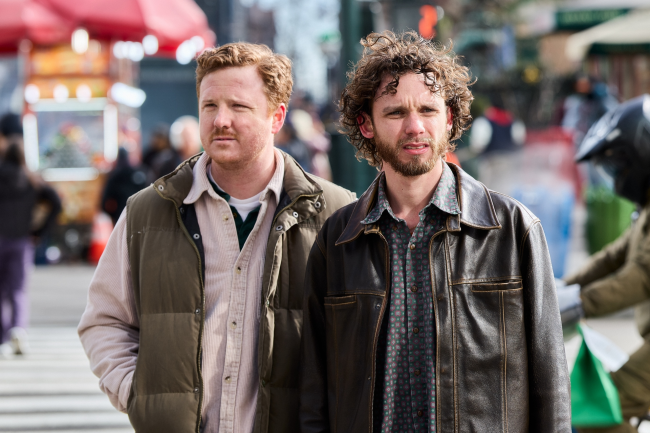
In the age of social media, it’s inevitable that TV creators have found inspiration in viral videos. Such was the case with Neighbors, which began when Harrison Fishman started receiving “these neighbor dispute fight videos that were coming out online” from his brother. Fishman shared these clips with his friend Dylan Redford. “We all just got really obsessed with them because we love chaotic confrontation videos online,” Fishman tells Gold Derby. “I think these ones felt exciting to us because of the preexisting relationship that was there.”
The more videos the pair watched, the more Fishman began to wonder about the lives of the people beyond the clips. That spurred him and Redford to start making fake neighbor dispute videos, which they put online in the hopes of convincing viewers that they were real. “Those were very fun to make,” Fishman recalls.

Those initial videos were produced pre-pandemic. After the COVID lockdowns, Redford says he noticed a shift. “It just felt like everything you were watching was just people who were pissed off at each other fighting each other,” he explains. That realization prompted them to reconsider their output. “Maybe it was more interesting to actually follow real disputes and get involved with these real peoples lives, and understand the context, than it is to make one up ourselves or make comps of them from ones that already exist.”
With that in mind, the duo created Neighbors, an HBO documentary series that examines absurd and outrageous community disputes. Josh Safdie serves as an executive producer alongside Ronald Bronstein and Eli Bush. “I think the pandemic was in general a gasoline on human conflict,” Safdie divulges. “Say you have a conflict in your home: pre-pandemic, you can just never be home,” but during COVID, “all of a sudden, you’re locked inside, and the conflict is exacerbated.”

Safdie says he was surprised when he began watching Fishman and Redford’s videos and recognized an actor. He recalls his reaction: “These guys are on another plane right now, because they understand that fiction is no different from nonfiction, and sometimes, if you look to fiction for reality, that means you can kind of understand how reality can also be fiction.” Impressed with the formal filmmaking choices the pair had made, Safdie and his producing partners saw something that could “entertain me and my friends.”
With Safdie involved, Fishman and Redford started scouring the nation for real people with dramatic stories. “Our casting process is crazy,” Fishman explains. “We’ve gone through so many different ways to find these people.” Their casting director, Harleigh Shaw, looked everywhere from small claims court cases to TikTok. “It’s a similar way that Judge Judy and People’s Court find people,” Fishman continues. But their favorite method is combing through small-town newspapers. “Some of these neighbor pieces get really violent,” he says, “and then they get into the news, and we can’t document that stuff because that’s no fun. We want something that reaches a boiling point enough to break a local news bubble.”

“Because our show deals in the format of escalation, of small things becoming big things, local newspapers are perfect in that curve of when we want to jump into a story,” adds Redford.
Safdie likens Shaw to Jennifer Venditti, who earned as Oscar nomination for casting his Marty Supreme. Like Venditti, Shaw “is a documentarian first, and I think that her philosophy towards casting transcends casting.” That’s in keeping with what initially attracted Safdie to the videos Fishman and Redford were producing. “You could feel the egalitarianism,” he recalls. “You could feel the love and the interest for the characters, and there was no condescension. It felt like the people who are making this are genuinely interested in these people, and they love them.” So “the casting is everything for this show,” and they’re already discussing “how to be even a little more far-out in the approach” to Season 2.

Safdie has often cast nonprofessionals in his films, taking inspiration from direct-cinema documentarians like Frederick Wiseman, D.A. Pennebaker, and the Maysles brothers, who “understood that real people can be actors [because] they’re the actors in their own films.” Before writing scripts, he and Bronstein will often pen intense character biographies. That’s further transformed during casting, when Venditti sends in audition tapes that include extensive interviews with the real people who are up for roles. Those tapes will inspire Safdie to rewrite because “there’s no better backstory that’s going to come than the backstory of some of these people, and it allows the smallest walk-on character to have a lived-in quality that’s going to be bringing an entire lifetime of experience.”
With Neighbors, Safdie says, “even the interviews function like scenes in a way. The formal elements of this show kind of bring it into the world of fiction,” from the music to camera movements. “There’s lots of things like that happening in the show that are very magical, and allow the nonfiction element of this show to transcend into almost like a fiction show. That’s why I think it’s been so consumable and addictive to people, because they do feel like little books. I’m trying to bring the nonfiction world into fiction, and here they’re bringing nonfiction into fiction in some way.”
Fishman and Redford believe their docuseries is holding a mirror up to society. “We’re always just chasing the most contemporary America that we can find,” says Fishman, and “the America that we’re in right now is truly a post-pandemic America. When we set out to make the show, we really weren’t trying to explore that.”

“The show is about conflict. It’s not about resolution,” sats Redford. “We’re interested in understanding people and a basic desire to connect, and the ways in which that desire itself can create conflict. I think that for a lot of cases, our neighbors originally were friends, or they wanted something from the other one, and there was a misfire, and they both retreated to their own worlds. So that retreat, and that misfire, and that conflict, is what the show is interested in looking at. There’s no better way to understand peoples’ desires and motivations than through them being in a fight with someone.”
Although the show is rooted in anger, Safdie points to a remark from one of the show’s subjects, who said, “People can’t argue if they’re loved.” That, the filmmaker says, “makes you think about everything … it’s so much easier to hate something than it is to love something.”
“I don’t consider this at all a political show,” Safdie adds, but instead “a beautiful show about people.”
