
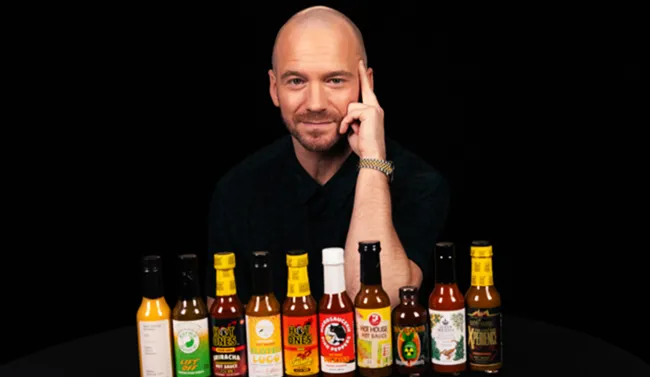
Sean Evans used to win everything. Webbys. Shortys. Streamys. If there was an internet award, Hot Ones took it home. Then something changed. The show — a deceptively simple concept in which celebrities eat progressively spicier chicken wings while answering questions — grew into one of the most-watched interview programs on the planet, racking up over four billion YouTube views across 30 seasons. And now Evans finds himself in a different conversation entirely.
Hot Ones has received two Daytime Emmy nominations and is now campaigning at the Primetime level, where it has submitted the Season 28 episode “Kate McKinnon Gets Weird While Eating Spicy Hot Wings” in both the Variety Series and Variety Writing categories, alongside the BTS episode for Picture Editing.

Evans spoke with Gold Derby about what goes into building a season, what makes a great guest, and the show’s unchanged format — plus what it’s like, after 30 seasons, to compete against the late night heavyweights: “It’s fun to be in the conversation.”
Gold Derby: You’ve described yourself as an average-looking bald guy who interviews celebrities. What does that job actually require?
Sean Evans: Because it takes one to know one [laughs]. I think it just requires a relatively strong work ethic. It’s an effort job, I think, at the end of the day. We have our guests eating scorching hot chicken wings, we have them jumping through hoops — I think it’s only fair that we meet them halfway with what is hopefully a thoughtful, career-spanning interview. And then on top of that, you have to be comfortable in the uncomfortable when it comes to spice. I’ve shot hundreds of these episodes over the years and eaten thousands upon thousands of chicken wings for the internet’s amusement. So I think those two things — a natural curiosity and at least a foundational tolerance for heat.
How does a season come together? How has the booking process changed over 11 years?
I can’t describe to you how happy I am to be past the days of having to convince people, or persuade people, or con people into doing Hot Ones — the embarrassing, awkward task of explaining the show to them as they walk in skeptical of the whole thing. Those were dark, dark days in the origin story of Hot Ones. So it’s so nice to now be at a point where we’re booking the show 50-50 in terms of incoming pitches and outgoing pitches. We have a list of every celebrity you can imagine, the projects they have coming out this year, next year. We have it color coded — are they firmly a pass? That’ll be a red. Do they kind of flirt with us, offering dates but haven’t confirmed? That’ll be yellow. Green means they’re actively trying to get on the show.
The way a season breaks down — it kind of schedules itself. Once you book the first three or four episodes, you almost stop making decisions and choices at that point. We’re trying to book many of the busiest, least available people on planet Earth — big A-list superstars — and once you get the first few locked, everything else fills in because of limited availability on both sides.
Halle Berry got a trophy for eating her wings to the bone — no milk, no water. How satisfying is it when a guest takes the wings as seriously as the questions?
I never really police wings. If the person is struggling and they start nibbling, I really understand it — that means something to me that they’ve continued. If somebody taps out and waves the white flag, I get that too. No one who I interview needs Hot Ones. We are booking at a caliber that humbles me every single day. They don’t need to do it, but they’re down. Maybe they watch the show, maybe they’ve seen their friends doing it, maybe their kids have been begging them. I’m so grateful that people come in no matter what they’re going through.
It does happen — where someone comes in and crushes the wings and walks me like a dog on my own show. Those episodes are kind of in their own category. But if every guest came in with Halle Berry energy and was cleaning the wings down to the bone — and I have to do the exact same thing — I don’t know if I’d still be here 11 years later talking to you.
The episode you submitted for the Emmy campaign is “Kate McKinnon Gets Weird While Eating Spicy Wings.” On a scale of 1 to 10, how weird did she actually get?
She’s so funny. I love that episode. I just think it has everything. I love the animal-guessing wing on “Da Bomb” where she’s kind of dying but can identify every animal. It was one of those where we connected really early. These interviews, it’s all about building a rhythm and a chemistry and a sense of trust with one another — and we kind of had that right when she walked into the studio. We had a nice chat before the episode and we were already on the same page. So I knew it would be fun to dance with her once it all started. She’s amazing. I love that episode and obviously the whole team does. That’s why we submitted it.

The show has a very consistent look — the black curtain, the table, the wings. How has it evolved, if at all?
The core of Hot Ones has remained almost unchanged from the beginning until now. I’ve worked with my editor for years and years. My producers Domonique Burroughs and Victoria Astudillo — I remember Victoria brought us our million subscriber cake. Chris Schonberger, who I’ve been in this with since the beginning. Sarah Honda, since the beginning. My brother, Gavin Evans, who I hired to help with research in the beginning, he’s still with me. So honestly the team is basically the same, and we make the show almost the exact same way.
The plain black background makes it a blank canvas so that each episode serves as an extension of the guest’s personality — they can eat up all of that space. I kind of look at it like the ivy on Wrigley Field. Even as there have been all these changing trends in media, we’ve never had to chase one. We’re still doing the classic sitcom time length and the interview, which is the oldest construct in the history of media, even though we have this very of-the-times internet format. A lot of it is just shaped by the time-tested classics.
Celebrities coming on Hot Ones are signing up for something very different from a standard press appearance. How do you look out for them?
We’re not trying to embarrass anyone. I’m a big Howard Stern fan, and I think there was a time during press runs where people would do the late night couches — but then they’d be like, “Oh, I’m doing the Howard Stern interview,” and go in with a completely different mentality. Hot Ones, for different reasons, is kind of the same thing. You’re like, “OK, now I’m doing my Hot Ones interview.” We expect them to sweat and curse and turn into a little bit of a cartoon character — but that’s the entertainment they’re signing up for.
There are certain ways in which we can look out for guests. Funny’s funny — we’ve seen big A-list actresses like Aubrey Plaza snort milk through her nose, and that makes the episode. I think people just walk in with a different kind of mentality. So I don’t really have to do much convincing that it’ll be OK. They’ve signed on for the risk.
One of the standout Hot Ones moments this year wasn’t an episode you hosted — it was Valerie Cherish (Lisa Kudrow) on The Comeback. What’s it like seeing the show reflected back in pop culture like that?
It’s awesome. Back in the day, during a film or a TV show, if they wanted to make a point about a character going through the celebrity press cycle, they’d have them on the late night couches. But now in popular culture, if you want to show a character going through the press cycle, you have to have them on Hot Ones. That is kind of a flag-planting moment for our humble little chicken wing talk show.
I did a cameo in Happy Gilmore 2. I’ve done a handful of these things over the years. And to walk around L.A. and walk into Pink Dot and see Hot Ones Pringles — to see our hot sauces on the shelf at Whole Foods — seeing myself and the show reflected back at me as I walk through life is really a testament to our amazing fans and the hard work we’ve done.

Does interviewing come naturally to you? How has it developed over 11 years?
I think interviewing is something that doesn’t come naturally to anyone. It’s really kind of like stand-up comedy — you’re just going to suck the first hundred times you do it. But the ones who get out the other side are the ones who work through all of those feelings and gain the experience where you can finally develop a point of view and a real confidence in what you’re doing.
I remember interviewing Finn Wolfhard one time and I asked him, as a child actor, was there a moment where you went from being a young kid who feels like their job is to hit their marks and say their lines, into becoming an actor? He talked about how he misses the naivete of not really knowing what he was doing — that once you develop a confidence, you have an awareness, and maybe that’s limiting in some way. Some of that resonated with me. But overall I’m a much better interviewer now than when I started. I really think it’s a 10,000-hour kind of effort. The only way to get good at it is to do it a lot, to do it often, and to have a real volume of work. I’m curious how I’ll interview 10 years from now.
Hot Ones is an Emmy contender this year. What was the first award you ever won for anything?
I played a lot of sports. I think there was a City Series trophy in the late ’90s when I played Little League for the Storm — shout out to National Little League in Crystal Lake, Ill. But it’s funny to think about awards in terms of the Emmy conversation, because I used to win at these internet award shows all the time. I’ve got more Webbys than I know what to do with. I got Shortys, I got Streamys — I used to just crush at those internet award shows.
And then now we’ve gotten to a point where we’re up against Jon Stewart and John Oliver and Jimmy Kimmel and Saturday Night Live and Stephen Colbert and Seth Meyers — on and on. And I’m like, “I don’t think I’m ever going to win anything again, Denton.” Gone are the days where I used to take home trophies. But it’s fun to be in the conversation, and I always appreciate this time of year.
This interview has been edited for length and clarity.
