
Warning: This story contains major spoilers for the Euphoria series finale. Please proceed with caution!
If betrayal had a name, it would be Alamo Brown.
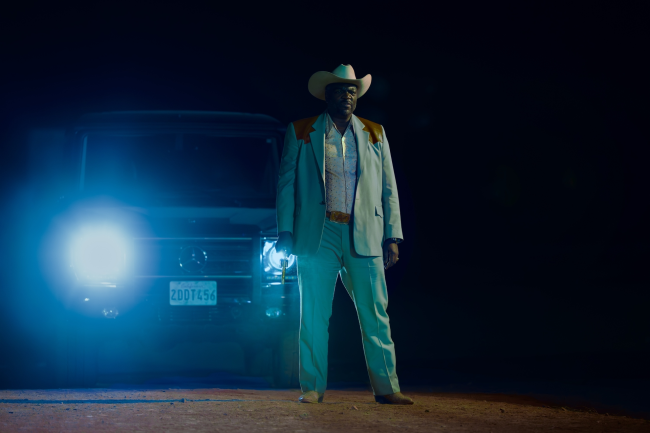
Adewale Akinnuoye-Agbaje‘s crime boss on Euphoria hired Rue Bennett (Zendaya) as his drug mule, only for her to betray him to the DEA to save herself. Alamo retaliated by intentionally giving Rue fentanyl disguised as Percocet, leading to her death. He was later betrayed by his No. 1 ally, Bishop (Darrell Britt-Gibson), who handed him an unloaded gun during a Western-style showdown with Ali (Colman Domingo), allowing Ali to take him out.
“To be quite honest, I think he died before the bullet hit him,” the actor tells Gold Derby. “The manner in which it happened, and by who — that was his trusted right-hand — it killed him right there. That’s why I said, ‘I’ll see you in hell.’ He knew he was dead before the bullet hit him. The betrayal killed him.”

Alamo was “a gangster” through and through, Akinnuoye-Agbaje tells us. “He doesn’t really have a moral code. He’s a charming man, but at the end of it, he will achieve what he needs to do by any means necessary. … It’s typified in how he treated Maddy [Alexa Demie] one minute, professing his love for her and how he wants to have four cocoa-colored babies, and the next minute she’s a bulletproof shield that he throws out the window. Because when push comes to shove, Alamo Brown is always going to be about himself.”

Rue’s death on Euphoria was handled in “a sadistic manner, albeit poignant,” he believes. But he isn’t worried irate fans will come for him personally.
“If I’m honest with you, I leave that in the hands of the audience,” he says. “That’s the wonderful thing about being an actor. My job is to really engage them, to touch them, to move them, to inspire them. Whether it’s through hatred or love or anger, you want a reaction out of them.”
He adds that Zendaya as Rue “became beloved to this fan base, such that she’s a part of their family, their friends. … That’s what Sam [Levinson, the showrunner] wanted to really bring out — to convey the message that when you deal in a life of drugs, particularly fentanyl, it’s fatal. It doesn’t matter if you’re cute, pretty, humorous, or beloved. This is a reality.”
Akinnuoye-Agbaje chuckles, “I’ve seen in my comments, people really are not happy with Alamo, but not me.”

During the planning of Season 3, Levinson expressed to the actor that his vision of Alamo Brown was “heavily influenced by the Western iconography of Sergio Leone, John Ford, and characters within those movies, like Jim Brown, Woody Strode, and Eli Wallach.”
He admits, “As a kid, I grew up in London watching those movies and being so inspired, especially when I saw Black characters on the screen. We didn’t have very many role models out there on screen, so to see Jim Brown up there and then to be able to emulate those performances, but give it my own take in a modern twist, it was exciting for me to do that.”
As luck would have it, Akinnuoye-Agbaje worked with Levinson’s father, Barry Levinson, 30 years ago on Oz, so he was “excited” to join the world of Euphoria. “Sam had elicited for me some of the most incredible performances on TV from this young cast that were so raw, authentic, and true.” He also praises the show’s cinematography from Marcell Rév and music from Hans Zimmer.
Since the actors weren’t given any prep time or rehearsals, he and Zendaya “got to know each other in the scenes, which was very organic,” he reveals. “First of all, it was lovely working with her. She’s so witty and intelligent. She has a great sense of humor and great depth. She can really go to those uncomfortable places and then pop right out and be bubbly and funny. … We used the scenes to discover and explore each other’s personalities.”

The first scene they had together was when Alamo instructed Rue to show off her “pearly whites,” he recalls. “While it still had this ominous undertone, it was quite funny, diabolically humorous, and called for me to really bring humor out of her as well. I think that broke the ice for us, because we knew that we were going to go to some uncomfortable places in some of the other scenes.”
Even though Akinnuoye-Agbaje knew the “full arc of the character” when he came on board, Levinson’s work ethic is fluid: “It can change at any moment, as it did. So, the finale that you saw was not the finale that was initially on the page. We had a really profound discussion about … what do we really want to say? Is it just about chasing women and money, or can we do something a bit more substantive here? And Sam was really up for that.
“We certainly don’t want to glamorize or sensationalize this lifestyle, so let’s have a moment of reflection. All of a sudden, he has everything, but he realizes that he has nothing, he’s empty. … He realized that he’d spent a lifetime exploiting women, and then at the end, he wanted to surrender to the power of women and have children. Just like any other normal human being, it normalized him. It showed a level of vulnerability. And it was a great epiphany before his ultimate karmic demise.”

Addressing his Emmy buzz, Akinnuoye-Agbaje admits a nomination for Euphoria “would mean everything, to be honest.” He says, “It’s such a rich, textured, layered character. And it’s been an important show within not only the industry, but it’s tapped into the zeitgeist and it’s validated the emotions of Generation Z. When you can be doing something that is creatively innovative but also has a substantive impact, it’s the best of both worlds.”
The 2026 Emmys nominations will be announced July 8, with Akinnuoye-Agbaje eligible in the Best Drama Supporting Actor category.
