
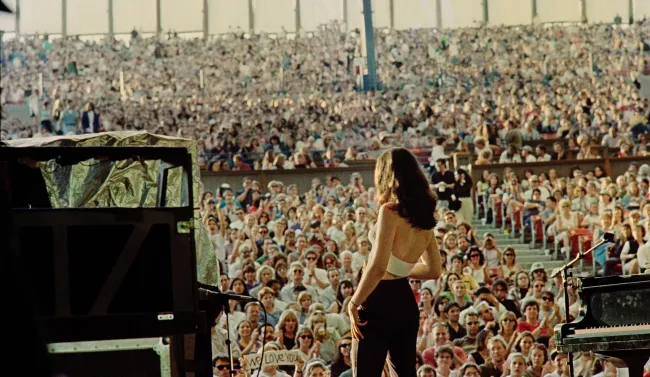
This year’s Emmy contenders for Outstanding Arts and Culture Documentary include John Candy: I Like Me, Aka Charlie Sheen, Mel Brooks: The 99 Year Old Man!, Billy Joel: And So It Goes, Martin Short’s Marty, Life Is Short… and then there’s Lilith Fair: Building a Mystery — The Untold Story. Once again, Sarah McLachlan is fighting a battle in a male-dominated field.
But McLachlan is used to that. She’s been doing just that since 1997, when the singer-songwriter co-founded the all-women Lilith Fair music festival and proved all doubters and haters — who’d ludicrously claimed that so-called “p—y package” concerts could never sell tickets – very, very wrong. The inaugural Lilith Fair earned $16 million, making it the top-grossing of any touring festival that year.

Named after Adam’s mythical first wife – who, according to Mesopotamian and Jewish folklore, fled from the Garden of Eden because she refused to submit to her biblical husband — Lilith Fair was its own real-life utopia, built for and by women. A-list acts like Sheryl Crow, Paula Cole, Bonnie Raitt, Liz Phair, Shawn Colvin, Jewel, the Indigo Girls, and Natalie Merchant, all of whom appear in Building a Mystery, joined fierce forces with McLachlan to create what was one of the live music industry’s first truly safe spaces. McLachlan then responded to criticism that the first “Lily-White Fair” lineup wasn’t diverse enough by bringing on legends like Erykah Badu, Queen Latifah, Lauryn Hill, Neneh Cherry, and even rising hip-hop superstar Missy Elliott (who’d never performed live publicly before appearing at Lilith Fair ’98), and the feminine phenomenon became even more massive — taking in $25 million in its second year, and $21 million in 1999. The festival also raised $10 million for various local charities during its historic, or herstoric, three-year run.
However, all was not well in McLachlan’s garden. As Lilith Fair became bigger, so did the backlash. Grumpy, rockist music critics (surprisingly even some female ones, like Gina Arnold and Ann Powers, although Powers eventually came around and actually appears in the Lilith documentary) blasted the festival for being overly earnest and unhip. Shock-jocks, SNL sketches, and late-night TV hosts made nasty jokes about Cole’s armpit hair or the stereotypical lesbian cat ladies who supposedly comprised Lilith’s audience. Pro-life protesters picketed Lilith Fair due to its support for Planned Parenthood and other feminist organizations. McLachlan and other Lilith acts fielded shockingly sexist, homophobic, or just plain ignorant questions at the tour’s daily press conferences. (McLachlan says she still gets “PTSD” when watching that excruciating footage in Building a Mystery.) And even at the 1998 Grammy Awards, when three prominent Lilith Fair artists received multiple nominations — Best New Artist winner Cole; Best Female Pop Vocal Performance winner McLachlan; and Colvin, who received one the night’s top awards, for Record of the Year — they were lumped together for a tokenistic, Lilith-themed group number, rather than given their own performance slots during the ceremony. (McLachlan reveals in the Lilith documentary that she, Cole, and Colvin very seriously considered boycotting the Grammys that year.)
“Honestly, I think I always said to the people who s–t on us or said we were all the negative things: ‘Show up. We will change your mind,’” McLachlan tells Gold Derby with a sly smile. And despite all the above-mentioned backlash — and the fact that McLachlan decided to end the festival “on a high note” in 1999, just as the industry was shifting to shiny TRL pop and hypermasculine nu-metal, although she does “wonder what would’ve happened if we had done a fourth year of Lilith” — the festival’s impact was massive for Generation X and Xennials.
For instance, 45-year-old Brandi Carlile, who for the past eight years has hosted her own all-female Girls Just Wanna Weekend fest, gushes in Building a Mystery about how attending Lilith Fair as a teenager changed her life. And even if some female Gen Z musicians and their fans are unaware of the Lilith lore, they do walk the trail that McLachlan and her peers blazed for them: In Building a Mystery, an incredulous Olivia Rodrigo, age 23, confesses that she never even knew about Lilith Fair until recently, but she obviously has no problem selling tickets when she tours with female/female-fronted openers like the Last Dinner Party, Wolf Alice, Die Spitz, Remi Wolf, and the Breeders.
“Sarah started that and opened people’s eyes to that thinking, specifically in music,” declares Building a Mystery director Ally Pankiw. “I think that’s a huge thing that she needs to be applauded for.” In the Q&A below, Pankiw and McLachlan open up about Lilith’s legacy and their documentary — an Emmy-worthy story that, much like Lilith Fair itself, is female-driven in front of and behind the scenes.
Gold Derby: The first thing that surprised me at the beginning of this film was younger people saying they did not know about Lillith Fair. So, I think it’s interesting to see this film through the lens of today. Maybe young music fans, who see Taylor Swift touring with Boygenius and Hayley Williams, would be shocked to know that the idea of a multi-female-artist tour was once unheard of in the music business. What stuck out to you when making this film about how the industry has changed, or sadly maybe not changed, since ‘97?
Sarah McLachlan: I think the industry has changed a lot. I think that there are way more women in successful positions, who are using their platforms amazingly. That being said, the greater world is shifting in a very different direction. And as women gain more power, the old guys in the positions of power are trying to claw back, hold onto their power. So, there’s going to be this push and pull. But I love seeing what’s happening in music right now, and women and artists using their platforms to talk about this stuff and continue to push forward. That being said, there’s a long way to go.
Ally Pankiw: Looking at it from a 2026 perspective, I can speak more to the entertainment industry at large. We’re kind of in a contraction point, where there has been a bit of a little punitive backswing of progress in terms of diversity, who’s invested in the arts and in entertainment. I put that together as I was making the doc. It was an interesting parallel of what I was experiencing in the industry today, and what was going on then and immediately after Lilith. It all kind of lands under the same theme that no matter what era you look at, there’s going to be periods of time where there’s a lie or a myth put in place to keep other people where they’re at, and not giving them the tools to lift themselves up or gain more privilege or power.
I think what’s really remarkable about this doc. And to your point, young people might not know that that was the culture at the time, and they also might not know more widely how just incredibly misogynistic and homophobic and racist that time period was in pop culture and what the prominent voice was in that time. But what’s so remarkable about Sarah’s story, and why I wanted to tell the story: She did the very brave but simple thing of just going, “I think that’s a lie. I just don’t believe it about myself, about my peers.” And so, she did this really remarkable thing, but from this very simple place of like, “I’m seeing the opposite be true with my own eyes, so I’m going to stand up against that existing monolithic thinking,” at that time. I feel like we’re there again.
Speaking of lies or fallacies, in the mid ’90s, for the first time in history, more women were consuming more music than men were. Women were buying more CDs than men. And I’ve always thought that women and girls are predictors of pop trends, driving the music market. So, where did this idea come from that women can’t sell records, can’t sell tickets, or can’t sell radio ads if they’re played back-to-back on the radio? The statistics prove that’s not true.
McLachlan: Those old-school attitudes prevailed in every industry. One of the crazy moments in the documentary is where [talent agent and Lilith Fair co-founder] Marty Diamond says, “We were trying to find corporate sponsors, and we went to a water company. and they said, ‘We’re marketing to guys.’” And like, it’s water!
Well, maybe women would like water if it was in a pink bottle…
Pankiw: Remember “Pens for Girls”? Bic did that and made pink pens. And everyone was like, “What?”
McLachlan: We were dismissed on so many levels, consistently, and not taken seriously and put down. And if we had strong opinions, it was just like, “Oh, sweetie.” It just became really insulting, to a point where I would go to radio stations and they’d say, “We can’t add you this week because we added these other female artists.” And I thought, “We’re all different. Why are you allocating this tiny sliver of the pie to us and thinking that we’re going to be placated by this?” And same with promoters saying, “You can’t do this. You can’t put two women on the same bill.” Well, I’d already been doing that, to Ally’s point. I had been living in this world where it’s like, “This does work. It’s great. People like it. I know music. My tastes are not particular to a gender. It’s music.” I just thought that idea was ridiculous. And then of course, when men said, “You can’t do that, people won’t come,” all that did was put a fire under me to prove them wrong.
Pankiw: People have always underestimated young women’s taste and thought it wasn’t “cool.” But I really do think young women have great taste and are predictive in their taste, to your point. And one of my main goals with the doc was it made me the most upset that [Lilith Fair] was misremembered as not being the coolest place to be those summers. And it was so cool and radical there! I wanted to show that side of it, too. Sometimes it was trivialized or people said it was “too earnest,” but again, these are feminine qualities, so they’re put down in general pop culture. It’s like anything that women enjoy is kind of like a second-class thing.
Yes, people are always trying to yuck women’s yum. Like, what’s wrong with it if some women like pumpkin spice lattes? They’re delicious! Why is a beverage uncool because supposedly more women drink it?
Pankiw: Because it’s the myth that things we enjoy aren’t enjoyed also by men. And that also sucks for men. In the doc, Jewel was like, “Metalheads have to tell me secretly that they love my music. They don’t feel like they can announce it, but they’re like, ‘We’re big fans.’” That’s so sad too for all genders, for taste to be gate-kept in this weird way.
What was interesting to me was an internalized misogyny, because a lot of women also bashed Lilith Fair at the time. Female music critics like Gina Arnold put it down, and there were some female musicians who at least initially didn’t want to do Lilith Fair because they thought it was a bad look. I’ll even admit that maybe back in the day I thought that if you’re a “rock chick” you have to be one of the guys and not go see women play acoustic guitars. A powerful moment in your film is when Thao Nguyen, from Tao & the Get Down Stay Down, talks about this and actually starts to cry, like she feels really bad about bashing the festival when she was young.
McLachlan: Well, that was survival at the time, too. That was the myth that was normalized. Ann Powers as well — she tore us apart.
Wait, she did? Ann is in your documentary, and it looks like she had a great time at Lilith Fair.
McLachlan: No, she tore us apart [in the ‘90s], and I was heartbroken because I thought, “This is a woman!” But then time a little while later I was thinking, “This is a woman who is existing in a system built by men, for men, and she’s one woman.” And if you want to get along and be part of that world, you have to go along with the prevailing attitudes or you’re out. You’re out really quickly, because it’s very unforgiving to have those kind of attitudes. So, it took me a while to forgive her, because I think women should know better.
So, Ann being in the doc, talking about how important and fun Lilith was, is a full-circle moment.
McLachlan: She alluded gently to maybe not having … she didn’t own it in the same way [as Nguyen did].
Pankiw: She just felt “weird” there, but I think it just goes back to the unlearning that unfortunately a lot of women and other people spend decades, well into their adulthood — the unlearning of what you thought you liked, who you thought you were.
And to Sarah’s point about survival, this project has been such a gift, because it’s really highlighted that unlearning that I’m already doing in my life, as a woman approaching 40 who was a young girl and a teenager in the ’90s and early 2000s. I did the exact same thing. All these things that I knew in this ancient place of what I actually liked and what I thought was cool and what I thought was great art, I gave those things away. You have to hide those parts of yourself because earnestness and things that were more traditionally feminine were not “cool.” They were not cool in the early 2000s, especially. And I think probably Ann Powers has spent a few decades unlearning as well some of the myths she believed about her own taste. … So, I don’t hold it against anyone who came up in that time, because it’s an impossible hill or place to climb out from. And I think some people never climb out from it and still are holding a lot of internalized misogyny. Probably being a lesbian helped me get over it faster!
McLachlan: Honestly, I think I always said to the people who s–t on us or said we were all the negative things: “Show up. We will change your mind.”
Pankiw: And you did.
McLachlan: Come and be part of it. I think Ann even alluded to that as well, where it’s just like, “Oh, yeah, dang it, this is kind of fun. It’s kind of cool. Oh, I’m not allowed to say that, but…”
We can all say it now!
McLachlan: We were too busy just doing it. We were busy celebrating each other’s great music and having incredible times every night performing with each other and getting to know each other and creating this community that didn’t exist, and getting rid of the competition that existed to keep us apart. It was like, “No, we’re going to break down all those walls.” And so it was, for me, incredibly joyful. Certainly there were some moments of PTSD watching some of the press conferences! But honestly, I glaze things over and I’m always looking for silver linings. I forgot how prevailing and pervasive that negativity and that bro culture really was back then. I had friends who were still in the closet because they didn’t feel comfortable coming out. And now I think about that, and that’s crazy. Back then, it didn’t seem so crazy. And it wasn’t that long ago.
A recurring theme throughout this film is that we didn’t really have the term “safe spaces” back then, but that Little Fair was a safe space. Even the film’s producer, Dan Levy, who was a closeted young gay boy in the ‘90s, said it’s an early memory of him feeling safe when he went to the festival. Women, in the audiences and onstage, felt safe, whether that was safe to be themselves and just have a good time, or physically safe, like safe from being groped or leered at or worse. Tell me about what it felt like to be there.
McLachlan: That was one of the big desires in my mind, to create this safe space, this place where all these women can be together celebrating each other, getting to know each other, learning from each other, like having mothers and aunties there. That kind of community is so powerful and so important. I think we’ve really lost that as a society.
I certainly didn’t have that. I grew up in isolation. My family were on the other side of the coast, so I just had my immediate family and I didn’t have a lot of friends and felt really lonely for most of my childhood. So, to come into this situation where you are instantly held and honored for who you are, without any pretense, on a very equal footing, it felt like coming home in a lot of ways. It took a bit for that to come out.
I was a little bit shy and didn’t know that I could just come up to people and start talking to them. Honestly, when the Indigo Girls showed up, that was so amazing because they were just like, “OK, we’re going to play with everybody! Don’t you want to play together?” I’m like, “Yes, I so do! I don’t know how to do this.” I remember Jewel saying the same thing, like, “I didn’t know how to ask.” They really blew everything open, and then that’s when the floodgates sort of opened. And it was multigenerational, too, because Emmylou Harris was there, Bonnie Raitt was there. Learning and witnessing women from a different generation, who had been through so much more than we had been through, and hearing their stories and feeling their respect and admiration and cheering us on, it felt really, really powerful.
In Vanity Fair’s Lilith Fair oral history, Bonnie Raitt actually said Lilith was the best live experience of her 50-plus-year entire career.
Pankiw: And imagine the generation that she came from and what the industry looked like. When you talk about Sarah creating a safe space and this sort of utopian ecosystem … I think this doc is a nice reminder that the systems built by women — not just in arts and entertainment, but if you broaden that out, it can apply to many places and many parts of our society — they’re safer, they’re more equitable, they’re more diverse, they run more smoothly, they protect people, they’re intergenerational. They don’t leave different generations behind.
But I think this is an important thing to mention, too, especially in the moment in time we’re in right now and all the sort of backsliding that we’re seeing everywhere: It wasn’t just a warm, fuzzy feeling. It was incredibly financially successful and commercially viable and this massive success, sold-out everywhere. … I think it’s also still the most successful financial touring festival. I think about that so often, like what a great example that women investing in their systems and ideas is not a risk. It’s a huge opportunity, and it’s not just to tick a box. Again, to go back to Taylor Swift and these massive [female] artists, no one would think of those people as business risks. But Sarah started that and opened people’s eyes to that thinking, specifically in music. And that’s a huge thing that she needs to be applauded for.
Sarah, did you feel at the time that you were doing something important or game-changing, or is that something you only realized in retrospect?
McLachlan: All of the above! In the midst of it, I was too busy to even know what we were doing. I didn’t really understand the larger ramifications of it until halfway through the first tour. Actually, in 1997, we did four test runs, which proved the model with the promoters that we had relationships with. And then we went into the greater world and said, “OK, we’re going to do this.” They were like, “You can’t do that,” and I’m like, “Well, we just did, and we sold out every time! So yes, we can!” But even then, with promoters, or many of them, we had to shoulder 100 percent of the guarantee. There was no underwriting it. They didn’t want to take the chance. It took us a while to prove ourselves, but we did.
But in the middle of it, it’s very hard to have any kind of perspective other than, “This is amazing, this is so much fun, this is so much work, it’s so exhausting, it’s so all-encompassing.” This idea that we are moving the dial forward, I think that came over time with the success of it, with the second year, getting more diverse artists that initially said no because it was not cool enough or not proven, whatever reasons. I went, “Listen, just look at how many fans show up. Do you want to diversify your audiences? Do you want to get new fans?” It’s actually very simple, and it’s financially a smart choice to make, and a smart choice any manager should make for their young artist. It took a while for those things to build and to become understandable.
And now, having years of time in between, women who were there as young people are coming up to me over the years and saying, “I was there, and you showed me that I could do and be anything I wanted to be, to dream big! Now I’m the head of my law firm and I’m bringing along women to be my partners.” Hundreds of stories like that. That legacy of celebrating each other, of caring for each other, of supporting each other and bringing each other alongside, that has continued in the same way. That was the legacy, of giving. A big part of it for me was being able to leave a lasting impact, not just musically, but on the community. How do we actually help the community? Being able to give a dollar of every ticket sale, which is a nominal amount, but sometimes that was upwards of $30,000 and sometimes the biggest single check that any of these [local charitable] organizations [in ever tour stop] had ever received. That is what made the press conferences so much less painful, because they were generally very painful, but I got to be the lucky person at the end to give the check to the local charity.
It’s amazing that all of us together built this thing that could go out and not only put on a great show and entertain people and bring people together and create a community, but could leave a lasting impact to continue to help women and marginalized citizens in that community. I took the money I made from Lilith and put it into foundation and started my music schools. And so, that legacy of giving continues, 25 years later.
Pankiw: If everyone could be Sarah McLachlan, the world would be a much better place.
I wish that were the case, but there’s only one Sarah McLachlan! We were talking about safe spaces, and the last year of the original Lilith Fair was also the year of the infamously violent Woodstock ’99, a festival that couldn’t have been more opposite to Lilith. It seemed to signify an abrupt culture shift, back to toxic masculinity or bro culture, that’s still very prevalent today. What happened?
Pankiw: That’s a big question, but I often reference a brilliant book by this author named Sophie Gilbert called Girl on Girl: How Pop Culture Turned a Generation of Women Against Themselves. It talks about this shift from the power and autonomy from women in entertainment. The pendulum swings, and sometimes it is in response to progress. She has an interesting chapter about music transitioning from the ’90s to the 2000s. She says it did feel a bit like a punitive pendulum swing, and she has a line that is so chilling: “The women of the ’90s were replaced by the girls of the 2000s.” And I think that was not just in music but in pop culture in general, in terms of who was becoming a star and a celebrity. It felt like people with ownership over their own careers, and then there was then this push to have a lot of young people that didn’t have full ownership over their careers, where a lot of a bigger machine could own a piece of the money of these younger artists. I don’t think that fully answers your question, but I think it’s indicative of some of that shift into the early 2000s.
As for how Woodstock ’99 plays into that, I mean, Sheryl Crow [who played both Lilith Fair and Woodstock ‘99] says it in the doc. She says [in a press conference scene], “I hope [Woodstock ‘99] is not an indication of where we’re headed as a country!” And you kind of go, “Ugh!” when you watch that line, because for a moment it felt like this vulnerability and sentimentality and lyricism was front and center. And then different types of music and art and movies kind of rushed in to replace some of that in the early 2000s.
McLachlan: I often wonder what would’ve happened if we had done a fourth year of Lilith. I was exhausted and I was done, and my record label was screaming for a new record. And I’m always of the mindset of “end on a high note.” I just had this feeling that by doing it another year, the success of it might start to wane, and that would be a real bummer. But it’s true that I felt by the next year, [pop music was dominated by] boy bands and girl bands and very fabricated, part of a larger machine typically run by men, created by men, to make a lot of money, and be a very particular narrative. It did feel like the door slammed closed a little bit. [The women of Lilith Fair] as individual artists all continued to make music and continued to be successful, but the media machine moved on to something else, as it does. There wasn’t massive focus. And so, it is cyclical in that way. But hindsight is everything.
It’s touched on very briefly in the film that you did try to revive Lilith Fair in 2010, but maybe it was a bit too early to do that, because it wasn’t as successful as it had been in the ‘90s. But next year is the 30th anniversary of the festival, and with everything we’re talking about, where society is right now, plus there are many amazing female artists dominating the pop space right now, is there a chance Lilith could be revived? Maybe even for just some kind of one-off anniversary event next year? I feel the world needs Lilith Fair right now.
Pankiw: And you’re like, “Can I get tickets?” [Laughs]
McLachlan: Actually, I didn’t even realize it was the 30th anniversary coming! Stay tuned. I have nothing in the plans, but there are always things brewing, moving forward.
This Q&A has been edited for brevity and clarity. Watch Sarah McLachlan & Ally Pankiw’s full interview in the video below:
