
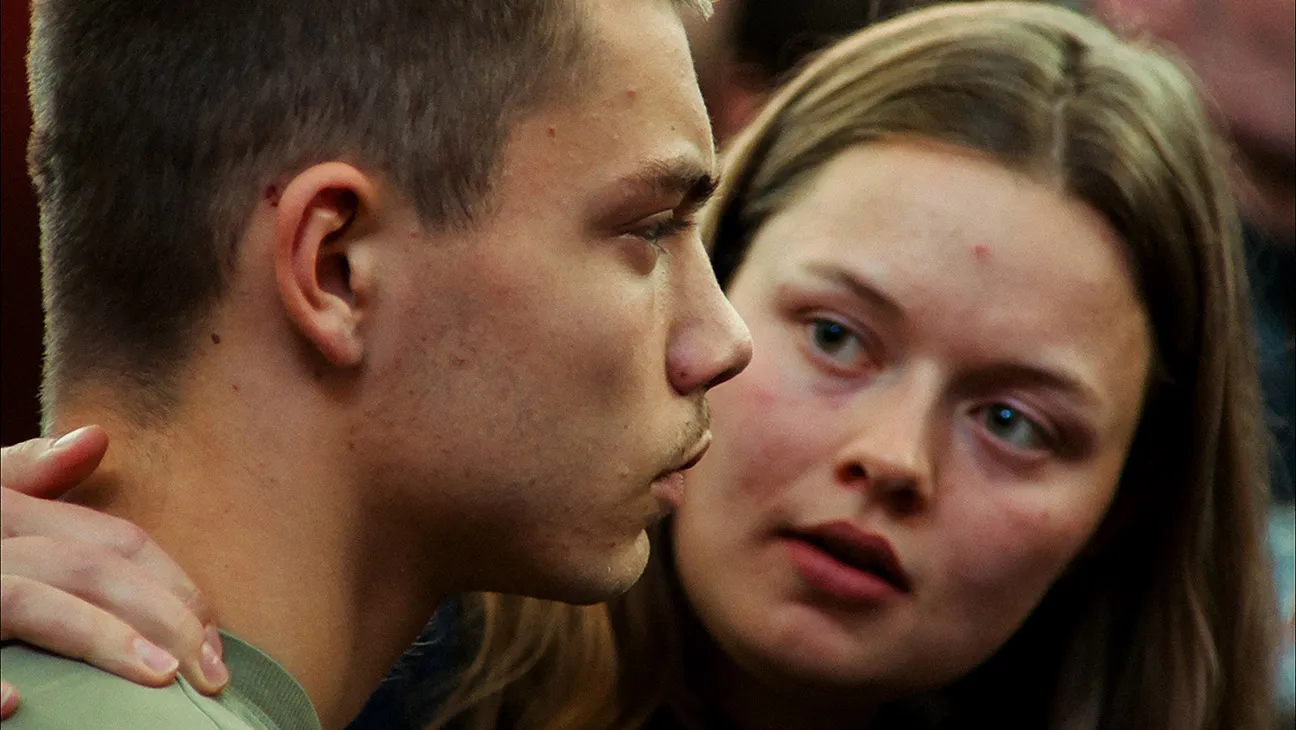
For his bracing first feature, The Blow (La Frappe), writer-director Julien Gaspar-Oliveri chose a subject so bleak, many filmmakers wouldn’t touch it with a ten-foot pole. And yet this raw and grippingly honest incest drama manages to find a bit of light in the darkness, showing how it’s possible to live with the traumas of sexual abuse. Feverishly performed by newcomer Diego Murgia, who stars alongside César award winner Bastien Bouillon, Gaspar-Oliveri’s moving debut reveals that he’s not only a talented director to watch, but one who’s unafraid to tackle tough scenarios.
The Blow focuses on a disarmingly troubled young man, Enzo (Murgia), who tries so hard to find affection in the eyes of his dad, Anthony (Bouillon), he’s willing to ignore the worst thing a father could ever do to his own son. Enzo spends much of the film in a crushing state of denial, hoping against hope that love will somehow emerge from this mess. He’s so vulnerable that you can’t help feeling his pain — even when he winds up inflicting that pain on others.
The Blow
The Bottom Line
A powerful debut tackles a tough subject.
Venue: Cannes Film Festival (Critics’ Week)
Cast: Diego Murgia, Bastien Bouillon, Romane Fringeli, Héloïse Volle
Director: Julien Gaspar-Oliveri
Screenwriters: Julien Gaspar-Oliveri, Claudia Bottino
1 hour 46 minutes
Per the press notes, Gaspar-Oliveri (who co-created the successful high school series, Those Who Blush) partially based the story (co-written with Claudia Bottino) on his own life, which seems evident given the emotional authenticity of his characters. Murgia’s portrayal of Enzo is the movie’s breakthrough performance, although Romane Fringeli, who plays the 19-year-old’s abrasive older sister, Carla, is also a standout. Bouillon, meanwhile, continues a string of strong turns (including in The Birthday Party, which screened in Cannes’ main competition this year) that began back in 2022 with Dominik Moll’s thriller The Night of the 12th.
The opening scene, lensed by Martin Rit in grainy close-ups, shows Enzo and Carla carelessly sleeping in bed together, their bodies subtly rising and falling with each breath. It seems like a blissful moment between the two siblings, who share a tight if volatile bond. But as the film progresses and we learn more about their childhood, that scene takes on a very different meaning: one in which proximity can breed both affection and contempt.
With no parents in the picture and Carla moving out to a college dorm, Enzo’s whole life seems to be in front of him. It helps that he has a burgeoning and very loving relationship with new girlfriend Laura (Héloïse Volle), whose parents run a go-kart track that seems to be the main source of entertainment in their working-class suburb of Marseille.
But the state of independence Enzo has achieved at such a young age is broken when his dad returns home after a five-year stint in prison. A scene in which the two discuss Anthony’s future with a parole officer underlines to what extent Enzo has become the man of the household, hiring his own father to help sell kitchen appliances at local flea markets.
Bouillon creates a charming if menacing presence from the get-go, portraying Anthony as a father who’s been out of the loop for too long with regards to both family and civilian life, yet still wants to be in charge. In one sequence foreshadowing what’s to come, Enzo hides in a closet while his dad brings a woman home from the bar, witnessing some awkward and then off-putting sexual behavior. A latter scene in which the boy climbs in bed with Anthony reveals much worse, although it takes Gaspar-Oliveri a while to explain what exactly went down in the past.
What’s most moving about The Blow — whose French title can mean both a physical hit and a young hoodlum — is the way it charts Enzo’s gradual awakening from a kid who’s still too attached to his father, mostly for terrible reasons, to an adult who finally steps back and sees the truth, at which point the trauma is so overwhelming that it takes over. This happens during several explosive scenes in which Enzo lashes out at those who truly love him (his girlfriend; his sister, who wants nothing to do with their dad), searching in vain for someone to quell the suffering.
Murgia is a revelation here, playing a loose cannon who’s also deeply wounded, like a battered dog occasionally showing his teeth and sometimes biting those who feed him. The early moments in the drama, when Enzo is trying his best to please Anthony after he gets out of jail, offering to cook dinner or lending him a few bucks, will just about break your heart. Because deep down, Enzo knows that by getting closer to his dad, he’s also getting further away from his own recovery. It’s the constant push and pull between trauma and salvation that makes The Blow such a powerful experience.
