
[The following story contains spoilers from Is God Is.]
A great playwright does not always make a great filmmaker, but Aleshea Harris proves the path is there. Making her feature screenwriting and directing debut with Is God Is, an adaptation of her play which was a Pulitzer Prize finalist, Harris is behind one of the year’s wildest and most acclaimed films, sitting at a 97 percent freshness rating on Rotten Tomatoes.
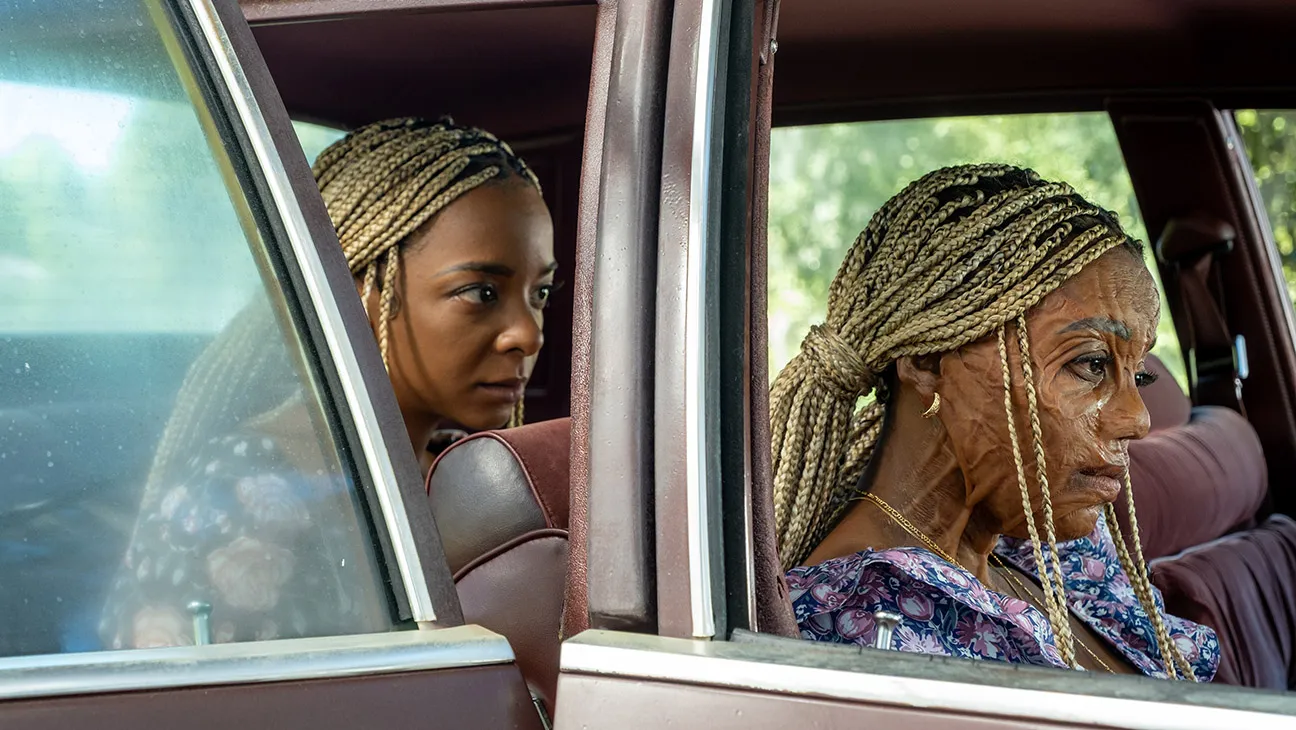
With inspirations ranging from ancient Greek tragedy to the Coen brothers’ O Brother, Where Art Thou, Is God Is brings a classic revenge-narrative structure to the always bloody, brutally funny, violently sad story of twin sisters Racine (Kara Young) and Anaia (Mallori Johnson), who go on the hunt for their father (Sterling K. Brown) at their mother’s request after learning that his physical abuse is the reason for their disfiguring scars from childhood. Along the way, they encounter a range of his acquaintances, played by the likes of Mykelti Williamson, Janelle Monáe and Erika Alexander.
Harris introduces an audacious cinematic language all her own, one that might take a little longer for audiences to catch onto — in a wide release of about 1,500 theaters, it brought in just $2.2 million over opening weekend — but has landed with those who’ve given it a chance, earning strong audience scores across the board. In a spoilery conversation, Harris detailed her process of transferring the film from stage to screen, her biggest learning curves behind the camera, and what it meant to tell a revenge story about Black women.
Kara Young and Mallori Johnson with director Aleshea Harris (center) on the set of ‘Is God Is.’
Did you have particular interest in filmmaking coming into this?
Coming into making the film, certainly, I was excited. I was jazzed. But I have not had an aspiration to be a filmmaker the way that other people have. I didn’t go to film school. I was a theater person. It existed for me like, if that opportunity came, sure, I would take it, I would try, but I think I expected it would be further out in my journey.
So what about the possibilities of it, as they related to this particular play, excited you?
When I write, I think in pictures — I also studied visual art before I studied theater. I kind of had a brain that was ready [for] that. I was really challenged about the tone of it, some of which we experienced in the visuals, obviously, but also in the performances. How do we hit this mythic register? That was all about curation: How do we curate the spaces that we’re in? How do we curate the colors and the costumes, and when is there simultaneity and the performances? It was really just a journey of thinking super specifically and communicating. Also there wasn’t a lot of time, so I’m being very quick, well-prepared and ready to go.
How did you find attracting the financing you needed, the resources you needed to make the movie at the intended scale?
There were a few studios that were interested, a little bit of a bidding war, and we decided to go with Amazon–MGM–Orion. There was a long conversation about where to shoot it, how to shoot it, how to trim the budget. I made edits to the script. To that end, we all had to sort of tighten our purse strings and figure out how to make the thing go.
What was the toughest thing to compromise on?
Trimming the boy twin stories, and especially since Justen [Ross] and Xavier [Mills] are so good. In the play, there’s a lot more of those boys, so it would’ve been cool to get to see what life has been like for them in that household.
Kara Young and Mallori Johnson are so in sync here, as they needed to be, playing twins with such an intimate understanding of each other. Was the casting process unique there?
Quite a journey. I knew that I wanted two people. We did look at actual sets of twins, but it was really important to me that it’d just be the best actors to portray those roles — who we could buy as two twins. So I cast a lot. I looked at a lot of women. I would have Mallori and Kara in scenes with other actors, and they would eat that person up. I needed them to be in scenes with each other. When I put them together and they matched, I knew, plus they had tremendous chemistry their first time in a Zoom room together. They just showed such tenderness.
How did you figure out the visual language between the two of them? They communicate wordlessly sometimes, which you subtitle, but even the framing and choreography is very exacting.
In the play, there’s a lot of performance in the typography, and I wanted a way to bring that into the movie, but it needed to be organic. The idea that these twins have a language between them is very true to life. For twins, there’ve been stories of twins who create their own language that felt totally natural and a simple and easy way and a fun way to bring that performative typography into the movie. I wanted to, in the framing, really twin them as much as possible — not to be obnoxious, but why not use that visual language to remind the audience who they are? It isn’t a one-to-one, but I did think a lot about, O Brother, Where Art Thou?, because it’s also a road movie inspired by ancient Greek tragedy, based on an ancient Greek poem. The Coen brothers crafted such a specific world that was not realistic — it’s play. So looking at their use of music, their use of the color grade, their use of the style of the movement and the manners of speech and the framing — then I wanted to think about that specifically with this world.
When they walk in to meet their mother and we see her for the first time, we’ve got this curtain behind her that’s lace. Obviously we’re in the realm of the Southern Gothic. We’re in a world that’s three clicks to the left of reality. We do have women, for example, who are in attendance, which is true to a person who’s bedbound. But they’ve got these nails that we hear click clack, and they braided their hair as a nod to the libation bearers from ancient Greek tragedy. There’s three of them, they sort of move in unison. I was thinking about playful ways to think about what’s real and what’s not. There’s a lot of portrait framing with the characters, and we see the portrait spin.

Harris behind the scenes.
I’m curious how you think about revenge in the context of a story like this. There’s a long lineage of revenge plots in fiction and drama and film, of course. With Is God Is, it’s serving a pretty painful tale through that kind of classically entertaining prism.
The wrong is so deep and the wound is so deep for these women — and I also think the wound is so deep for Black women that there’s a way that I’m sort of playing with what’s real and true. There’s something that’s happening inside of the frame, but also outside of the frame that will really resonate deeply with people. I know that I haven’t seen a lot of Black women featured in revenge narratives, and I love revenge narratives. It felt quite natural to put myself inside of that kind of narrative construct. I’m just really capitalizing on my sense that there are a lot of things that I think we have to be angry about as Black women. It’s going to do work both in the story and outside of the story, especially for some of us who understand that from the inside.
Do you have favorite revenge narratives?
I love Kill Bill. One I saw after I started working on the movie was Our Father, the Devil, which is also about a Black woman. There’s Five Fingers for Marseilles, which is a South African Western. Maybe that one’s a stretch, but. (Laughs.)
Sterling K. Brown is such a fascinating, menacing villain here. I know you’ve talked about working off of his charming persona in the casting here. Can you talk specifically about how you approached the character, knowing he was playing him?
I knew going in that I wanted us to obscure his face, give him an epic size by not showing every bit of him at the beginning, letting us hear a lot about him and saving his voice until I’m ready. The script indicates that when we see him, he’s like Obama — unassuming, we finally see him, there’s a subversion that’s very intentional. I knew how Sterling exists in the consciousness; people think they have this idea of him, and we get to play with that, which to me is more delicious. It’s true to life that sometimes people who do these awful things can get away with them because they’re charming and handsome. Sterling understood the assignment. He’s so smart, and he’s such a close reader. He knows who he is. He knows that it’s really going to get people to see him play this role, and he’s a phenomenal actor. So he just leaned all the way in and did the damn thing.
I do remember going to his trailer and telling him I wanted him to laugh when he’s being killed, because I’m often thinking about opposites: How can we freak the moment so it’s not exactly what we expect? He of course played that beautifully.
How did you block out the final sequence? As you mentioned, there’s that turn where we see the father for who he is, when Sterling slaps his daughter, but you mine incredible tension before that too.
That was a conversation between the images and the sound and thinking a lot about duration. From the moment dad steps out of the car to the very end, it’s very tense and we’re just turning up the dial. I was thinking a lot about the timing and the performance. It was really important to me that when he takes Anaia’s hand, that moment when says, “Put the rock down, you’re not a killer, dah, dah, dah, dah,” I’m holding my hands up. This is them in the frame. In the theater, people get really mad at her. The screenings I’ve sat in, people start yelling. I hope that means I’ve done my job to let the viewer understand why she wants to believe it, why she needs to believe that this man would save her. It’s a conversation between how long things happen. Duration is very important. We don’t want to tip our hand.
Was there a learning curve to directing the action sequences?
There was a learning curve to everything. (Laughs) But without question. The cinematographer and I and the fight choreographer are having a conversation about how best to shoot it to capture it. There are things I didn’t know about. We want to make sure that it feels viable. We have two young women taking down a man. What have we told the viewer before we get here about how violence exists in this world, about how magic this world is? What’s possible?
To the point about the larger learning curve, did you surprise yourself as a filmmaker here?
I’m still trying to figure out who I am. I think I surprise myself with how tough I am — how when it’s nose to the grindstone, I will show up for my work and for my collaborators. I’m hearing from people about the style and that they’re surprised it’s my first film. I don’t have the level of context and frame of reference that you have, so I am learning that, “Oh, okay, this is good and it’s good for someone who’s doing it for the first time.” Everything is a baptism by fire, David. Everything is learning for me.
I see a lot of debuts with a lot of style. What really struck me about this was the restraint — maybe a weird word, for as wild as this movie can be. But it felt very in control to me as a viewer.
That’s a word that I use a lot. It’s critical. It just becomes a mess and a wash of chaos. I’ve learned that from the theater: I’m always taking these big swings and I’ve had my hands smacked for the scope of my ambitions, but I’m always like, “It can hold.” You just have to know how to do it and which button you’re pressing, what sort of thing you’re foregrounding and what you’re backgrounding.
How did you experience location scouting? You get to actually show this world that you created on stage.
That was quite the adventure because as you know, this was written to take place in the Northeast, the South and the West — the desert. That is not what Louisiana is necessarily giving. But lucky for us, we had really great location scouts and we were expansive in our thinking about what kind of odyssey this could be and ways to use color and those locations to get a sense of it being barren. Where one showdown takes place, finding that road out in the middle of nowhere, or what looks like it’s in the middle of nowhere, was really important. I like the process of dreaming into a space. In fact, sometimes I’ll just have a space and I’ll want to write something for that specific space.
