
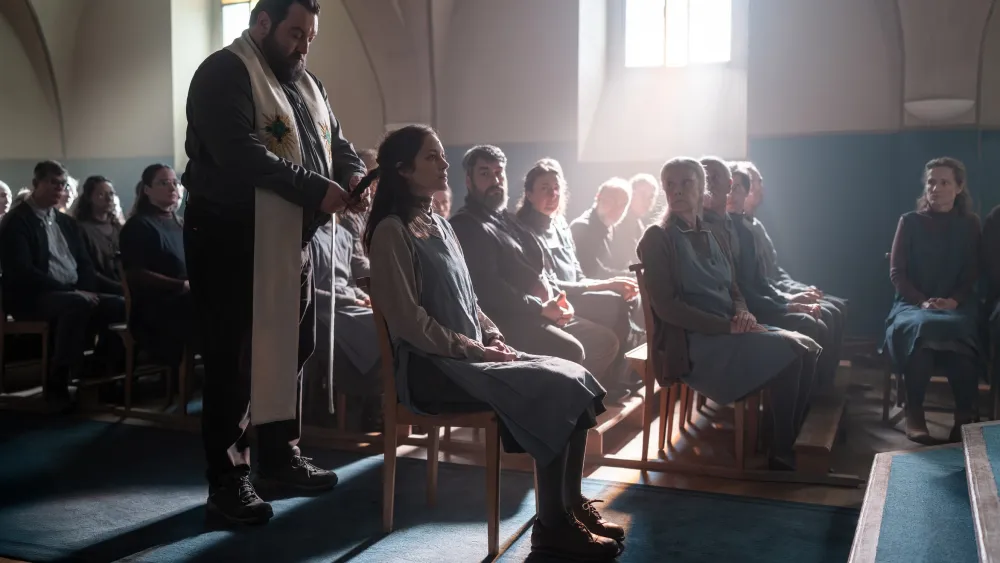
What goes around mostly just goes around, goes around, and goes around once more in “Karma,” a sometimes engrossing but indulgently drawn-out affair given the veneer of luxury trash by all-in performances from Marion Cotillard and Dénis Menochet. Directed by Guillaume Canet with the same compulsive genre gloss he brought to the international hit “Tell No One” a full 20 years ago, this fusion of solemn psychological thriller and ripely ludicrous melodrama boasts a lurid, grabby premise — opening on the puzzling case of a child’s disappearance in Spain that eventually leads across the border to a cultishly secretive, definitely incestuous commune in southwest France. The storytelling, however, is padded and repetitive, meaning this 149-minute movie never quite takes escapist flight, while also remaining hard to take altogether seriously.
Premiering out of competition at this year’s Cannes Film Festival, “Karma” should do healthy home-turf business when it opens this October in France — where, as the last film made by national golden couple Canet and Cotillard prior to their 2025 separation, it carries an additional tabloid-level interest factor. Internationally, however, the film’s distribution prospects rest largely on Cotillard, also burdened with the heaviest dramatic lifting to do as the stricken, unworldly protagonist who bridges the film’s two improbably connected realms.
Wild-eyed in a register that ranges from dreamy to terrified to stunned into submission, her performance is the most honestly felt thing here. Menochet, never more menoch-ing as the dastardly commune leader with an unspeakable hold on our heroine, is in an altogether broader, pulpier film than his co-star, though “Karma” clicks when those two sensibilities sporadically converge.
The film opens on a scene of loved-up, sunset-hour bliss in an isolated Catalonian country house: From the outside, Benoît Debie’s camera steadily zooms indoors to find Frenchwoman Jeanne (Cotillard) and her silver-fox Argentine partner Daniel (Leonardo Sbaraglia, also showing up at Cannes this year in Almodóvar’s “Bitter Christmas”) sharing a spliff and a slow dance. Enjoy this moment of two attractive characters in a happy, relaxed state, for it’s the only one that “Karma” has to offer. Soon enough, we sense something amiss in Jeanne’s behavior and general demeanor. Often distracted and anxious, she spends what seems an inordinate amount of time with her adoring six-year-old godson Mateo, to the growing consternation of his parents.
One afternoon, while in Jeanne’s care, Mateo suddenly vanishes. Her story, that she fell asleep during an excursion to a local lake and woke to find him gone, doesn’t quite add up, least of all when his blood is found on a nearby rock. Still, it’s hard to doubt the sincerity of her affection for the kid, and when she soon does a runner too, it’s clear there are larger, darker forces at work in this saga. At least one of those is Marc (Menochet), priest and all-round leader at the large, cloistered religious community in France that the police encounter in their investigations — where, it turns out, Jeanne lived before her move to Spain.
As communes go, it’s less kumbaya and more grimly in thrall to one galvanizing personality, with Marc dictating the routines and rituals followed by residents, who range in age from infant to elderly, and are all to some extent blood-related. Any inbreeding-related disabilities are waved away as “challenges from God” by Marc, who scowls when a cop asked drily if they aren’t overworking God a little. (Humor is otherwise in short supply here.) Menochet, whose bearish aspect is often used to more tender or conflicted effect, clearly relishes the opportunity to play a full cuckoo-o’clock villain, but he also makes Marc a genuinely frightening figure, with his slow, heavy-footed physicality, and baleful intent brewing behind a pale, blank-eyed gaze.
Once it establishes Marc as the architect of whatever evil is afoot here, however, the film takes its sweet time in proceeding — as Daniel, Jeanne and the cops (not nearly curious enough about this Gallic Jonestown settlement turning up in their enquiries, but whatever) all chip away at the mystery from different ends, to different ends, while turning up much of the same increasingly obvious information.
A tauter B-movie mindset would serve “Karma” well, but despite the nasty extremities of his and co-writer Simon Jacquet’s premise, Canet is chasing prestige here too — obscuring the film’s more visceral mission behind ponderous musings on trauma and spiritual corruption, the handsomely autumnal, permanent-gloaming murk of Debie’s photography and the plangent organ strains of Yodelice’s doomy score. Cotillard, at least, lends proceedings an air of gruelingly hard-earned anguish, but the film is ultimately about too little — with not much real-world social or philosophical meaning to be taken from its portrait of extreme, eccentric mass dysfunction — to justify its sprawl.
