
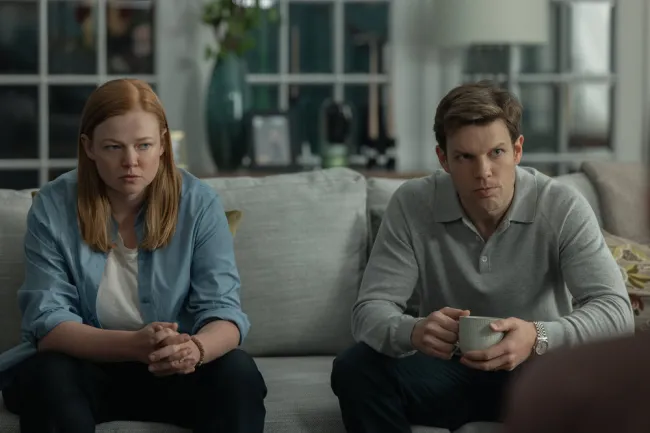
As a viewer, one of the strengths of Peacock‘s thriller All Her Fault is how many layers of mystery there are in the story and how they’re presented in each episode. There is much ado and credit to the performances by the all-star ensemble of course, but a lot of TV magic behind the scenes as well, like in how cinematographer Sergio Delgado decided to frame certain characters and character moments, and play up confusion by shooting through glass and using reflections.
The Peacock series, which premiered last November, is an adaptation of Andrea Mara’s bestseller of the same name. The complex story revolves around Marissa (Sarah Snook), a married Chicago mom whose young son disappears under mysterious circumstances which are slowly revealed over eight episodes. In addition to Snook, the all-star ensemble cast includes: Dakota Fanning, Michael Peña, Jake Lacy, Jay Ellis, and Abby Elliott.

“It’s not just a thriller because of the kidnapping of the child, but also because of the relationship between the couples, husbands and wives,” says Delgado. “That is in the background but is a really important part of the story.”

Gold Derby spoke with the BAFTA-nominated DP about the fun and challenges of presenting the many layers of mystery in the show, clever camera tricks for amping up tension and more.
Gold Derby: Is there one thing along the way, or a moment when you knew this the job you wanted to do?
Delgado: I was quite young, studying image and sound at Palma de Mallorca. I took part in a photographic tournament, that was my first contact with photography and I won my first award. Then they gave me a six-month black-and-white photography course and I loved it so much, that is when I decided I wanted to try to be a cinematographer.
How did you decide on your color palette?
I was planning this with [director] Minkie Spiro and the production designer. We decided to start with warm colors and as the story is building up, they start to get colder, as it is happening with the characters. Everybody is lying, or suspecting each other, we thought that was a good choice for the story.
Can you talk about the characters and how you decided to shoot them? Also if you have a favorite character?
We shoot the family differently from the rest of the characters. We were using handhelds for the family and wider lenses closer to them. I always have the feeling that if I’m using a wide lens close to the actors, I think I get something from inside that I don’t get with a longer lens. So we were shooting differently the family than the rest of the characters. It’s handheld, the family and studio mode the rest of the characters. It’s very subtle, handheld but we do have the reverse and studio mode for the rest of the characters. We thought that that was going to be really good for the story as well, it’s subtle but I think subtle things make a difference.
It’s difficult to choose a character because the cast is amazing. I really like Marissa but I really like Alcaras, Det. Alcaras. I think he is really sweet and I really like the relationship with his son and I really like the character. But it’s difficult to choose one because everyone has something special.

Any favorite cinematic tricks or effects deployed here that you love?
I like the pacing of the story. That was a long conversation with Minkie as well. In the beginning she was going to do more coverage. I tried to explain to her that, well she’s a great director I don’t need to explain anything, but with this I was telling her we don’t need to cut so much, we can hold more, especially with these amazing actors. We use a lot of reflections and shooting through glass as well to help on this, to help to try to get a bit of a blurry image as is the brain of Marissa [into the mind of ] especially, or with Peter in some moments of the story. I think that helps a lot, the reflection and shooting through glass.
Was there something on this one that was surprisingly challenging? Something that whether it was a sequence or a location that you are proud to have mastered?
The biggest problem was the weather in Melbourne. We were there in winter, the weather changed so much. Exteriors were a challenge, but one thing I’m really happy with is the mansion. It is a real mansion, but all the interior is built in a studio on a volume stage. So the drone shot that is in the opening [in episode one], the drone is flying and goes to the car and then we catch the drone and we are with Marissa to the house and she’s looking for the kid inside, it’s a mix between the real location and the studio and that always is a challenge because you’re mixing real house with a studio but I’m really how that turned out.
That’s a beautiful sequence and a great one. I always say I’m an easy audience because I can never tell when things change like that.
Yeah, it was good. She’s coming into the house, she opens the door: It’s the real house. As soon as she is inside, it’s the studio. She goes out to the swimming pool: It’s the real house. She comes inside again to go upstairs and it’s the studio. And I’m really happy with that. And I’m really happy how well the volume is staged as well for the studio. It was good.
This article and video are presented by Peacock.
