
Some shows take longer than others between seasons given things like global pandemics, the occasional strike, or busy schedules to slow things down. But while that typically means somewhere between a year or two, for Prime Video’s The Night Manager, nearly 10 years passed between the limited series’ first season which premiered on AMC in 2016, and the second season, which aired on Prime Video earlier this year.
The first season was an adaptation of John le Carré’s 1993 novel and followed a spy named Jonathan Pine (Tom Hiddleston) as he tried to bring down ruthless arms dealer Richard “Dickie” Roper (Hugh Laurie). Le Carré never continued with those characters in subsequent books, but given the first season’s success — it received 12 Emmy nominations (winning two for music composition and directing), it was announced in 2024 that the story would be fleshed out for two more seasons to form a trilogy.

Executive producer Stephen Garrett opened up to Gold Derby about the challenges of extending the story and the characters without a le Carré book to follow, as well as keeping surprises like the reappearance of Roper (who was believed to have been dead) and the familial connection between Roper and the object of Pine’s latest investigation, arms dealer Teddy Dos Santos (Diego Calva) under wraps.
Gold Derby: In shaping Season 2, what were the challenges in continuing without a roadmap beyond the first book?
Stephen Garrett: It’s incredibly hard in so many different ways. Firstly, le Carré is the reason I tell the kinds of stories I do. I grew up on his spy novels and the show that launched my first company in the U.K., Spooks, which played in the States as MI5, was inspired by le Carré. But because of the huge respect that all of us involved have for him, he sets a very high bar and even though he’s no longer with us, we feel his presence watching and we don’t want to let him down.
For Season 1 [of The Night Manager] we had the template of the book, but we actually departed quite dramatically from the book in many places having said from the get go, “I don’t care what happens with this because there is no way there will ever be a Season 2.” You adapt the book, which is liberating because you think, ‘OK, we can do what returning TV dramas can’t do, which is we can close all the doors.” We hadn’t planned a Season 2, which is why it took a while to get there.
It doesn’t really explain 10 years but, actually, we’re all pleased that it took 10 years because it allowed Tom to get older and I hesitate to say that the boy has become a man because he was in his mid-30s when we did Season 1. He’s definitely older and wiser and there’s been water under the bridge so it allows stuff to have happened that makes Season 2 more credible and plausible.
David Farr (executive producer and writer of all episodes in both seasons) obviously had the idea for a missing Roper son [Teddy] to emerge and that was exciting. We’d explored a little bit of a father-son relationship in Season 1 so that felt fun to play with. But I suppose the greatest challenge then was knowing that we were going to bring Hugh Laurie’s Roper character back and how we keep that a secret. But if you keep his return to the end of Episode 3, literally halfway through the show, even people who are cockily saying, “of course he’s coming back,” they watch Episode 1, no Roper, Episode 2, no Roper, and then most of Episode 3. It was challenging.
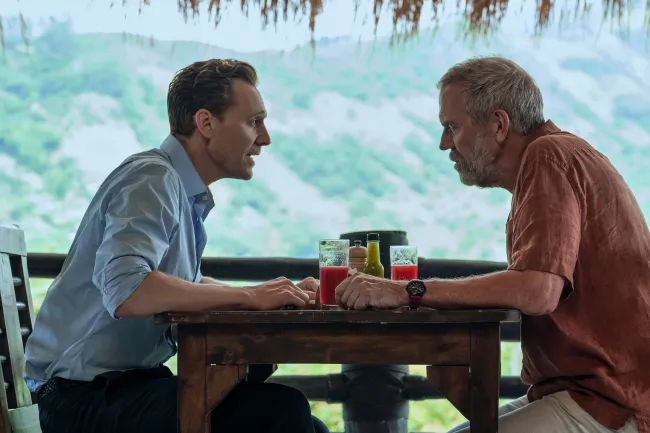
These shows are not about the story, so you need a story architecture that makes sense. It’s really about the machinations of these two complex characters who are one another’s nemesis and how they dance to the death to some extent with one another. One of our favorite scenes is that hilltop restaurant scene in Episode 5 where you have [Pine and Roper] alone and it’s thrilling. It felt like a play and they’re such great actors. It’s completely mesmerizing to watch. The pressures of a smart streamer programming is you probably can’t have a half-hour scene of just two people talking — but why not?
We also delve deeper inside characters more this time around. How did you make sure you stayed on track with the characters set up in the first season?
It’s a very delicate balance. You’ve got to tell a story that’s compelling and to some extent the storytelling but the surface story of Night Manager is like a Trojan horse. That’s the way you trick people into watch it and keep them hooked and then you use that as your delivery system for more nuanced three-dimensional exchanges of character. If we’re good, it’s because of the multi-layering of those characters and the way they toy with one another, outsmart one another. and it’s thrilling to watch.
It’s nice to respect the audience and tell an intelligent story and treat them smart and keep them guessing. Not in an Agatha Christie kind of way but genuinely not knowing how this is going to play out, but knowing that there are dark, dangerous forces at play and that anything can happen. And of course it does.
We showed in Season 1 that the threats are real. So much of returning television [shows], if you see one of your lead characters have a gun to their head, you go, “I know they’re coming back next week, I know they’re coming back next season.” So it’s jeopardy but it’s not real jeopardy. And what we try and create is jeopardy that you believe in and makes you tense in a fun way.
We all know Tom Hiddleston can do pretty much anything, but were there things in Season 2 that you saw him do that surprised you either physically or emotionally?
Daily. The challenge of these stories generally, and this is why he’s so brilliant, is because spies are that classic lone wolf who has no friends, has no family, has no one to confide in. And if they do talk to people, they’re lying. In a novel, what le Carré and his contemporaries can do is use the omniscient narrator, get inside the head of these people and say what he’s thinking now. On screen, unless you have reams and reams of voiceover, which is the recourse of the lazy, it’s how does he communicate what’s going on in his head? Tom is one of those very few actors who, even if he’s not talking, his eyes speak a thousand words. And I really can’t imagine anyone else doing that.
When I talked to Tom back when the show was airing, I asked him about the moment where he hears Roper’s voice for the first time, and the shock is all on his face with no dialogue. It’s a great moment in the series.
That’s exactly it. But the challenge there is you can’t assume that the audience has seen Season 1. So that’s a very good example of the challenge of the storytelling in Season 2 is how do you lay track about the Roper history and Pine’s relationship with Roper? As you may remember in Season 1, Roper is referred to as the worst man in the world. And you keep that alive in the audience’s head. It’s delicate and we all know what we need to do. You don’t quite know whether it succeeded or not until it’s presented to the world, by which point, it’s too late.
Also the relationship between Pine and Teddy at times gets so intimate to the point where you feel it could lean into being sexual. Can you talk about that aspect of their relationship?
To David’s credit, it’s something he wanted to do. He created that ambiguity. There’s something generally in the friendships between men who profess to be heterosexual where there’s more going on. Whatever our sexual tendencies and proclivities, there’s something in any friendship, where there’s more than just “we both like stamp collecting.” It’s one of the things that in the 10 years between Season 1 and Season 2, there’s a gender fluidity that has entered the world and a certain kind of man, the culture of male.
It’s the opposite of the toxic Stone Age kind of masculinity that gets a lot of attention. This is the flip side of it where men are actually acknowledging that there isn’t just one version of being a man. As more and more knowledge enters the universe about the way in which DNA works and the way we all emerge, where there are gradations of masculinity, heterosexuality, homosexuality, and it’s complicated. To be able to explore that complexity in a spy story actually is, in a way, metaphorically consistent because it’s always asking the question, who are you really? What’s behind the mask?
That said, we wanted a kind of ambiguity about it and it’s something Georgi Banks-Davies, our director, was very brilliant with. You don’t know whether Pine is using his sexuality and exploiting an attraction that he can feel Teddy has for him, and whether there’s something really there on his part too. That’s a delicious added element to the power of the drama.
In terms of episode count, is six episodes a good number for you?
It’s tight. We felt Season 1, again, particularly with those strictures that I mentioned that le Carré provided [in his writing], which is saying there’s no way these characters are coming back. So having Susanne Bier direct the first season, an Oscar winning director, it felt like we were making a six-hour movie and the number of episodes felt right. We weren’t struggling to fill the time but if anyone had said we need seven or eight episodes, the cracks [in the story] would have shown. It’s tight and all the better for being tight.
Will Season 3 have the same tone as Season 2, or will it step away from there?
I can’t say anything since it’s quite early and a work in progress. Even if I were to say where I think it’s going, I’m sure that will change. We’ve made it even harder for ourselves in the sense that we’ve gotten away with it twice now. We’ve got to reimagine what we do for the audience to keep them on their toes and to keep them excited. You don’t want to just create a formula or retrofit a formula on what you’ve done slightly by accident.
