
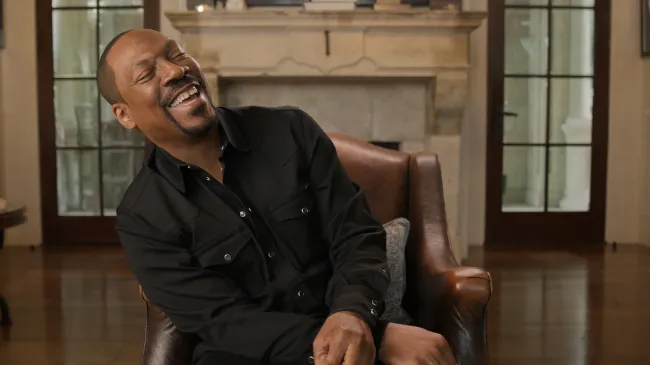
In Hollywood, Eddie Murphy has been a defining presence for decades — a comedy star whose impact on film and culture is hard to overstate. But Being Eddie is less interested in the icon than the person behind it.
For director Angus Wall, the Netflix documentary began with a deceptively straightforward goal and quickly became something far more intimate.
“I tried to approach every conversation not like I was talking to Eddie Murphy,” Wall told Gold Derby, “but like I was talking to a person. Because there’s Eddie the icon … and then there’s the living, breathing person.”
What followed was a five-year process — reshaped by timing, trust, and a pandemic — that redirected the film from a planned stand-up comeback story into something far more reflective.

A ‘happy accident’ that opened the door
Even Wall isn’t entirely sure how he landed the project. “It literally just kind of happened,” he said. “I pinched myself that I even had the opportunity to do it.”
The origin traces back to a conversation with a Netflix executive that led to a meeting with Murphy at his home alongside producer John Davis — an informal introduction that set the tone for everything that followed.
“We watched YouTube on his flat screen in the back of his house,” Wall recalled. “I left that day with my ribs hurting because I was laughing so hard.”
For a filmmaker accustomed to fighting for projects, the ease of it all stood out. “Most things that I do, I really have to fight and fight for,” he said. “And this was just one of those things that just kind of happened.”
That early access proved crucial. Murphy’s home — where some of his children still live — became more than a location; it became the film’s emotional center. “It’s his domain,” Wall said. “And the house is sort of a character in the movie.”

The movie that didn’t happen
The initial concept of Being Eddie looked very different. “The original idea was to follow Eddie as he prepared to return to stand-up,” Wall said.
Then COVID hit. There would be no tour. Suddenly, the film lost its narrative engine — but gained something far more valuable: time.
“We set up some cameras in his house and basically did what you and I are doing right now,” Wall said over our Zoom call. “We would just roll and have these long, rambling conversations.”
Freed from production pressure, those conversations became the foundation of the film, allowing Murphy to open up in ways a more structured shoot likely wouldn’t have captured. “Having the space and time to really just have real conversations … allowed all that stuff to bubble up,” Wall said.
Finding the person behind the icon
That shift in approach unlocked some of the documentary’s most revealing moments — often from unexpected directions.
One came from an offhand question about obsessive-compulsive tendencies. “He sparked on that,” Wall said, recalling Murphy describing how he would repeatedly check the stove as a child — a habit that still lingers.
Moments like that reframed Murphy not just as a performer, but as an artist driven by instinct, discipline, and curiosity. “I think people know him as a funny person,” Wall said. “But I think he’s an artist first and foremost.”
That perspective extends beyond comedy. Wall points to Murphy’s music — including songs he’s quietly released online — as another outlet for creative expression. “It’s just something he does to express himself,” Wall said. “That, to me, is really extraordinary.”
Building a film from experimentation
Even with that intimacy, shaping Being Eddie was far from straightforward. With the original premise gone, Wall and editor Will Znidaric spent years experimenting with structure — testing and discarding multiple versions of the film.
“We were constantly trying novel structures,” Wall said. “Let’s try this. Let’s learn from that. Let’s try something completely different.”
The solution was deceptively simple: use Murphy’s career as the framework. “His career was the skeletal system of the movie,” Wall explained, “with these more personal digressions hung off that central thread.”
The result is a film that feels clean and direct, but is built on layers of iteration — a process Wall, a two-time Oscar-winning editor of more than three decades, embraced fully.
A chorus of voices — and why they showed up
If access to Murphy himself was a breakthrough, assembling the film’s roster of interviewees was surprisingly effortless.
With figures like Dave Chappelle, Chris Rock, Jamie Foxx, Tracy Morgan, and Jerry Seinfeld, Wall found no shortage of willing participants. “It wasn’t hard to get them,” he said. “Everybody was like, ‘I’m ready. Just tell me.’”
Their perspectives reveal the complexity of Murphy’s influence — relationships that are at once peer-based, aspirational, and deeply personal. “He has these multifaceted relationships with a lot of people,” Wall said. “He’s not much older than them, but in terms of life experience, he is.”

Reframing a legacy — and an awards story
Any conversation about Murphy’s legacy inevitably circles back to awards — and the sense that his career hasn’t been fully recognized.
Wall doesn’t shy away from the belief that the release of Norbit may have impacted Murphy’s Oscar chances for Dreamgirls. “I think he’s really proud of Norbit,” Wall said. “But he said it ‘shittied up the water.’”
Still, Wall is unequivocal in his own assessment. “I think he deserves an Oscar at some point,” he said. “I don’t think I’m being bold in saying that.”
Murphy himself, however, seems to maintain perspective — a mix of humor and detachment that mirrors Wall’s own view of recognition. “Being recognized by your peers is a great thing,” Wall said. “But if it doesn’t happen… he’s still going to wake up and be Eddie in the morning.”
A filmmaker’s perspective on recognition
For Wall, who won Academy Awards for editing The Social Network and The Girl With the Dragon Tattoo, that mindset resonates on a personal level.
“Growing up, I never thought I’d meet somebody that had won an Oscar, much less win one,” he said. “So it’s always a surreal experience.”
His own statues, notably, aren’t on display. “They’re in a cabinet with the door closed,” he said with a laugh, recalling how he once kept them in storage before realizing they deserved better care.
It’s a small detail, but a telling one — a reflection of the same grounded perspective he sees in his subject.
Murphy, after all, may exist at a level few artists ever reach. But as Being Eddie makes clear, the most compelling version of his story isn’t the icon audiences already know. It’s the person who, when everything else fades away, simply wakes up — and is still Eddie.
