
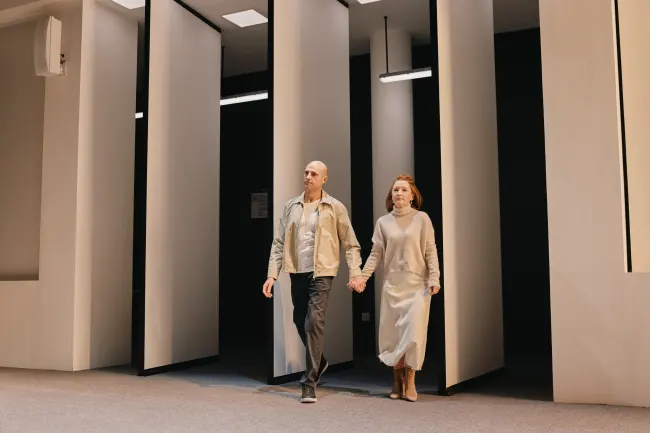
Mark Strong has a confession to make: while the acclaimed British actor has appeared in a wide variety of genres on stage and screen over the years — from mid-century American dramas like A View From the Bridge to comic book adaptations like Green Lantern — he hadn’t brushed up on his Sophocles… until now.
“I’d not done any Greek tragedy before Oedipus,” Strong tells Gold Derby about his participation in the acclaimed revival, which opened in London in 2024 and came to Broadway last fall. Co-starring Lesley Manville, the Robert Icke-directed production turned the clock forward to the present day, casting Strong’s Oedipus as an aspiring politician on the cusp of an Election Night victory and Manville’s Jocasta as his wife — who turns out be someone even closer to him. “I thought the updating the play to the modern context was genius,” Strong says of that bold time shift.

The origin of this new Oedipus dates back roughly 10 years ago, when Strong became “firm friends” with Icke and vowed they each vowed they “would do something together.” Icke eventually approached him about this new version of the classic Greek tragedy, which retains many of the elements of the original work, but updates the setting and also allows it to unfold during the two hours between when the polls close and the announcement of the victor.

After the opening scene — a pre-recorded video in which Oedipus makes ill-advised campaign promises en route to his headquarters — Strong hardly leaves the stage for a moment of that pressure cooker runtime. “It’s very daunting, the realization that you’re not going to have an interval,” confesses the thespian, who ran a similar gauntlet in director Ivo van Hove’s take on A View From the Bridge over a decade ago. “It’s like a roller-coaster; you start, and in a way it takes over.”
Icke’s play foregrounds the title character’s journey of self-discovery, in which he learns his true parentage and uncovers his role in the murder of the nation’s former leader. Performing in the production also taught Strong a lesson about his own approach to acting.
“The stamina required of a Greek tragedy is something that I wasn’t aware of being able to cope with,” he admits. “The intensity of the emotion and the depth of the emotions, and the craziness of the story. I don’t know what those Greeks were drinking!”

Fortunately Strong’s Olivier-winning and Tony-nominated role as Eddie Carbone in A View From the Bridge primed him to take on the gargantuan task. And he found Eddie and Oedipus to be “similar” characters. “Eddie totally prepared me for Oedipus because the revelation that happens to both of those characters is enormous and life changing and almost impossible to come back from. You basically watch everything fall apart over two hours.”
Those two hours showcase Strong’s compelling range, from the love and devotion he exhibits toward his children and Jocasta to the rage he flashes at campaign manager and brother-in-law Creon, played by John Carroll Lynch, as well as the soothsayer Teiresias, who reveals Oedipus’ future to him. “What’s gorgeous is that he’s fantastically complicated,” Strong emphasizes. “Oedipus does have that fury and that anger in him that he can’t control that just comes to the fore [and that] almost makes him unlikeable, and I played with that.”
Strong shares the stage with Manville during one of the production’s greatest scenes as Jocasta reveals that her first husband Laius abused her when she was a young girl and details the traumatic birth and separation from her child. “I knew that my job during that speech of Lesley’s was not to find things to do,” Strong says of how he approached that moment. “If somebody reveals themselves to you in that way, you just listen. I also thought that Oedipus in that moment should be the conduit for the audience; they hear the speech through me”
Of course, most audiences know exactly how the story of Oedipus will end. In Icke’s version, after Jocasta and Oedipus realize their true relation — he is the son of Jocasta and Laius — she shoots herself. “The moment the gunshot goes off and then the blind comes down and then you see what’s happened, there were gasps every night, screams sometimes,” Strong recalls of how the audience reacted to that scene as well as the moment when Oedipus blinds himself with his mother-wife’s stiletto heel as the stage goes dark. “We played it that it’s just too horrific a thing to see.”

Oedipus does not end on that extraordinary bleak note, though. After raucous crowd noises celebrate the new leader’s victory, Oedipus and Jocasta return to the stage for an epilogue set a year earlier. Strong and Manville had to “turn on sixpence” in only 12 seconds to play the final scene in which the duo see their campaign headquarters for the first time — a final scene that’s full of hope preceding the darkness to come. “I literally had the plumb the depths of that darkness in one moment, and then play hope,” Strong says. “The trouble was, I’d still have tears in my eyes, so I had to pretend that those were tears of joy.”
Although it took Strong a decade to return to Broadway, he hopes to make a more prompt appearance next. “There’s something special about the live theatre experience, even more so now in this day of screens,” he notes. “It’s vital that we get people into a communal place and watch live theatre, much as they did 2,500 years ago.”
In particular, Strong teases a near-future collaboration with Icke on one of Shakespeare’s great tragedies, Macbeth, revealing that the director has “got some very strong ideas” about how to uniquely remount the oft-revived show. Also on his wish list are more Shakespearean roles — including Richard III, King Lear, and Iago — as well as another round with a Miller play. “I would love to do more Arthur Miller, because there is something so solid about him as a playwright,” he shares.
