
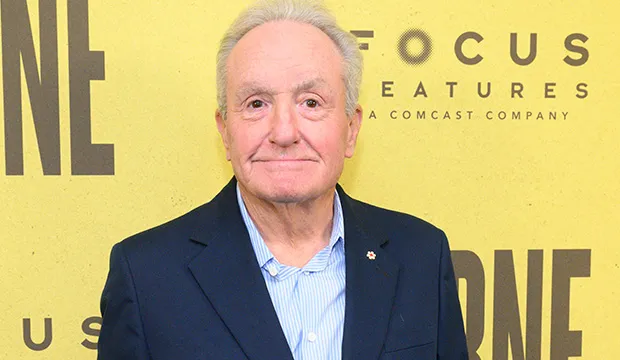
The stars came out in force for Saturday Night Live creator Lorne Michaels at the Los Angeles special screening of the documentary Lorne Tuesday night at Universal Studios.
Steven Spielberg, Jon Hamm, Owen Wilson, Oscar Nuñez, and Seth Rogen joined such Saturday Night Live alums as Kevin Nealon, Laraine Newman, Kyle Mooney, Vanessa Bayer, along with the film’s narrator, Chris Parnell, to celebrate Michaels and the Focus Features film, which opens in theaters April 17. Directed by Morgan Neville, Lorne gives audiences unprecedented access to the man behind the legendary sketch-comedy show.
“This is a look inside the life of Lorne Michaels and also a very, very rare glimpse into Saturday Night Live, one of the most documented TV shows on God’s green earth,” SNL five-timer John Mulaney said before the screening. “I don’t know if it covers any of the succession rumors.

Who would succeed Lorne Michaels if he ever left? I don’t think Lorne Michaels is going to ever leave, but obviously a lot of people are excited. Which lucky duck will get to run that show at a third of the salary with none of the stature?”
Neville also shared his take on filming the award-winning producer ahead of the screening.
“As a subject, Lorne is, to paraphrase Winston Churchill, a riddle wrapped inside a mystery inside of an enigma,” Neville said. “So in other words, really f–king difficult. But I’m really proud of the film we ended up making, and I’m grateful to Lorne for opening the door into his world and the world he’s created.”

The film offers intimate behind-the-scenes glimpses of what it’s like to pitch, rehearse and fight for the 50-plus-season-strong show. Interviews with alums and collaborators like Tina Fey, Jimmy Fallon, Adam Sandler, Conan O’Brien, Colin Jost, Michael Che, Lily Tomlin, Paul Simon give audiences insights on how both Michaels and the show has evolved over the years. (Also, who knew Michaels was that into popcorn?)
After the special screening, the SNL legend sat down with Donna Langley, chairman of NBCUniversal Entertainment, to discuss the impact the show has had on his life.
“From the beginning, I don’t mean to sound as earnest as it will, but I thought what we were doing was important,” the Canadian-born producer said. “I don’t think I could have done it without that belief. And it turns out, after 50 years, it was important.”
Langley shared one of her favorite pieces of advice from Michaels, “Take the high road, there’s less traffic up there,” before asking him where all of his signature wisdom comes from.
“I think I was always attracted to the people who seemed to know stuff. But I got to New York, [Candice] Bergen introduced me to Mike Nichols, and I started spending time with him. And you sort of watch the way they work and also their standard, or Buck Henry would come in and write with us, or Paul Simon is a perfect example as well. You just sort of see, they care so much about it being good,” Michaels explained.

Working with a big group is powerful, he added, when they’re all working together and supporting each other.
“That cohesion is really important, and also tolerance is really important because they’re going to do awful things,” he said. “Not thinking that they’re awful, but they’re taking chances and it has to be a forgiving culture that way.”
As Saturday Night Live evolved over many successes and challenges, Michaels evolved as well. Whether that was when he left the show for five years, realized that reinvention was key or when he realized that he needed to establish himself as a leader rather than a peer, the SNL producer admitted that change was a constant.
One pivotal moment was taking on the role as boss, something that Michaels said made him “uncomfortable” at first. But not for long, he added. The longtime producer even has a sign in his office that reads, “The captain’s word is law.”
“There has to be a leader, and I didn’t really understand that at the beginning because we were all about the same age. And we were all, I mean, Chevy [Chase] and I, or Danny [Aykroyd] and I could be writing something earlier. But then the decision part came down. And then you realize that separates you when you’re in charge.”
He added that you also have to live with the consequences of those decisions.
“When it doesn’t work, you wear that for the better part of the next week. But then you’re saved because we’re doing another show,” he said. “And so there’s always the chance of redemption.”
After 50-plus seasons, countless awards and now a U.K. edition, Michaels said that having a winning attitude is a must.
“Building a winning culture, whether it’s in sports or in politics or whatever, is really hard, but everybody has to understand that that’s what we’re built to do,” he said. “And that’s what I realized after the first decade or two was that, no, we have to win. As Steve [Martin] would say, ‘You have to win every time.’”
“And when people are laughing,” he added, “it’s great.”
