
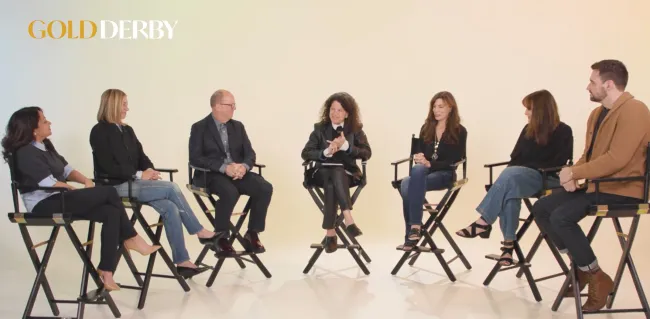
Whether you’re tackling drama, comedy, or true crime, creating a TV show — and keeping it on the air — is hard work. Just ask the showrunners behind Scrubs, Best Medicine, The Miniature Wife, The Twisted Life of Amanda Knox, and Murdaugh: Death in the Family who are on the front lines of trying to make a hit show in these ever-challenging times.
In our exclusive roundtable, Aseem Batra (Scrubs), Liz Tuccillo (Best Medicine), Jennifer Ames and Steve Turner (The Miniature Wife), K.J. Steinberg (The Twisted Life of Amanda Knox), and Michael D. Fuller (Murdaugh: Death in the Family) swapped stories about translating their creative visions from script to screen, while juggling the many and varied responsibilities of being a showrunner — including ratings metrics (“it’s the curtain of Oz”), notes calls (“There should be a class on that!”), social media (“If you feel like emotionally cutting, sure, take a peek”). Click each name above to watch an individual interview with that person.

Gold Derby: What does success look like for a TV show today? There’s ratings, there’s buzz, there’s social media. What makes you feel like you’ve nailed it?
Jennifer Ames, co-showrunner, The Miniature Wife: Personally, I just think getting something on the air is a success, which is so hard. I want to try to watch everyone’s show when it comes out. I’m always just like a cheerleader. I make sure, whatever it is, I get through the pilot, because I understand how many people weigh in on that. And again, just actually selling it and getting it to air for me feels like a success.
Steve Turner, co-showrunner, The Miniature Wife: I would say the same thing about the metrics. I don’t think any of us have any idea what the metrics are for anything ever, and the idea that there’s some algorithm going around. I think all of us would probably answer it the same — all we’re doing is just trying to tell a good story, so maybe that’s the success — getting it on the air and telling a good story.
Aseem Batra, showrunner, Scrubs: I think even if we don’t stay on the air, which has happened to me many, many times, if you reach people, that’s really meaningful, because I’ve seen so many great shows not get a second chance or a third chance, but it meant something to people, so I think that matters, too.
K.J. Steinberg, showrunner, The Twisted Life of Amanda Knox: I didn’t get any much visibility into the metrics. I feel like there’s the curtain of Oz, and there’s something happening behind there and nobody’s really telling me what it is, but I’ve been told that we did well. But I would say, in addition to what everybody said, that when my peers reach out and say, “Excellent work,” that really is meaningful.
Liz Tuccillo, showrunner, Best Medicine: It seems like it’s impossible to know if something’s doing well, because you don’t have any of the metrics, you don’t have any of the information. And then when they do say something, I don’t really understand it. And then when I go online, because then I don’t want to read the reviews, because I’d rather die, so then I don’t really know what’s going on with that. Well, I’ve got to figure out something, and I’ll click, and I’m like, “Oh no!” It is really difficult. I hear people saying, “Congratulations, Best Medicine is doing really well.” I’m like, “Is it? I don’t know.” But then to your point, when your peers who never reach out are reaching out, and then family from all over are reaching out, then you go, “Oh, OK,” so I guess it’s landing somewhere, and that feels really good, but it’s very tricky.
Michael Fuller, showrunner, Murdaugh: Death in the Family: I would say, in addition to all those terrific answers, I think that, those moments when that we’re here, we’re getting to actually make a show that we’re getting feedback from the people whose opinions we admire, but also do you feel good about this moment, this scene, this episode? Do you feel good before anybody else weighs in, before anybody else has notes or a say, or there’s an audience reaction, it’s a version of what I set out to do, that was then elevated by all the people I got to work with, and all they brought to the table, and I think that to me feels like that’s a win and a success.
Tuccillo: So you’re saying not to have the external [pressure]…
Fuller: It’s a struggle, but yes.
Ames: Did you make the show that you set out to do? Yes, and also did you have fun, because it’s a tough job, very tough, but there’s so much joy in it, and I hope that everyone’s able to find that I think in the show.
Tuccillo: And creating joy for the people that work on the show. Yes, I do feel that there’s so little that you have control over, but you do have some control over people showing up to work, having a good time, feeling valued and respected and joyful. So that I do feel it does have a lot to do with it as well.
Ames: And really letting people do their jobs. I think when they’re as invested in it as you are, I think that just again adds to the joy and the idea of making the show that you wanted to make, because you set out to make one show, but you end up making a different show. You see elements of it, of course, throughout the process, and you’re constantly rewriting it in every stage.
Batra: There is a capitalist answer to this too, but we’re not going there.
Being a showrunner is such a challenging job, because you have to wear so many different hats. What is the most important part of it? What do you think when you put your head on the pillow at night? You think, “OK, I’ve done a great job today, because I did X.” What is that thing for you?
Turner: I think it’s important to get scripts done on time, because if you have the script done, at least everybody else can do their job. So it’s our job, I think, first to just get a script done on time, and that is the hardest part really.
Batra: It’s crazy, because as writers, we all were taught that get you inspired. We don’t have time for that. You have to manufacture inspiration, and I think part of it is you have to have ideas and ideas and ideas flowing out from your people, because you really are a curator then of those ideas, and in order to do that, you have to be a good leader, so that people feel great and safe to put that out there, and so that’s a big part of our job.
Steinberg: Standing behind your vision, I think, and hiring well. We have the most brilliant, brilliant writers, and I could not have done it without them. And brilliant heads of department. Writing is such an isolating endeavor, and then it starts to grow and grow and grow beyond your wildest dreams and beyond your control as a writer sitting at the desk writing that pilot alone, or that format, or that pitch document and you’re bringing upwards of 200 people into the family, and when you see people performing at the top of their game, because they see your vision and they believe in what you’re doing, and transitively in what they’re doing, it’s so fulfilling.
Fuller: Becoming an avalanche of its inspiration, or they’re taking something you had an idea about, and then they’re taking their craft and their artistry and going in their own direction and infusing it with that, and then that in turn inspiring you to do something different, whether it’s practically, whether it’s emotionally, and then when it’s all kind of working together as an organism. I think just creating an environment of respect for everyone at every level, at every stage, every number on a call sheet, so that that creativity can be incubated, so that people feel safe and can express.
Ames: The collaboration part is so important. We always try to be open, but with a point of view, so that there’s a direction, but remaining nimble, because someone’s going to think of something we didn’t think of. Someone’s going to bring in whatever that prop is — production designer, the talent, it doesn’t matter. I think you want to try to be as open as you can to that, but again, having that point of view for the leadership.
Tuccillo: The first week in the writers’ room, there was a writer on staff who was a former showrunner, so I was not worried but so interested to see his point of view, because I was so happy that he was coming on. And he said, “Oh, no.” After the first day, I was like, “Oh, she knows what she wants, we’re going to be OK.” You have to know what you want, like you said, a point of view, but then because people all day long are going to come at you with their points of view, which is fantastic, but you’re steering the ship to be like, no, I don’t think that’s what I meant, but yes. I really learned that it is very important to know what you want.
Networks and studios are coming at you with notes. What’s the best or worst note you got from the network, and how do you deal with it?
Ames: Well, we only get the very best notes. [Laughs.] It only elevates the material.
Fuller: They are your first audience, which is what’s so important, and I’ve been very fortunate. We’ve all had, as you said terrific ones. I think a lot of times it can get — I’ve seen it with on other projects, not my own — where it can get very combative, people can get entrenched in things, and there are threshold concerns where, hey, that feels too far, but giving good faith ear to what they’re saying, because, again, they need the show that they’re working on to succeed just as much, if not more so, in so many ways than you do, and so giving credibility to it, listening to it, and engaging in it in good faith, so that you can then, if you don’t go with it, you can explain why, and they feel heard and respected.
Ames: I think there’s a thoughtfulness behind the notes, whether they seem really crazy, but also an openness. Look, they aren’t writers, and I think underneath it, the material is like the scaffolding. We always say, so sometimes the note isn’t actually the note. I know that on their end, it’s always what’s the note behind the note, but frankly, it’s the same on ours as well, because that actually might not be the problem. It might not be this scene, it actually might be two scenes earlier that are affecting how you’re responding. I would apply the open with a point of view, just making sure that you’re being thoughtful, but to the vision and guiding them through it.
Batra: Not on this show, but an executive couldn’t figure out why the brother and sister didn’t get along. She was like, “That doesn’t seem real.” I’m like, sibling rivalry? But it is a good point. It’s like, wait a minute, just don’t react, that’s the big one for us, because in that moment you want to get defensive or you want to push back and say, “Well, this is my vision, and this is how I want it,” but you really have to just take a beat and then go back and figure out the note behind the note with your staff. It’s actually this that they’re feeling, they’re just expressing it in a different way, and so it’s valuable to just digest it, because they are looking at it to help you.
Tuccillo: Somebody could teach a course on just taking notes and listening to notes and executing notes, because it’s such a huge part of the job. I never listen harder than when I’m listening on a notes call, because it’s not just the note, it’s how they say the note, what example they’re giving. Then you start understanding, “Oh, well, because they had a sister that they didn’t like,” or “they had a great relationship so they don’t understand,” the lived experience is part of why they’re giving a note, and then they’re also themselves sometimes nervous about giving notes, so then you have to make them feel OK about giving notes, and then you have to let them know that you’re going to be really open to trying their note, so that when a note comes down that you really don’t like, there’s been such a level of trust up to that point that they know that you really try, that when you say this one’s really I can’t do, they believe you and they respect you. So it’s a very big part of the job that’s tricky and takes a lot of skill.
Steinberg: One of the villains in Amanda’s story was the language gap. We tried to make all of the characters as dimensional as possible and nuanced as possible, but having her not speak Italian and having so much happening to her in Italian was the whole point. And at one point, they were like, “Can we not have so much Italian? Can the prosecutor maybe speak English?” “No, because it’s the source fracture of the entire ecosystem of the crime and it also takes place in Italy.” But to their credit they heard that for the authenticity, to have the audience experience the alienation that Amanda experienced, and an infantilization that you feel when you don’t understand a language that’s being spoken to you, the powerlessness and helplessness you feel, once they heard that, they were like, “OK, yeah, we understand.”
Batra: I agree that there should be a class on this for young showrunners. When I was too young to be developing on my own, I got a crazy note, I was trying to tell a story about my Indian family, growing up in the South, my dad was a surgeon down there, and I got a note where it’s like, “But the mother’s not that interesting. Do we need the mother? Can we just kill the mother?” I’m like, “Dead mom’s not that funny,” but I was so young and impressionable. I’m like, “I guess I should take this.” By the time I was done taking everyone’s notes, it was three black men raising a baby in the South. So it can go very wrong.
I’m curious about your feelings about social media and fans. How much do you listen to them? How much do you engage with fans on social media, or do you just tune it out and write the show that you want to write?
Ames: I’m not on social media.
Steinberg: Me either!
[Others agree.]
Fuller: For Murdaugh, there’s an entire subreddit — not for the show, but for the saga. A lot of my writers on staff and one of my executive producers was very tapped into all that, and at a certain point I just said, I don’t want to see it, I don’t want it to influence or impact anything in terms of their reactions to casting or their thoughts on how we’ll approach certain things. I didn’t want it to color what we were doing, and then after the fact, once the show was released, it was interesting to see some of the reactions to things. I do know on TikTok there was a trend that was sent to me, as I’m way too old to be on TikTok, but there was this movement that actually Alex Murdaugh was innocent. No one would have ever predicted that would be what took flight on social media, but it’s a hornet’s nest on there, and I think you have to either just go all in on it, and or just keep it at arm’s length. That’s up to the user.
Ames: Everything in moderation, and then if you feel like emotionally cutting, sure, take a peek.
Tuccillo: This is the first time I’ve showrun something that had a second season, so I was wanting to take a minute to be like, “OK, I wonder what people are saying as we go into a second season,” but you don’t want to make the decisions based on what fans are saying either, because you have to have your own thoughts. So I talked to all the writers that were coming back separately, just to see what would they would like to see in the second season, knowing that they probably have all gone online. So I sensed that they maybe had more in touch with what people were saying about certain things, like I could feel like, “Oh, that might be an online comment,” so it got it filtered through me in that way, but it is again tricky because you don’t want to be doing a show based on what people are saying, but you hear people who are really disconnected from what everybody’s saying, and then you don’t want that, either.
If you could be in any writers’ room in history, what writers’ room would you want to be in?
Ames: Succession, DTF, The Chair Company, just to name three.
Turner: I’ll take Sopranos.
Batra: I would do Sopranos, Breaking Bad, Better Call Saul, Mad Men — those were all favorites.
Steinberg: Succession, Breaking Bad, St. Elsewhere.
Turner: I love St. Elsewhere!
Tuccillo: 30 Rock, Succession.
Fuller: I’m going to say Sopranos, Mad Men, ER, and Homicide: Life on the Street.
Batra: We should have said Friends, because they got paid the most!
This article and video are presented by ABC, Fox, Hulu, and Peacock.
