
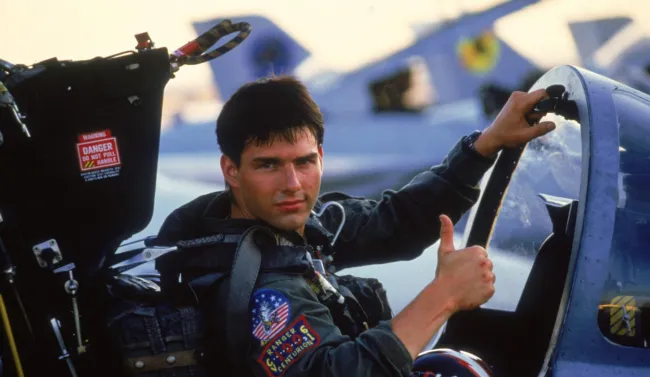
Forty years ago, the blockbuster soundtrack described by AllMusic as “a quintessential artifact of the mid-’80s” that defined “the bombastic, melodramatic sound that dominated the pop charts of the era,” was released — going on to top the Billboard 200 for five weeks, earn an Academy Award for Best Original Song, and sell more than 12 million copies worldwide. No points for second place, indeed.
We are, of course, referring to Top Gun, which boasted a Grammy-winning need-for-speed-fulfilling Harold Faltermeyer instrumental driven by Billy Idol’s glam-metal guitar hero Steve Stevens; the unmistakably unsubtle Midas touch of disco pioneer Giorgio Moroder, one of the most influential composers-producers of all time; and words by Moroder’s lyrical wingman Tom Whitlock, who, somehow fittingly, was the composer’s former Ferrari mechanic. But three tracks — Berlin’s Oscar-winning love theme, Kenny Loggins’s uncharacteristically not-soft-rockin’ fight song, and another Loggins banger that he chucklingly admits “took on a life of its own that was not anticipated” — are the classics that still have bodies working overtime, four decades later.

Gold Derby spoke with Moroder, Loggins, Berlin’s Terri Nunn, and the Motels’ Martha Davis (who was the first choice to sing the film’s big ballad, before Nunn got the career-changing gig instead), to reflect on the soundtrack that took everyone’s breath away in 1986.

“Take My Breath Away” made new wave band Berlin the fated ones
As a teen actress, future Berlin frontwoman Terri Nunn briefly met her idol, Giorgio Moroder, on the set of much more obscure movie. And eight years later, after working with him on Berlin’s Top 40 hit “No More Words,” she fatefully ended up recording Top Gun’s emotional centerpiece with the legendary producer. Several other new wave divas of the era, including ‘Til Tuesday’s Aimee Mann, Yazoo’s Alison Moyet, and the Motels’ Martha Davis, were considered — Davis even recorded an impressive demo, which was released 15 years later — and while things didn’t go entirely smoothly with Nunn, even Davis acknowledges that Nunn was clearly the woman for the job.
Giorigio Moroder (composer-producer): I did [“Take My Breath Away”] with a girl called Martha, from the Motels. She did a demo. And there was a girl called “Tuesday” … what’s her name? Aimee Mann. Supposedly she was interested, but then I gave her the songs and I didn’t hear anything back!
Martha Davis (singer, The Motels): Giorgio called me — because we were recording at his studio with [record producer] Richie Zito, and so I’d see Giorgio all the time; a lovely, lovely man — and was like, “Hey, Martha, we got this song.” They messengered it over. It was a demo with another gal singing it, so I just basically sang what I heard.
Moroder: I don’t know why Martha wasn’t the right [fit]. … I guess maybe [film producer] Jerry Bruckheimer didn’t like it? She still has the demo, and she released it, actually. I was just listening to it. She did a good job.
Davis: I don’t think that it got heard until that [Motels compilation] album Anthologyland came out [in 2001]. It was a short-lived album; I don’t even know if you can get it anymore. But once it was out, that [demo] became part of the whatever it is we live in now, the soup of digital craziness.
Moroder: And then Terri did an incredible job. She has a pop voice, but she’s really good at high notes, too. And she gave it a lot of inspiration. She sang it with a believable attitude.
Terri Nunn (singer, Berlin): Giorgio actually did say he thought it was his best piece of work.
Davis: I knew it was a great song. That was one of the two songs that I’ve heard where I went, “That’s a hit.” The other was “Every Breath You Take.” So, I started writing breath songs! But so far, no Jello.
Nunn: I was in [the 1978 disco movie] Thank God It’s Friday when I was 17, playing what I wanted to be: an underage teenager going to clubs. I was playing the girlfriend of Valerie Landsburg, and we were trying to win a dance contest so we could get KISS tickets. But the exciting thing is when I did that movie, Giorgio Moroder was there with Donna Summer, because she was breaking in America at that time. It was the late ’70s, and I met him. He couldn’t give a s–t about me — I was a stupid little actress, whatever — but I was so excited to meet him, because his music for me, just the electronics and everything about it, was so cool. … Berlin later stole from [Moroder and Summer’s] “Love to Love You Baby” — we took the bassline for “Sex (I’m a…).” We totally stole from him; we just inverted it.
Moroder: I know that Terri did not like the change of chords [in “Take My Breath Away”]. Towards the end I changed the key, and she didn’t like that! But I said, “Look, this works so well the way it’s done that you have to do it.” So, she did it.
Nunn: I was an idiot. An arrogant idiot. An egotistical idiot. Berlin was in Taiwan on tour when the Oscars called and said, “We’re doing the broadcast, and we want to do a medley of all the [nominated] songs, and you’ll sing your piece.” And I told the Oscar guy, “No, I’m singing the whole song, or I’m not doing it!” He said, “OK, thank you.” Click. And that was the end of me. I learned real fast that you don’t say no to an Oscar guy. Lou Rawls and Melba Moore did it instead. That was definitely a different version; I could have done it better. So, I’m watching it on this little screen in Taiwan… and it won. I watched my song win, and I wasn’t there.
Davis: I love Terri, and really, I’m so grateful it was her [that recorded “Take My Breath Away”] and not me. Because that’s one of those things that would’ve all of a sudden cemented fame. I mean, I was skirting fame. [The Motels] never had a single that charted above No. 9. “Only the Lonely” went to No. 9, “Suddenly Last Summer” went to No. 9, so that was my favorite spot. And thank God, because literally I would’ve not made it, I don’t think, had I been a superstar at that point. … I had never wanted to be a pop star. I wanted to be an art band. I wanted to be cutting-edge weirdo.
Nunn: And who woulda thunk that few years after Thank God It’s Friday, Giorgio and I won an Oscar together.
“Danger Zone” got Kenny Loggins up as high as he could go
After Kenny Loggins broke away from ‘70s yacht-rock duo Loggins & Messina, he became the first male solo artist to chart four Top 10 singles off four different soundtracks, including “I’m Alright” from Caddyshack, “Nobody’s Fool” from Caddyshack II, and the theme from Footloose. However, just as Berlin were not the first artist approached to record “Take My Breath Away,” Loggins was, surprisingly, far from Moroder’s top pick for “Danger Zone”: Bryan Adams, Corey Hart, Toto, REO Speedwagon’s Kevin Cronin, and Jefferson Starship’s Mickey Thomas were all in the running. But when Loggins’ revved-up recording of the fist-pumping anthem ultimately scored Top Gun’s iconic opening sequence, it effectively established him as the soundtrack GOAT of the 1980s.
Moroder: I did a good demo with Tom Whitlock, who wrote the lyrics, which I thought were absolutely, absolutely well done and fitted the movie so well. So, we did the tracks and I had a few groups and singers who wanted to do it. I don’t want to name names, I don’t want to say who passed or who we passed on.
Kenny Loggins (singer): I talked to [REO Speedwagon’s] Kevin [Cronin], and he said he couldn’t hit the high notes, so he bailed. Mickey Thomas from Starship was one of the top contenders, as I understand it, and he definitely could hit the high notes. But the message I got, the rumor I got, was that the lawyers had screwed it up. And suddenly Giorgio found himself with a song he had to dub into the movie in like three days, “Danger Zone” — and no singer for it.
Moroder: We liked that Kenny wanted to do it. Kenny is a great, great singer.
Loggins: He heard that I was in the studio down the street, working on “Playing With the Boys.” He called me and said, “Are you interested?” And I just asked one question, which was: “Is it a rocker?” Because I needed something uptempo for my show. And he assured me that it rocked.
Moroder: With movies you have to think out of the box. Because when you see those airplanes leaving the air carrier and the fights, you cannot have a disco song! That was actually my second rock song; the other one was “Call Me” with Blondie [for Paul Schrader’s American Gigolo]. If a director asks me to write a rock song, I’m good. I can do that, too, you know. In the end, it’s music.
Loggins: So, two days later, I’m in Giorgio’s studio, and he and I worked on the tune vocally. My inspiration for my vocal approach was Tina Turner, because I wanted to have that edgy thing that she was developing — her new rock persona with that classic R&B voice that she had, pushed into more of a Rod Stewart direction. So, when I got to do “daaaangerrr zonnnne,” I did definitely my version of Tina.
Moroder: He changed one or two little things, but all in all, he did a really good job.
Loggins: Writing for movies gave me the freedom to write in any style I wanted to, because I didn’t feel that I had to stick with anything I’d previously done. I wanted to write whatever would be appropriate for that movie, and I guess I’ve just been naive enough to believe that I could sing in any style. So, that allowed me to do it.
Moroder: And you still hear that song quite often now — even when some politicians use it as a song for their parties and shows!
“Playing With the Boys” built up that strange anticipation
“Danger Zone” may have been a No. 2 Billboard hit, but ironically, Loggins initially only expected toonly write for Top Gun’s volleyball scene, which he never thought would be a standout moment in the action flick. But when his upbeat, aerobics-worthy bop played during that (perhaps unintentionally) homoerotic beach game featuring an oiled-up, shirtless Tom Cruise and Val Kilmer — a scene that served as a sexual awakening for both gay boys and straight girls of the ‘80s, and was later parodied on Family Guy, American Dad, and It’s Always Sunny in Philadelphia — it became a cult favorite, an unexpected club hit, and even a Pride anthem.
Loggins: My co-producer and I, Peter Wolf — not the Peter Wolf from J. Geils! — had been watching a screening of Top Gun, and there were a lot of acts coming to different screenings to write music for the movie, so I figured the competition would be stiff and plentiful. We got to the volleyball scene and I turned to Peter and said, “We have to write for this one, because we won’t have any competition.” It seemed to me that nobody would write for the volleyball scene. I saw it as a secondary scene to the movie, just a little fluffy moment.
Lyrically for me, it was a metaphor for the dangers of being in a relationship. You know: “Said it was the wrong thing for me to do/I said it’s just a boys’ game, but girls play too.” There’s a line in there about how in this kind of game, people get hurt. I’m thinking that the “people” is me, and this was a message that I’m not going to play that game. But apparently that message that I wrote in that lyric has nothing to do with how people hear the song. Sometimes songs are adopted in ways that you never see coming!
The [Top Gun: Maverick] director [Joseph Kosinski] actually asked me to give it a shot [remaking] “Playing With the Boys.” He wanted me to do a boy-girl version, a duet with a female artist, and I thought about Butterfly Boucher. I’d loved her music for a few years, and then Butterfly started moving into more of a punk direction. She’s from Australia, and she’s definitely gay. A very two-hands-on-the-hips kind of gal. I thought, “Oh, this is gonna be a great shock to them, and it could be a really great approach because she’s a rocker.” Unfortunately, they didn’t use it in the movie, but you should check it out if you get a chance. It’s still very much in that [Pride] ethos.
