
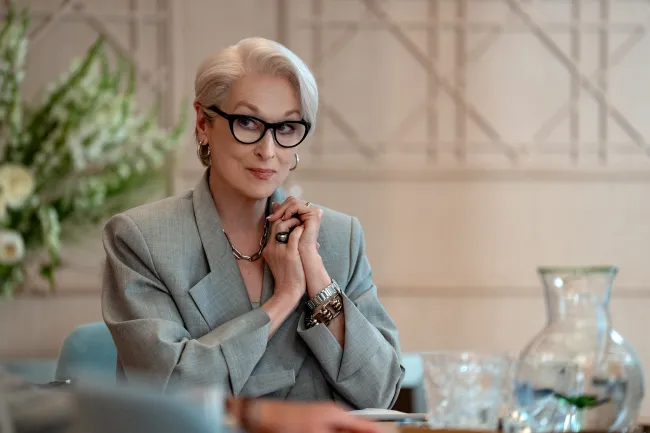
The Devil Wears Prada 2 has already been praised as a surprisingly timely take on the current media landscape, one in which print publications are floundering, conglomerates reign, and the threat of merging teams always looms. While layoffs across all aspects of entertainment continue — ranging from magazines shuttering to even The Devil Wears Prada 2 parent production company Walt Disney recently letting go thousands of staffers — the Prada sequel doesn’t just capitalize on nostalgia for the first film (released in 2005) but feels like a necessary spotlight on where free speech and fashion coverage exists today. The offices of fictional magazine Runway, long believed — and now confirmed! — to be inspired by Vogue, had to reflect that shift across the two decades since audiences last saw editor-in-chief Miranda Priestley (Meryl Streep).

“I think the overall goal for the sequel was to move away from a print-centric world and reflect the digital media age — showing a different side of Runway magazine,” production designer Jess Gonchor, who returned to the sequel after leading the below-the-line team for the first film, told Gold Derby. “It felt like stepping back into something truly special. How often do you get a second chance?”

Gonchor also was ready for fans to weigh in on the aesthetic shift for the sequel. “I think most fans of the original film already had a clear sense of what the Runway offices looked like,” he said. “At the same time, I was aware that Vogue had moved its headquarters from Times Square to One World Trade Center, which influenced the evolution of the space.”
And the shift of the Condé Nast New York headquarters wasn’t the only difference across the years since designing the first Prada film: In a meta moment, Gonchor was hired by Vogue to oversee the design for experiential fashion show Vogue World: Los Angeles while in pre-production for The Devil Wears Prada 2. Gonchor had several meetings with Vogue EIC Anna Wintour in her office, a “surreal overlap” which in part inspired the change in office decor for fictional Runway editor Miranda.

“Seeing that environment firsthand was invaluable,” Gonchor said of bearing witness to Wintour’s office, “and it was exciting to bring some of those elements into the set.
“As strange as the experience was — working on a film loosely inspired by that world while simultaneously stepping inside the real thing — it became an incredible bit of research you could never truly manufacture,” Gonchor continued. “I found myself sitting in on meetings at the Vogue offices, getting a firsthand look at the atmosphere, the rhythm, and the personalities behind it all.”
Gonchor was determined to bring that personality to the screen, while still maintaining the chic stylings of Miranda’s office from the original film (she is the editor-in-chief of the definitive leading fashion magazine, after all). Gonchor was further then tasked with bringing the decorations into modern times.

“We kept the core essence of Miranda’s office intact, but elevated it — making it larger, more refined, and more intentional in its design,” Gonchor said.
Devil Wears Prada 2 producer Streep also had specific notes for how Miranda’s office should appear onscreen. “Meryl definitely had a few very specific thoughts about Miranda’s office — she wanted it to feel uncluttered, curated, and quietly elegant,” Gonchor said. “I remember on the first film, Meryl walked me through the office set and asked about nearly every piece of artwork in the room — where it came from, why Miranda owned it, what the story behind it was. At the time, I didn’t have all the answers. It was the first major film I had designed, and honestly, it became one of the greatest lessons of my career: if you put something on a set, you should know exactly why it belongs there and be able to speak about it with confidence. This time, I was ready for her.”

Set decorator Stephanie Bowen cited that certain pieces from the original set dressing made their way to the sequel, including Miranda’s desk chair. “We were informed by the look of the first film, but we wanted to express the passage of time and how much the world has changed in 20-plus years,” Bowen told Gold Derby. “While we were inspired by the Condé Nast and Vogue offices — and specifically Anna Wintour’s office — we also were reminded that Runway was our fictitious world and Miranda Priestly is her own character.”

Bowen echoed that it was imperative to have the Runway offices lean into the more technologically savvy elements of modern media. “The film acknowledges the demise of printed magazines,” Bowen said, “and we certainly felt that when dressing our set. Our Runway magazines were much thinner than the one used 20 years ago. We had clutter but certainly less paperwork than the first movie and we introduced digital screens.”

The inclusion of more screens, and therefore, less “clutter” of tangible objects, meant that each prop and decor piece had that much more emphasis. “Great care went into the details; each book, each lamp, and every piece of art which was thoughtfully curated for each set,” Bowen said, revealing that select paintings in Miranda’s original office were brought back on set for the sequel.
Miranda’s workplace ranged from Gustavian antiques to mid-century pieces and more contemporary elements. In contrast, the office of art director Nigel (Stanley Tucci) had to reflect his warmer character. “Nigel’s office had lots of personality with an antique console and Elliot Puckette painting. We wanted it to feel stylish and collected,” Bowen said. “After all, he has been with Runway for more than 20 years.”

As for Miranda — and Meryl’s — eye for authenticity, Bowen had to let out a “phew” after the legendary star Streep first walked into her office set. “Needless to say it was a big relief when Meryl saw her office a day before filming and left us very few notes,” Bowen said, adding, “other than how much she loved it.”
