
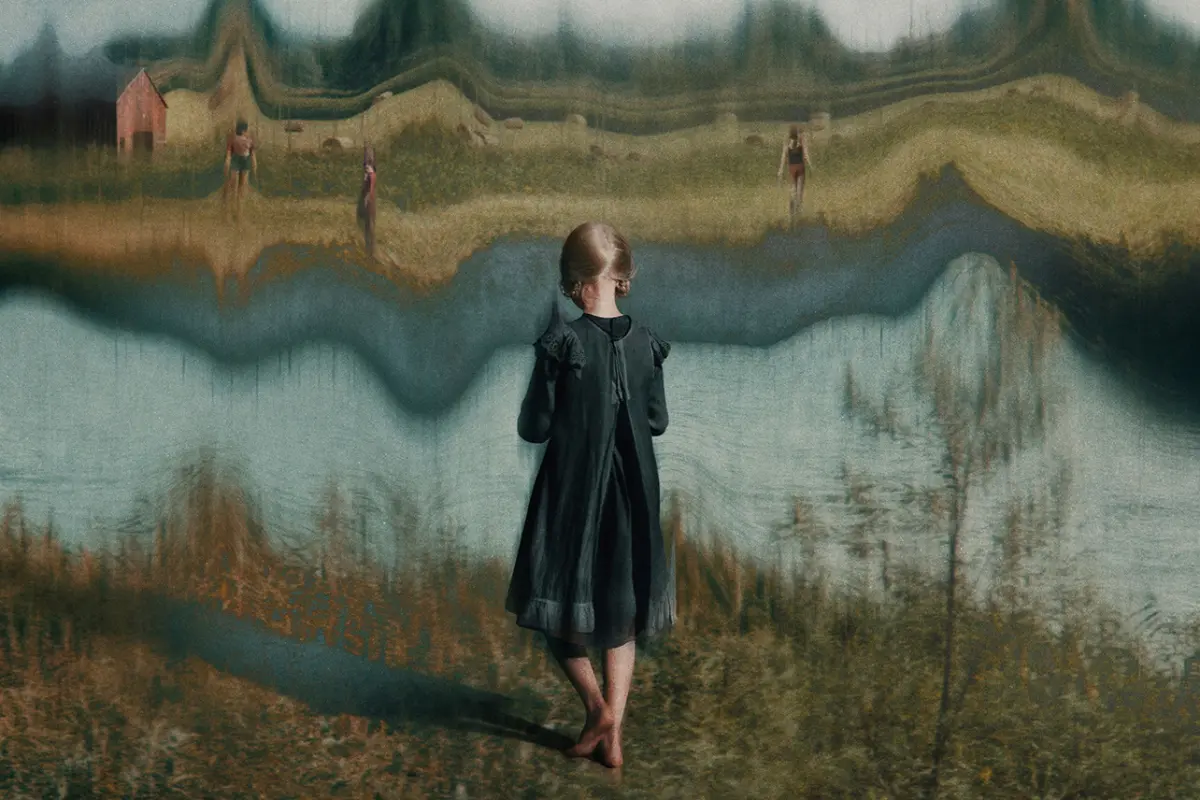
The scope and ambition of Mascha Schilinski’s Sound of Falling (now streaming on Mubi) earned it the Jury Prize at Cannes 2025, sharing the award with the similarly unforgettable Sirat. But where the latter film haunts us with terrifying imagery, Sound of Falling cloaks its audience in a ruminative mood, an invisible weighted blanket of unspoken generational pain endured by four generations of women at a farm in Germany’s Altmark region. Those four narrative strands tangle, overlap and blur together like memories that, like this film, are tough to shake.
The Gist: We open in the 1940s, when Erika (Lea Drinda) straps one leg under her dress and hobbles along on crutches, seemingly as a way of understanding the experience of her uncle, Fritz (Martin Rother), whose left leg ends in a stump above the knee; there’s a degree of sexual curiosity within her obsession. Fritz is the link to the previous generation, in the 1910s, when four sisters gambol playfully through the family farm, which includes a cluster of connected homes surrounding a courtyard; Alma (Hanna Heckt) is the youngest, peering through cracks in the wall or through keyholes to observe adults and her siblings’ behavior, e.g., older brother Fritz (Filip Schnack), bedridden with a missing leg, being cared for by the housemaid Trudi (Luzie Oppermann).
In the 1980s, teenager Angelika (Lena Urzendowsky), whose mother is Erika’s sister Irm (Claudia Geisler-Bading), knows how her Uncle Uwe (Konstantin Lindhorst) and cousin Rainer (Florian Geibelmann) ogle her as they swim in the river; Uwe does more than just ogle, surely in the darkest dark of night, and Rainer is fully aware, and angry about it, because he’s in love with his cousin. In the current day, the farm has gone condo, and a family with two young daughters, tween Lenka (Laeni Geiseler) and her little sister Nelly (Zoe Baier), is here from Berlin to renovate their battered and aging space; Lenka befriends the neighbor girl, Kaya (Ninel Geiger), who carries with her the omnipresent melancholy of her mother’s death.
Sound of Falling shuffles sequences from these four timelines intuitively, like a function of memory, these women and girls existing in visual rhymes and reciting similar dialogue as if words and images were genetically inherited. Alma is obsessed with her family’s ritual of taking family photos with a recently deceased member, specifically one in which her mother – who’s frequently stricken with mysterious illnesses – poses with a girl who might have also been named Alma, and bears an unsettling resemblance. Erika sneaks into Uncle Fritz’s room as he sleeps naked, and tastes the sweat on his abdomen; after she leaves his eyes open as if he’s been awake the whole time. Angelika grows aggressive and suggestive with her sexuality, and imagines herself lying in the hay as the thresher bears down on her. And Lenka seems to envy the emotionally distant Kaya, emulating her; during a sleepover, Kaya asks Lenka’s mother Christa (Luise Heyer) to sing her a lullaby, and she obliges.

What Movies Will It Remind You Of? Sound of Falling exists in a similar thematic sphere as Sarah Polley’s Women Talking and Kelly Reichardt’s Certain Women.
Performance Worth Watching: Among many heartbreaking performances, Urzendowsky’s stands out for its rawness, its balance of vulnerability and confidence, both deeply feminine.
Sex And Skin: A graphic sex scene, some frontal nudity.

Our Take: One of Schilinski’s visual motifs finds her primary characters turning toward the camera and looking directly at us with haunted eyes. They reflect pain, endurance, humiliation, lifetimes of buried secrets; sometimes it seems as if they’re staring at us as we stare at them, their accusatory eyes asking us to bear witness, daring us to look away as so many others have done. The director’s camera floats ghostly through scenes, dissolving and blurring from one generation to the next with little interest in linear storytelling; the audio track often dissolves into an enveloping, doom-ridden ambient hum. Various characters deliver voiceover narration, sometimes not revealing their identities until deep in the film, at a moment of significant dramatic impact. There’s intent here – Sound of Falling doesn’t jump around or meander, it just flows, stirring up complex emotions, restlessly artsy in the telling, and the result can be hypnotic and frustrating, but above all else, deeply compelling.
Thematically, the film’s aches and angst are undeniably feminine. With those parameters, it offers multiple variations on the loss of innocence, and even the loss of life. Women enduring agonizing grief often become blurs in photographs, reflecting their inability to feel at ease. Hands and feet are another motif, and the warmth of sexual energy; inevitably, these characters must mask their emotions as they conform to a world defined by men. But Schilinski foregoes the obvious overtures of recent feminist films (she’s provocative and fetishy like Emerald Fennell if her films were more impressionistic and less enamored with chaos). The drama is strictly confined to the farm, conveying a sense of isolation – one scene finds Angelika swimming across the river, leaving Communist East Germany for the freedom of West Germany. What compels (forces?) her to return to her tormented home is anyone’s guess.
Our Call: Sound of Falling is an exquisitely conceptualized and realized near-triumph that leaves us with an overwhelming, almost unshakable sense of sadness. You won’t soon forget it. STREAM IT.
John Serba is a freelance film critic from Grand Rapids, Michigan. Werner Herzog hugged him once.
