
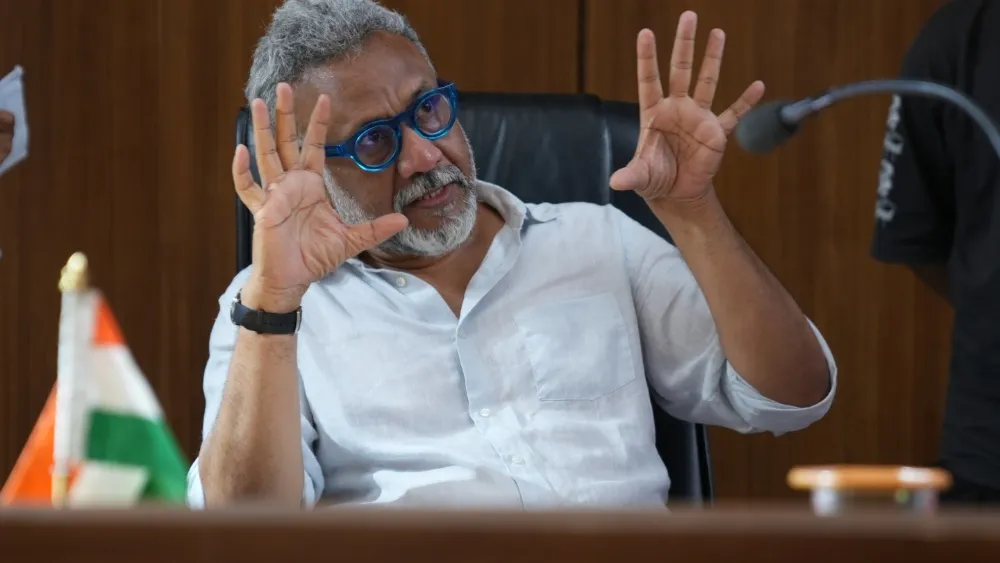
Anubhav Sinha spent years carrying the unease before “Assi” became a film.
The director, whose socially driven second act began with “Mulk” in 2018, tells Variety that the subject of sexual violence never fully left him between news cycles and candle-march protests. “Maybe it goes away from your front lobe,” he says, “but it stays there.” The reckoning came when he stopped blaming institutions and looked closer to home.
The title takes its name from the Hindi word for 80 – a reference to the roughly 80 rapes reported in India every day – and the film, written by Sinha with co-writer Gaurav Solanki and produced by Bhushan Kumar, Krishan Kumar and Sinha under the T-Series Films and Benaras Media Works banners, takes that statistic as both a provocation and a structural device. At its center is Parima, a schoolteacher and mother found near a railway track in the aftermath of a gang rape, whose case moves through Delhi’s courts while the film simultaneously asks where the crime originates and what it leaves behind. Taapsee Pannu plays the lawyer, Kani Kusruti the survivor and Revathy the presiding judge, with an ensemble that also includes Mohammed Zeeshan Ayyub, Manoj Pahwa, Kumud Mishra, Naseeruddin Shah, Supriya Pathak and Seema Pahwa.
For the better part of two decades, Sinha worked in a register far removed from social inquiry. His early career produced glossy commercial entertainments – the romantic drama “Tum Bin,” the sci-fi spectacle “Ra.One,” the action film “Dus” – before a deliberate reinvention beginning with “Mulk” in 2018 repositioned him as one of Hindi cinema’s more uncompromising voices on caste, religion and gender. “Article 15,” “Thappad,” “Anek” and “Bheed” followed in quick succession, each taking aim at a different fault line in Indian public life, a run that extended to the Netflix series “IC 814: The Kandahar Hijack,” his dramatization of the 1999 Indian Airlines hostage crisis. “Everything that’s a hit today is something that I’ve done 20 years back,” he tells Variety, “and I can do it again” – though whether he returns to that earlier mode, he adds, is still unresolved.
Sinha is clear that he wanted “Assi” to be about the phenomenon rather than a single case. “This is a story of rape,” he says. “This is not the story of an individual.” Though the narrative bears surface resemblances to documented incidents, he and Solanki deliberately avoided anchoring it to any one event, researching instead the patterns that recur across cases – gang rape, assault in moving vehicles, victims discarded afterward – rather than reconstructing any specific crime. The shift from institutional blame to self-examination is where the film found its real subject. “I was cursing the judiciary,” Sinha recalls. “Then I blamed the police. And then it dawned upon me that it’s actually us.”
That inquiry shapes the film’s portrait of systemic failure: a legal apparatus that cannot act without evidence, a police machinery unequipped to detect private violations, and a society that normalizes what it cannot confront. Sinha says the best he hopes for is that audiences leave with the discomfort activated rather than resolved. “Whatever number of people who watch the film will go back with the thought that this needs to be thought about,” he says. “They would find some of the songs their kids are dancing to disturbing and inappropriate, because we don’t look at it like that. It’s normalized.”
The film’s courtroom sequences drew particular praise for their unglamourized procedural texture. That authenticity came from field research: two lawyer friends introduced Sinha to Patiala House Courts in Delhi, after which he dispatched the entire crew – including Pannu, who attended in a burka – to observe sessions individually. “My own courtroom in ‘Mulk’ started looking stupid and ridiculous to me,” he says. Production designer Nikhil Kovale and his team followed, and the background extras were coached in the inattentive, overlapping business of real hearings rather than the rapt pantomime standard to Bollywood courtroom scenes.
Delhi itself was shot deliberately against type. Sinha and director of photography Ewan Mulligan chose the city’s grime and density over its monuments and parkways. “The iconic Delhi is very secure Delhi,” Sinha says, “but the real Delhi starts after that.” Metro-rail interiors gave audiences a vantage point from which to observe districts they would otherwise only glimpse as tourists.
Casting followed the director’s habitual practice of writing toward a face. Pannu was attached before a word of script existed. Kusruti’s casting emerged after Sinha spent weeks describing a face to casting director Mukesh Chhabra without being able to name the actress, until Chhabra supplied the name himself. Revathy was Chhabra’s suggestion for a judge whose neutrality the film needed to sustain across a narrative that withholds easy verdicts. After a scheduling collapse nearly cost them the actor entirely, a single follow-up call from Chhabra – prompted by Sinha on the eve of shooting – revealed that her other project had fallen through and she had assumed the role had been recast.
The film refuses to locate sexual violence exclusively in aberration or pathology. “I have tried to humanize the rapists as well,” Sinha says. “The sooner we understand and accept that they are one of us, you will get to the root of the problem faster.” He traces the underlying cause to entitlement calcified by patriarchy and to a society that simultaneously treats sex as taboo and saturates popular culture with suggestive imagery – a contradiction the film makes explicit in sequences featuring chart-topping Bollywood songs to which children routinely dance on national television.
On the question of narrative register, Sinha is direct. He makes films with borrowed commercial capital rather than grants, and the obligation to recoup that investment shapes every storytelling choice. “I’m too mainstream for art house and too art house for mainstream,” he says. He argues that European festivals might usefully broaden their criteria for what counts as serious Indian cinema, noting that the films selected there tend to approximate European narrative grammar. Sinha agrees that festivals such as Busan program a more representative range – and adds that even Cannes has made exceptions, pointing to the premiere of Sanjay Leela Bhansali’s “Devdas” there – and says the tendency to favor a single filmic idiom misrepresents what Indian cinema actually looks like.
The Indian theatrical run of “Assi” proved harder to decode than Sinha anticipated. The film has been seen in cinemas by over a million people in India and recouped its investment through pre-sales, but fell short of what the critical response suggested was possible. Sinha suspects the word most commonly used by reviewers – “disturbing” – may have deterred casual audiences. The film heads to streamer ZEE5 on April 17, and he says he will feel the commercial picture is fully resolved only if it performs there too.
Looking ahead, Sinha is less certain than he has been at any point in his second act. “Assi” has affected him more sharply than previous disappointments, and he describes watching recent genre films with the awareness that he may need different ground. “I need to find a new me as a filmmaker,” he says. What that looks like remains open.
