
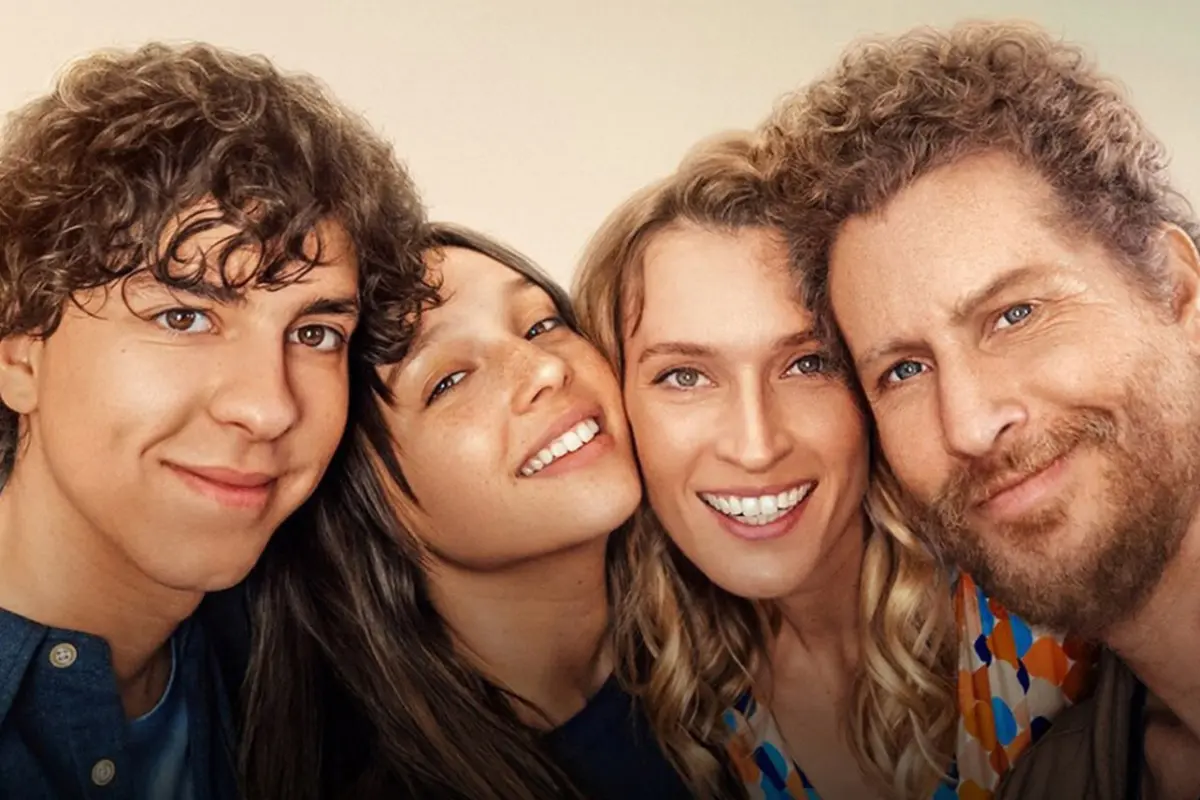
Feel My Voice is a true Netflix product, an Italian version of a film that’s already been made in two other languages: The original is La Famille Belier, the French story from 2014. The other is 2021’s CODA, famously the American best picture Oscar winner for that year. Feel My Voice casts Sarah Toscano, the winner of Italian singing-contest show Amici di Maria De Filippi, to play the lead, an aspiring singer who’s the only hearing person in a deaf family. The names, setting and some of the contextual details have been altered, but the story remains pretty much the same. Whether it comes together as well as the other films is the question.
The Gist: Eletta (Toscano) awakens to the sound of a braying donkey. It’s giving birth and in distress. She rouses her family and they rush to the barn. After the ordeal ends, we learn that the calf was breech, and the mother would have died without assistance. Now consider if Eletta hadn’t been there – her father Alessandro (Emilio Insolera), mother Caterina (Carola Insolera) and older brother Francesco (Antonio Iorillo) are all deaf and never would have heard the animal in anguish. Such is Eletta’s vital role in the family and its donkey-breeding business. She’s the translator, the default link between her unavoidably insular family and the world of the hearing. She goes to the outdoor market and helps sell milk and cheese, and becomes the communication link between Alessandro and the residents of their town when he runs for mayor, after the current candidate shows a propensity for condescension and phony gladhanding.
This isn’t an abusive or unloving situation. But it absolves Eletta of choice. What if she aspires to leave provincial Camagna, population 500, to follow her own path? She deems it unthinkable, and unfortunately, so do her parents. It’s her first day of sophomore year. Two big things happen that day: The gregarious and outgoing Martina (Asia Corvino) sidles up to shy Eletta and they become fast friends, yin and yang. And forced to choose an elective, Eletta impulsively signs up for choir. Is it a third big thing that she eyes Marco (Alessandro Parigi), a beefy MMA fighter, from across the room and feels a little sumpin’-sumpin’? Yeah, probably. Coincidentally, he signs up for choir too.
We get the sense that Eletta needs to parent her mom and dad rather often. The first time Martina comes over to visit, Eletta has to barge in on her parents having very loud sex and ask them to tone it down a little, an exchange that strikes one as so very European. In choir class, Miss Giuliana (Serena Rossi) proves she’s One Of Those Effing Teachers when she singles out the two most introverted students, Eletta and Marco, and assigns them a duet. Eventually, Eletta reaches a point where Marco’s big gooey eyeballs inspire her so much she lets rip and out comes That Voice. Giuliana pulls her aside, gives her the you-have-a-gift speech and begins working one-on-one with Eletta to prepare her for an audition for a prestigious arts school in Turin.
Although in reasonable circles this is cause for joy and celebration, Eletta keeps her prospects to herself. She knows, and we’ll soon witness, the frustrating lack of reasonableness from her family. What happens when she’s needed to translate between her father and a TV reporter, and it’s at the same time as rehearsal with Giuliana? Everyone is an asshole to her, that’s what. Eletta has spent her whole life using her voice for strictly pragmatic reasons, never singing a tune or even expressing her feelings. And on top of that, her mother nurses deep animosity for hearing people for reasons that are never quite elaborated on, so Eletta likely feels some guilt, too. If she’d just let some of those emotions out, share herself and her struggles, this conundrum might be easier to manage. But she’s 16, and caught between the proverbial rock and hard place.

What Movies Will It Remind You Of? Well, it reminds me that CODA, despite its winning qualities, won’t go down as Oscar’s most inspired best picture winner.
Performance Worth Watching: Toscano is the focal point of a film that needs her to be a sturdy presence lest the whole thing spin apart – and she succeeds, leaning heavily on earnestness and authenticity.
Sex And Skin: The aforementioned instance of rumpy-pumpy, although it’s brief and we don’t see much.
Our Take: Feel My Voice is populated with frustrating characters whose broad dramatics dilute and distract from the layered emotional and psychological complexities of Eletta’s conundrum. Although the film never truly gives us a sense of Eletta’s passion, her need to turn everything upside down in order to learn about and find who she truly is, Toscano plays her as a relatable and realistic character, a typical 16-year-old who understands her role in her family, but lacks the confidence to communicate her needs and wants. Compare that to the borderline implausible emotional outbursts from her parents and Giuliana, brash characters who seemingly lack the maturity to truly acknowledge the pincer-grip Eletta finds herself in.
Those false notes ring especially tinny as the drama heats up halfway through the film, and the romantic chemistry between Torino and Parigi fizzles. Instead of executing something believable like a sit-down conversation so the primary characters can talk about the problem, the film insists on amplifying dramatics, staging a hyperventilation of a scene in which Giuliana and Caterina nearly come to blows. The moment is supposed to illustrate how nuanced communication between deaf people and hearing people is a struggle, a legitimate problem, but Feel My Voice craters a crucial dramatic scene by going big and dumb instead of subtle and thoughtful.
Such is the primary problem with a film carrying potential to hit some strong, elevating – and, per CODA’s success, broadly appealing – emotional beats. Director Luca Ribuoli struggles to get consistent and believable performances from his cast, and his inability (unwillingness?) to explore the gray areas of the core conflict renders the story shallow and chintzy. The narrative builds to Eletta’s audition, and the tears it inspires feel cheap and unearned, the product of pushy sentimentality rather than deep affection for the character. A scene in which Alessandro bursts into the room and lets rip with a big, rambunctious fart right while Eletta and Marco are having a moment is all too illustrative a metaphor for how the film functions as a whole.
Our Call: Stick with the other films. SKIP IT.
John Serba is a freelance film critic from Grand Rapids, Michigan. Werner Herzog hugged him once.
