
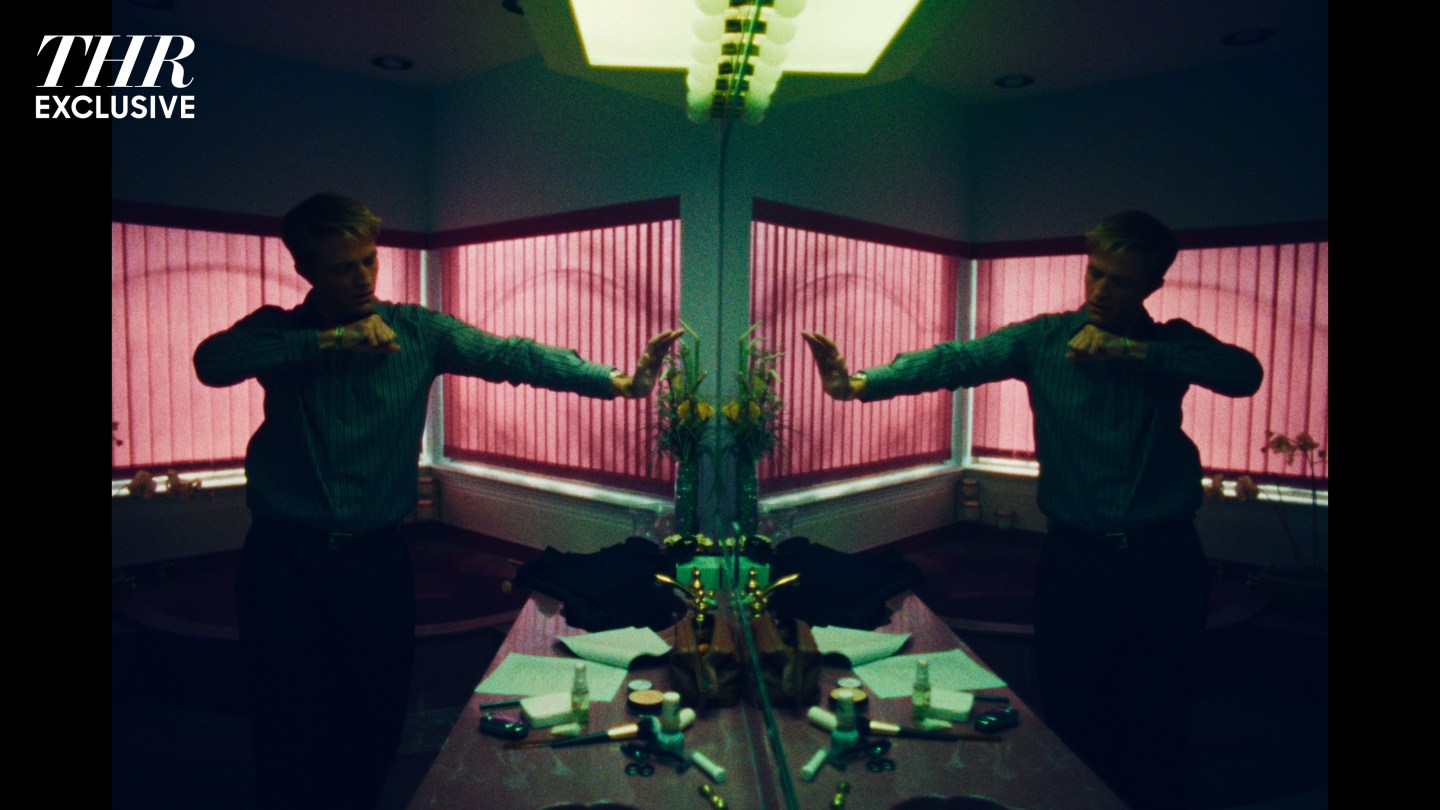
For Lance Oppenheim, Primetime’s DNA resides inside a silly Cameo video. The director, who’d grown up fascinated with To Catch a Predator’s Chris Hansen, was celebrating the release of his FX documentary, 2024’s Spermworld, when his wife bought him a recorded message from the Dateline NBC host himself as a surprise gift. In it, Hansen congratulated Oppenheim on Spermworld, told him to “have a seat” — riffing on one of his beloved catchphrases from the series — and then, unusually, started pitching him on new projects he was working on.
“I thought to myself, ‘Oh, he’s not just the crusading journalist, he’s also an entertainer, and he’s also self-aware of this media persona that he’s cultivated for a very long time,’” Oppenheim says. “That Cameo video almost crystallized the whole thing for me. In a weird way, this film is almost an adaptation of the Cameo video. He had been absorbed into this strange, performative version of himself.”
Watch Primetime, which stars Robert Pattinson as Hansen, and that vision is clear. The film, loosely adapted by first-time screenwriter Ajon Singh from an Esquire article by Luke Dittrich, dramatizes the darkest year in Hansen’s time on To Catch a Predator, which ran from 2004-07 and saw the host trapping would-be pedophiles in hidden-camera setups before often coordinating their arrest with law enforcement. The show was a phenomenon that continues to inspire copycats and parodies; Hansen emerged as an icon for some, and a meme for others.
Tony Revolori and Robert Pattinson in ‘Primetime.’
Primetime plays directly into that. This is anything but an authorized biopic. Oppenheim describes his approach as “docufantasia,” and indeed, Primetime is best experienced as a probing, darkly surreal immersion into the mid-aughts, and specifically the era’s rapidly transforming media landscape that allowed Hansen to evolve from broadcast journalist to “mythological being,” in Oppenheim’s words.
“I always loved the way To Catch a Predator mixed truth and fiction — creating this apparatus, blending artifice actors with fake decoy houses and props like the sweet tea and the pepperoni pizza, that would then collide with very, very real stakes,” Oppenheim says. “How do you create something that captures the darkest feelings of humanity mixed with the feeling you would get when you’d hear Chris Hansen say one of his all-time great one-liners?”
Primetime will premiere at the Venice Film Festival in just a few days. Hansen was not involved in the making of the movie, a conscious choice on the part of the filmmakers, and has already spoken out against it in various ways. He questioned “Hollywood’s motive” in making the movie. He suggested Denis Leary would’ve been a better casting choice than Pattinson. He lambasted studio A24 for being asked “to sign away my rights to my name” after being presented with a nondisclosure agreement in advance of a screening of the film; he declined to sign, and therefore has still not seen the movie. (A source close to A24 says that the document he was asked to sign was a standard NDA for the studio’s pre-premiere screenings.)

Pattinson and Skyler Gisondo in ‘Primetime.’
Sinna Nasseri
“It’s the first time I’ve ever thought I could say this — I’m excited for him to ‘have a seat’ and watch the movie in a movie theater, if that’s where he chooses to watch it,” Oppenheim says cheekily. “I hope, when the time comes, that he sees it — and I’m excited to hear what he has to say about it.”
When pressed on Hansen’s claims that he felt he was being asked to sign away his legal rights via the NDA, the director adds: “I can’t really speak to that because I wasn’t there when that all happened, but I know — and I hope he knows — that this film is an exploration of what this kind of work does to the people who make it. It’s based on and inspired by the experiences of working inside an extremely dark world 24/7, attempting to do extremely serious journalism, and how that becomes also extremely confusing when you’re tasked with turning it into an entertaining television show.”
***
Pattinson was in his late teens during To Catch a Predator’s run, but caught on once he came to the U.S. in his early 20s, at the dawn of his Twilight fame. “I had no idea how massive the viewership was when it came out. I first watched reruns of the show on a channel that used to play back-to-back episodes for what felt like all day,” he says. “It was not just the intensely serious subject that the show is about that was connecting to a huge audience. It was something more.”
Singh felt that way too. “I was not really interested in a biopic,” the screenwriter says. “I wanted to create something heightened, stylized and subjective, dancing on the line between reality and spectacle, which To Catch a Predator did so well.” His script met a “sobering” marketplace, where few would even read it due to its challenging subject matter. In a lucky break, it eventually wound up in the hands of Pattinson and Brighton McCloskey, who were just ramping up their Icki Eneo Arlo producing banner. They were interested instantly. Pattinson had known and followed Oppenheim’s work for years, and after looping him in, everything came together quickly.
Pattinson in ‘Primetime.’
The director, writer and producers jointly executed a plan to mount Primetime over long talks. “A big part of those early stages was trying to convince Rob to act in the film instead of solely producing,” Singh says.
Indeed, Pattinson had a pretty full plate. Primetime marks his first producing credit — “It was the first time I’ve been on a project pre-director through release,” he says. “I was prepping Primetime while shooting Die My Love and The Drama.” He then started filming on The Odyssey only “a day after wrap” on Primetime: “Trying to prep The Odyssey while shooting Primetime was a bit more difficult,” he admits.
So what convinced him to squeeze the role into his relentless schedule? The character — specifically, the version realized by Oppenheim and Singh — proved too compelling for the chameleonic star to resist.
“There was something in the design of the show and the alchemy [of] what Chris Hansen was doing that was creating something entirely unpredictable,” Pattinson says. “I was interested in finding out what that was. As I continued to investigate, I became increasingly interested in playing a character who was trying to figure out what that ineffable alchemy was, in real time, while simultaneously becoming unexpectedly, incredibly famous.
“I watched a ton of the show, every episode of his podcast, every interview I could find,” Pattinson continues. “But I knew from the first read of the script that the character in the movie was going to be a conceptual figure based on the public persona of ‘Chris Hansen’ as he’s been portrayed and perceived across all mediums and internet culture — a reconfigured egregore of sorts.”
The filmmakers couldn’t have anticipated how that notion would materialize on set. Pattinson arrived with an eerie approximation of Hansen’s voice — Hansen himself conceded it was a “pretty good imitation” from viewing the trailer — and, more deeply, a kind of physiological transformation that would define Primetime’s very aesthetic. Once Oppenheim saw what his star was up to, he realized he didn’t have to veer too much from his approach on his docs — a fact only bolstered by much of Oppenheim’s crew from his recent projects, like HBO’s Ren Faire, returning for Primetime.
“Every day Rob would come in and would do something that felt like he was almost jumping off a cliff — make a decision or a choice that was so unexpected and so inspired that I wanted to engage with him how I normally would with a documentary subject,” the director says. “I gave him a lot of rope and allowed for his performance and his choices to dictate the tone of the film — which in some ways is exactly how Chris Hansen in the television show would go about things.”
Oppenheim adds of Pattinson’s performance, “he stitched very vulnerable parts of himself with every version of Chris Hansen that’s ever existed that we’ve ever seen. … We consumed every single thing about him out there and, somehow, what Rob’s performance is to me is a media collage of this cultural mythology that Chris Hansen has created.”
Lance Oppenheim on the set of ‘Primetime.’
Sinna Nasseri
Primetime also features rich performances from Merritt Wever as Hansen’s dogged producer and, in a true breakout, Skyler Gisondo as “Decoy” Dan Plumb, an aspiring young (adult) actor who’s cast to pose as a minor to help lure in predators for the show. (He’s a composite character who shares the first name of Dan Schrack, a real Predator decoy who was involved in a tragic incident depicted in both the Esquire article and in Primetime.) “I didn’t feel like I was the kind of actor who was considered for roles like this,” says Gisondo, known for his comic work in Booksmart and the upcoming Focker-in-Law.
Dan emerges as Primetime’s unlikely heart, bewildered by the dark world he’s wandered into and left to negotiate his ambitions with the high stakes of the job. “My own personal nervousness bled into it,” Gisondo says. “The very first take of the first scene of the first day, I remember watching Rob, thinking, ‘This is the best acting I’ve ever seen in my life.’ You’re having this experience of trying to just do your thing, but you can’t help but be in awe of his thing — and to a degree, that’s what is going on between Dan and Chris, since Dan is awe-struck by Chris.”
***
Gisondo came of age as a child actor, and drew from his early experiences in the industry to bring palpable complexity to Dan. The dramatized nature of Primetime leads to other inspired casting choices — like Phoebe Bridgers, who makes her acting debut as a fellow decoy, in this case a young woman tasked with portraying both boys and girls on Predator.
Bridgers has known Oppenheim since long before becoming a famous musician. “I’ve always known her to have an incredibly deep, almost baritone speaking voice, and I was then amazed that someone who had such a deep speaking voice could produce this beautiful, angelic singing voice,” Oppenheim says. “With how she’s able to use her voice in different environments, I kept thinking, ‘That’s exactly what a decoy would do.’ I remember texting her like, ‘This is so random, but I think you are perfect for this part,’ and she responded, ‘I don’t really act, I’ve never done it, I don’t know how.’ ” He convinced her that she did.
Gisondo in ‘Primetime.’
The most surprising appearance of all, however, is that of longtime media executive Jeff Zucker, tearing into a boorish version of himself. In 2006, Zucker oversaw programming across all of NBCUniversal, including To Catch a Predator, and we see him in bizarro-world action in Primetime. He instructs Chris to devise ways of blowing To Catch a Predator up to meet the insatiable demand — going so far as to risk programming it against Lost.
Zucker spoke with Oppenheim on background before agreeing to play himself. “He gave me such great information and texture for the time period and what was going on, what the slate was like at NBC,” Oppenheim says. “I loved the idea, keeping with the project of making this a true fever dream, of having real people alongside actors, but I wasn’t sure if Jeff would want to do it.” Zucker agreed, though, and has since watched and approved of the film. “He really enjoyed it,” Oppenheim says. “I’m very honored that he did it, in playing a version of himself that was the driver of tasking Chris Hansen and his team to think of the show as a commercial object.”
Zucker’s presence does more than nod to the period, however — it speaks to one of Primetime’s most potent ideas, the outrageous collision of journalism and entertainment. “We became increasingly interested in the dichotomies in the show,” Pattinson says. “The sharp splits between reality and artifice, between the shockingly serious and the absurd.”
Oppenheim sees To Catch a Predator on a continuum that’s lasted thousands of years. “This TV show was a form of performative justice. We used to have the pillory, we used to have whipping posts, and the new incarnations of it, on TikTok and elsewhere, are forms of that,” he says. “It’s ingrained in our DNA to want this spectacle of justice.”
Minute to minute, Primetime will make you feel many things — it’ll force you to question reality, bring you up agonizingly close to an unknowable figure, submerge you in the choppy waters of an infamous TV show’s methods. It may not, however, leave you with a feeling of justice being served.
“Right now, more than maybe ever, it feels like that conversation and that desire is very much alive in our culture,” Oppenheim says. “So I’m excited to see what kind of conversations this film creates.”
