
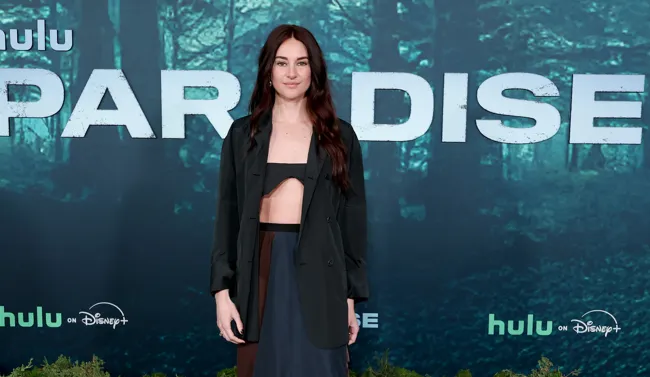
When fans tuned in for the second season premiere of Paradise, Xavier, Sinatra and the rest of the cast were nowhere in sight. Instead, we were introduced to Annie — a med school dropout-turned-Graceland tour guide who scrambled to survive alone once the apocalypse arrived. Not an easy task for any performer to take on, but leave it to Shailene Woodley to not only win over viewers but also voters — converting her stint on the hit Hulu thriller into a nomination for best guest actress in a drama. (Worth mentioning, too, she’s currently at the top of our Gold Derby leaderboards in the race.)
Here, Woodley tells Gold Derby why people responded so much to Annie’s ultimately tragic storyline, the on-screen relationship that “floored” her, and the one question she still asks of showrunner Dan Fogelman.

Gold Derby: Congratulations on the Emmy nomination. What does it mean to you?
Shailene Woodley: That’s such a funny question to answer, because it means many things — things that probably aren’t for interviews. Mostly, it’s so exciting to be in a room with people that I admire and people that I celebrate and people that I’m excited for. I don’t know how to answer it other than saying I’m excited and I’m thankful.
What was your reaction when you got the news?
I did a very me thing on accident. I was in Paris for a work thing, and I have a friend who lives near Paris. She was coming into the city to get some things done, and we were hanging out, and she was like, “I’m having my eyelashes lifted.” And I was like, “What is an eyelash lift?” I’m so ignorant to these things. And she’s like, “You should just do it.” And the technician was like, “It’ll take 20 minutes.” And I was like, “All right, cool. Why not?”
So I lay down, and my eyes get taped shut, and it’s taking a lot longer than 20 minutes. Suddenly my friend is like, “Your phone is blowing up. All these people keep FaceTiming you.” And I was like, “Oh, just answer it. It’s my mom.” I can’t open my eyes, and they’re like, “You just got nominated for an Emmy!” It was incredible because I couldn’t open my eyes for almost an hour and a half. So that’s how I found out. The whole thing was chaotic in a really beautiful, perfect way. It added to the giddiness of the experience.

What do you think it was about Annie’s storyline that people responded to so much?
I think people respond to Annie’s storyline, but also just Dan Fogelman’s shows and Dan’s characters in general, because they’re written with such honesty. Him and his writing team have this very special knack — we all wear masks and present a version of ourselves, and Dan has this ability to both examine the mask and the person underneath the mask in his writing. So as an actor, I felt like my job was just to honor what was on the page and honor what he created.
I think the reason people loved Annie in particular is because she represented someone who had not trained for resiliency. She wasn’t a practitioner of survival skills. She just happened to be in a position where she was forced to become resilient and forced to exercise that which already existed within her, in an unfortunate environment. I’d like to think people really admired that, and maybe saw pieces of themselves within her — like, if I were in that position, would I be able to contemplate myself enough to survive this scenario or not?
And then I also think Annie’s massive distrust of the world, and her fear of destruction and loss — I think it’s something a lot of people are living with today. There’s so much fear and so much uncertainty in the world, politically, environmentally. There’s just so much going on that I think maybe they saw a piece of themselves in her storyline that was like, trust actually is important if we’re going to move through hard things and get through challenging situations. So I’d like to think that was a message or a theme of her storyline.
Did you know her entire arc when you signed on? Did you know everything about her and what you were going to have to do?
I did. I knew where Annie started and I knew where she ended. I hadn’t read the final scene, so I knew what was to come for her and for her child, but I didn’t know exactly how it would be written. In our first conversation, as he was laying out her arc, Dan told me that Sterling K. Brown and Annie had a love story, and I didn’t know what that meant. Obviously, when you hear there’s a man and there’s a woman and there’s a love story, my mind immediately goes, “Oh, they must have a physically intimate moment together.”
And when I read the scripts and saw that he really had written one of the most emotionally intimate character developments between two people that I’ve ever read in such a short period of time — but without sexuality and without the distraction and the web of confusion that can sometimes come with physical intimacy — I was floored. I was so taken aback by witnessing love in its truest and purest form between a man and a woman. I really loved that aspect of the story, and that was the piece of the arc that I knew about, but I didn’t know how exactly it was going to unfold contextually, so that was fun to discover.

How did you then build that trust with Sterling?
Sterling and I are, I think, very fortunate. He is a very deep person. I’m a pretty deep person, I suppose. So when we met, there was no surface talk. There was nothing frivolous. We were just sniffing each other out in a really lovely way, and we had very real conversations quite quickly.
Because of the nature of who we both are and the way we see the world, I certainly learned a lot from him as a person — seeing how he was a leader on that set, and how he conducted himself with the crew, and how he built Xavier, and also how silly and playful and completely different from Xavier he is in his real life. I was captivated by all that Sterling was and is. We didn’t really have any conversations, if I recall, about what we were trying to do with our chemistry or our characters — it was more understanding the natural dynamic that we both have as curious people, and then infiltrating that within the binds and the boundaries and the constrictions of Annie and Xavier, and what that dynamic could look like, given this layer of mistrust that we got to play with.
Then you really get put through your paces in that challenging birth scene. How did you play that out?
I’ve yet to give birth. I’ve yet to die. So it was one of those situations where it really was just the power of make-believe and the power of imagination. I was so fortunate — we all were so fortunate — to have a filmmaker, Ken Olin, [as the director] on that episode who did such a beautiful job creating the space for me to play as an actor, for Sterling to play as an actor and all the other actors in that scene, but also for our camera operators to move and play and sense a moment and pick it up. That’s not often the case in television.
So many things in television can be quite cookie-cutter, for a lack of a better term, because of timing and how much you have to get in a day. So to have the freedom, and have hours and hours, and have a rough layout and outline of the physicality of the scene, so everybody knew where we would be going — and then Ken giving us the silence in the moment for me to really lean into the power of pretend pain, and lean into the power of pretend joy when this infant has finally arrived in Annie’s arms — was a true gift. And the rest of it was just alchemy. It was me feeling Sterling’s strong body and incredible presence, and leaning into that, and feeling held by it, and then also leaning into what I imagine it might feel like to take your last breath.
Was that the most challenging scene for you?
I think every scene is challenging in its own right, because — we can talk all day about the philosophy of acting, but I think it’s actually just so simple. We’re just, I believe, professional listeners. If you’re really present and you’re really listening, you’re reacting. We’re so complicated and complex by nature, but when you’re listening, you’re just present and reacting. So I don’t know if I would say that scene was any more challenging than a simple walk-and-talk scene or going from A to B, because it really is all about, for me, am I being as present as I possibly can be? And then the magic kind of happens when that presence is there, and you let the moment become what the moment wants — having prepared and knowing where it could go, and then letting it all be released and just surrendering to what it wants to be.
What conversations did you have with Dan? What was your biggest question that you wanted to know going into it?
Well, I was cast, Dan and I spoke, and then I was on set within eight or nine days. The turnaround was so quick, and I was finishing something else up in my life, so there was not a lot of time to prepare for Annie. I think my biggest question for Dan was, “No one really dies in your shows, right? They always somehow come back.” That was the question. That’s still the question I ask Dan all the time.
So that’s a good question for you: Have we seen the last of Annie?
Yeah, this is my question for Dan — my ongoing question. I hope we haven’t seen the last of her. They’re still filming Season 3, so maybe there’s a chance. I know they have like one week left. I’m in L.A.! I hope it’s not the last time we see her. But I’m not in charge of those decisions.
Well, her spirit certainly lives on through her daughter.
Yes, exactly.
What do you think her legacy is? What do you want her legacy for her daughter to be?
I think Annie wrote it in the letter that she left her daughter — it makes me want to cry, it’s so beautiful. Just this idea that good people exist. I think it’s one of the biggest themes of Paradise in general: that despite trials and tribulations, and despite how easy it is for us to point a finger and judge and project all of our issues onto other people, all that ultimately does is divide us and make us more lonely and more scared of each other. It’s easy to forget that there is so much goodness in the world. And in times of crisis, like this post-apocalyptic world that these people are living in, it’s often when you can see the best of humanity — and you can see how easy it is to forget about socio-economic and political opinions and situations, and really get to the root of a heart. So I think that is the message Annie was trying to pass on to her daughter as she was taking her last breath: that it is OK to trust, and it is OK to believe in good.
Annie, for her brief time in Paradise, certainly had an impact on the characters she encountered. She changed Xavier, and she changed Link. What did that mean to you as the actor who played this character?
I didn’t know what was to come after Episode 4, because I’m such a fan of Paradise — I didn’t want to know. I knew a little bit here and there, but I was like, “Don’t tell me anything, you guys.” So I got to watch, as I watched the full season, the development and the impact that Annie clearly did have on these characters. So it was less about, for myself, thinking how Annie would affect these people, and more about just excavating as many moments and giving the filmmakers as many moments as we possibly could while we were together, so they had the tools in their toolbox when they were in the edit to carve out the exact dynamics they wanted.

You talked about what it was like to work with Sterling. What was it like to work with Thomas Doherty?
Thomas is so remarkable, because he’s so handsome and he’s so charismatic and he’s so lovable. He really has a warmth and a deliberation to him that’s quite rare and very unique. He’s not the first person to say something — he’s the first person to take a long pause before he responds, and I admire that. I’m often amazed by it.
But I didn’t know that when we first started working together. I didn’t know who he was. He didn’t know who I was. And our first scene was this moment where Annie and him touch each other for the first time, and for Annie, it was the first time in years that she’d had human — not just human touch, but human connection, human eye contact — and there was a lot of vulnerability. The original plan was to shoot it from many angles, and before the first take, Thomas and I just kind of shook each other’s hands, or hugged, or high-fived, and it was like, “I’m going to choose to trust you. Please choose to trust me.” We didn’t talk much about the moment. We just let the moment become. And again, so fortunate that our filmmakers and camera department didn’t cut — they just continued with the scene. So what was meant to be chopped up a lot ended up being this very long take of two people discovering emotional and physical intimacy again.
He’s such an incredible dance partner. Every time we worked together, it was a dance. We had a sex scene together, and those can be so awkward. And with him, it really was about both of us leaning into the quiet intimacy instead of the loud intimacy. I feel very thankful, because he made me feel very comfortable, and he was down to find whatever that unspoken language of dance is.
What did you learn from the experience of making Paradise and playing Annie?
Working on Paradise has been a highlight of my career for sure. Personally, I learned so much. I learned so much from Dan, and I learned so much from Sterling. The way that Dan conducts and executes his sets is so inspiring. He cares so much about his crew, and working in Los Angeles and hiring crews in Los Angeles is at the top of his priority list. I’m a native Angeleno, and I grew up auditioning here and grew up acting here since I was five years old. To watch what’s happening to our industry, specifically in the city, and how so many people that I love and personally know — and then thousands more that I have not known and will never know — have moved, because work is so fleeting here at the moment in Hollywood.
So to have a leader like Dan, who creates these shows and really regards his crew as his family, and does everything he can to make sure that they’re set up and their families are set up in a healthy way, is such a great example. I think everybody should be taking note of what he’s doing, and we should be trying to copy it in a way, because it just works. Because he takes such good care — and not just takes care, but really earns the trust of his crew. When I got to go to set, I felt immediately welcomed, and I felt immediately cared for, and I felt like all of these people around me were on my team, and therefore I was on their team. It made me a better actor, and that is something that I will absolutely take with me moving forward.
The environment of a set is just as important as the relationships between two actors, or a director and an actor, or a director and their editor. We often focus on us, and yet it really is the only art form that requires thousands of people to make one thing. So to see Dan and Sterling focus so much of their attention on that as the leaders of this enterprise was so dynamic, and everyone’s a better actor for it. I will absolutely never forget working on Paradise.

So, Big Little Lies Season 3 — is it happening?
I freaking hope so. I hear whispers that it’s happening. I don’t know anything. It’s not even a matter of confirming or denying — I just have no information to divulge, other than crossing my own fingers.
We all are! What are you most looking forward to about the Emmys?
I have a lot of friends who are nominated this year, so I’m just rooting them all on. Antonio Campos — his show The Beast in Me is being celebrated, and Katherine Lanasa is being celebrated, and Betty Gilpin. So I’m most looking forward to just seeing everybody and having a boogie on a dance floor after, and rooting for the people that I love, and watching their careers and how they’ve unfolded, and being in awe of the artists that they are. It’s so fun to see people I know work really hard and give their all to something — to see them being nominated and noticed.
This interview has been edited for length and clarity.
