
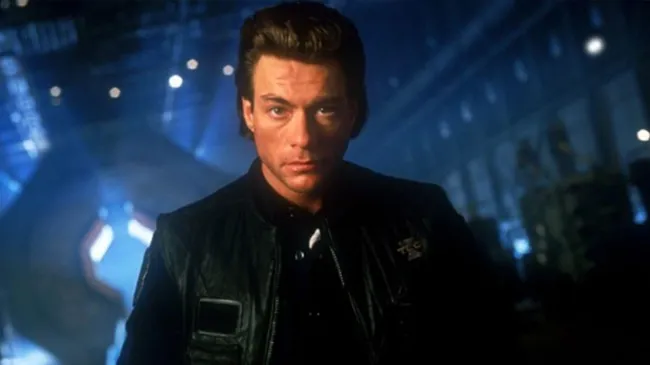
Directed by Peter Hyams and adapted from the Dark Horse comic, 1994’s Timecop became Jean-Claude Van Damme‘s top-grossing solo film. He plays Max Walker, an officer with the Time Enforcement Commission tasked with stopping criminals who venture into the past. His job pits him against Ron Silver’s evil Sen. Aaron McComb, whose goons hop across time to build a war chest for McComb’s presidential bid, a scheme that leads to the death of Max’s wife, Melissa (Mia Sara of Ferris Bueller’s Day Off fame). Now, Varèse Sarabande and Craft Recordings are teaming to release the long out-of-print score by Oscar-nominated composer Mark Isham (A River Runs Through It). The new deluxe edition, featuring previously unreleased music and exclusive liner notes by author and podcaster Daniel Schweiger, will be released July 10 via the labels’ CD Club (available for pre-order now).

In this excerpt from the liner notes, Hyams and Isham look back on the origins of the hit film and its “completely unpredictable” score.
“When I was approached to do it, I’d never seen a Van Damme movie,” Hyams remarks. “I’d also never made a ‘science fiction’ movie either. I’d made ‘science feasible’ movies. But Timecop’s script was pretty much there. So I was on the fence about it, and asked my director friend Andrew Davis, who’d made the best Steven Seagal movie, Above the Law, if I should do this. He said, ‘Why don’t you just make the best Van Damme movie? Let that be your goal.’ The way I photograph and direct everything is from a certain sensibility, and I tried to attach that to a Jean-Claude Van Damme movie.”
For a film with such an ambitious, era-hopping scope, Hyams was given a relatively tight budget of $27 million for the Vancouver-based shoot. He came in under budget enough to shoot his own opening sequence, in which McComb’s henchman guns down a Civil War–era gold shipment. Hyams made sure to surround himself with such longtime collaborators as Outland production designer Philip Harrison and 2010 conceptualist Syd Mead, who’d also helped realize the retro-future look of Blade Runner. In a similar vein, Hyams gave Timecop strikingly designed vehicles and a stripped-down, retro look for TEC headquarters. “I like a film to take people someplace that they don’t ordinarily go,” Hyams says. “The more gifted people you surround yourself with, the better your chances are of making a good movie. If I’m the smartest person on my film, I am screwed! And a good film score can add 10 IQ points to a movie.”
Hyams found an exceptionally intelligent composer in Mark Isham. A jazz trumpeter before making his ethereal scoring debut with 1983’s Never Cry Wolf, Isham shocked his beatific Windham Hill admirers with 1986’s The Hitcher, showing he could twist atmosphere and rhythm into a darker score for serial-killer road games. His subsequent career ranged widely, from the bucolic (Of Mice And Men and the Oscar-nominated A River Runs Through It) to pulse-pounding action (Point Break, The Getaway) and jazzily noir-drenched detective thrillers (Trouble In Mind, Romeo Is Bleeding).
“I knew of Mark as a wonderful composer and an absolutely brilliant trumpeter, and I wanted the elegance of a composer at his level,” Hyams remarks. “To me film scores can never enhance reality, they can only enhance emotion. And the emotions I wanted from Mark for Timecop were melancholy and the kind of ferocity, suddenness and jaggedness of physical conflict.”
Isham not only captured the haunted determination of a cop driven by his wife’s apparent death but also delivered a score that still stands as one of the action genre’s most continually hard-hitting soundtracks. His main theme (“Time Cop”) embodies both approaches, beginning with striking metallic percussion before launching into dark string rhythm, the melody building toward brassy, symphonic intensity. The music is as much about drive as it is about grim determination. With its harmony kept in a lower range, Max’s theme also conveys the idea of going back to right wrongs.
“I think Max’s theme hinges on the bittersweet relationship of the husband and wife. Then some of it just has to do with the overall mood of the picture. Peter didn’t really create a happy world here, and the movie has a lot of strife and tension,” Isham explains. “Brass is always a great tool for a ‘cop’ score, because it lets you hear that Max is going to be doing the right thing for a noble cause. But what means will justify that end? That musical moral ambiguity is always more interesting to me than how many punches a hero can take or give to the kidneys.”
Listen here:
…
“My attention was on keeping Peter happy with the unpredictability of the music,” Isham remarks. “He just wanted sounds that could come out of nowhere and scare the shit out of you, which is how the percussion evolved. I followed his instructions to be completely erratic and sporadic, so the music surprised you just as much as a punch coming out of left field. He also wanted to counterpoint the picture by putting big, huge bashes when there was nothing on the screen, which makes you constantly on the edge of your seat.”
To accomplish Timecop’s percussion, Isham created his own samples as well as drawing on a library. “It had a lot of prepared pianos that were recorded very, how shall we say, aggressively — like slamming piano lids and hitting piano strings. That poor piano! So those percussive sounds have a very organic feeling yet sound a little bit alien at the same time.”
Daniel Schweiger’s liner notes for Mark Isham include The Hitcher and Blade, while his liner notes for Peter Hyams’ movies include Outland/Capricorn One, Sudden Death, and The Relic. Visit Daniel’s soundtrack site at onthescore.com and watch his composer interview videocast Film Music Live on YouTube.
