
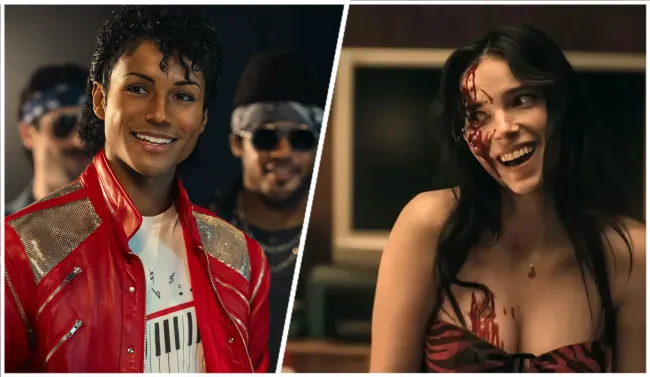
Call it the Great Clippening. If you’ve been on any social media platform lately, you’re familiar with the art of “clipping” — the process of extracting short 30- to 60-second clips or segments from a long-form video like a podcast or film and posting it to social media for engagement.
While clipping has been all over TikTok, Instagram Reels, and YouTube Shorts for the last few years, it’s increasingly become a way for studios and distributors to promote their TV shows and films, organically or directly — and stealthily — as part of their marketing campaigns. So far this year, early awards contenders like Michael, Project Hail Mary, Wuthering Heights, and Obsession have gone viral thanks to clipping. And in previous Oscar cycles, social media users clipped films like Sinners, One Battle After Another, and Barbie into contention.

But has clipping permanently changed the awards game? Gold Derby spoke with several experts about whether the practice could influence the future of award campaigns and FYC season come time for voting in the 2027 Oscars.
How it started
Let’s turn back the clock to 2022 when the clipping phenomenon originated. In an article for Vulture, journalist Lane Brown traced it back to influencer Andrew Tate, who convinced his fans to post clips of his podcast on social media.
Tori D’Amico, managing content editor for YPulse, the research firm specializing in millennials and Gen Z, tells Gold Derby that “clipping” speaks to young consumers and their interest in short-form content whether that’s consuming long-form series in parts on social media, microdramas, or via fan edits. She pointed to how studios like Paramount uploaded full movies like Mean Girls in clips on its official TikTok account. Lionsgate has also engaged in clipping to generate hype around its upcoming theatrical releases.
“The trend of watching a movie in one-and-a-half minute parts was something that existed four or five years ago,” D’Amico remarks. “I can remember watching a movie in six parts on YouTube as early as my tween years. It’s certainly not a new habit for young people, but the fact that studios have embraced it is a newer iteration of it.”
Clipping is also big in the TV world. HBO’s The Sopranos saw a resurgence in popularity a few years ago after the network posted recaps of the mob drama on its TikTok account. Meanwhile, HBO’s Heated Rivalry has gone viral thanks to its steamy fan edits being posted all over the internet. The trend got so popular the network even hired one of the creators who made a lot of the early clips from the sports romance series.
YPulse research found that 79% of 13- to 17-year-olds watch shows and movies in short clips on social media, while 68% said fan edits on social media make them want to watch a TV show or movie.
“There’s the question of what kind of clips succeed and the more TikTok-style they lean into, the better,” D’Amico notes. “Watching an uncut down clip of a movie is certainly going to be engaging because that’s essentially a microdrama. But that still veers into trailer territory whereas a fan edit makes it almost as if the movie was made for social media.”
Paul Hardart, a distinguished clinical professor at New York University’s Stern School of Business and director of the Entertainment, Media, and Technology program, compares clipping to native advertising with the added benefit of plausible deniability.
“The lines between content and ads are blurred because people don’t want to watch ads,” he explains. “That’s effectively what an influencer is. That line is getting even more blurred because something could look like it’s organic content but is part of a [paid marketing campaign].”
How it’s going
In recent years, some major studios and streaming services like Disney+ and Netflix have reportedly told filmmakers to shoot certain pivotal scenes so they can be clipped vertically for social platforms.
“I’ve seen discourse about some studios centering all of their characters in frame so that it cuts well vertically compared with others that utilized the whole frame — so clip marketing is just a smart idea,” D’Amico says.
Over the past few years, the Oscars have struggled with declines in viewership, particularly among younger viewers. In fact, YPulse research found that less than half of young consumers say they watch award shows, with only 35% of 13- to 17-year-olds saying they do, while 44% of 18- to 24-year-olds say they do.
The Oscars have traditionally served as a way for nominated and winning films to reach more viewers and in the past few years, the Academy of Arts and Sciences have tried to make itself more accessible to wider audiences. A few years ago, the Academy opened its Best Picture category to include ten films instead of five. Since then, crowd pleasing, blockbuster movies like F1, which made its way into the Oscar-nominated pile of Best Picture nominees last year.
If clipping were to play a part in the future of Oscar campaigns, D’Amico said it would likely continue to bridge that gap.
“Award shows started losing footing and never really totally got back to where they were for millennials or younger generations because they are just their own tastemakers,” D’Amico says.
While Myles McNutt, associate professor of communication and theater arts at Old Dominion University, agrees while the idea of clipping can generate more broad interest of young viewers who are on social media, he says that a distinction needs to be made for the actual Academy voting body, which includes older members who aren’t on social media and likely don’t follow those emerging trends.
“I’m not convinced that your average Academy voter is using social media in the way that young people are using it to connect to culture,” McNutt observes. “Ultimately, demographic divides are too deep for certain impacts, and awards fall into that category.”
McNutt also emphasizes that the Academy is a siloed institution and the job of campaigning a movie largely falls on the studios. “If they know they have a project like Obsession, which is critically acclaimed, it has other avenues they can use,” he notes. “But if they have a film where it looks like it’s connecting with people, how do they bring that to an FYC campaign?”
The To Leslie legacy

Betsy Walters, visiting assistant professor of film and media at Emory University, points out that the Academy has a set of rules when it comes to campaigns. However, those rules don’t explicitly state whether clipping is allowed. Nominees are only prohibited from using public communications and social media to talk directly about their voting strategy or disparage other nominees.
“The Academy is strict in the sense that they’re specific about what you can or cannot do as a member or voter,” Walters remarks. “You can’t directly say to vote for a person. There’s the sense that the internet still needs a bit of policing, but [The Academy] understands that people will still get their preferences out there. Clipping is interesting in that a lot of that conversation is going to happen because it can’t necessarily be traced back in a way that is going to specifically violate the Academy’s rules unless they can really trace it back.”
But Walters also points out that if clipping were to become more prominent in the future of awards campaigns, it’s not entirely too different from the whisper campaigns or grassroots campaigns that have taken place in the past. One of the most notable — and controversial examples — is when A-list performers like Kate Winslet, Gwyneth Paltrow, Edward Norton, and Jennifer Aniston put their support behind Andrea Riseborough, the star of the under the radar indie film, To Leslie. Thanks to that insurgent campaign, Riseborough ended up notching a Best Actress nomination at the 95th Academy Awards in 2023.
“This has always been a part of Oscar campaigning,” Walters says. “You’re trying to create these organic movements around movies because you’re supposed to campaign, but you can’t look like you’re campaigning too much outside of authorized events. But [clipping] seems like a prime way to do that now to create these online dialogues. That used to be more grassroots and more literal whisper campaigns, and now, this is just a digital manifestation of it.”
“The [Riseborough] campaign worked for Academy voters and speaks to that example of getting famous friends to post about something on social media in a very network-connected way reflective of Hollywood logics,” McNutt agrees. “The notion of people having power of audience participation and engagement still has to be filtered through a lot of other metrics for it to really matter.”
But McNutt also emphasizes that we have yet to see movie “clip” its way to the Oscars. “It’s hard to gauge that if or when that happens, we see an example where something goes viral,” he says. “The algorithmic nature of these social platforms to find success in a clip environment either has to be so broad that they get to everybody’s ‘For You’ page.”
