
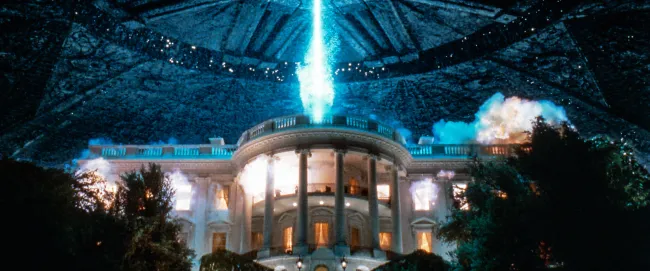
It’s the ultimate episode of Extreme Makeover: Home Edition. Last fall, President Donald Trump launched plans to “modernize” the White House by tearing down the East Wing and expanding the bunker that already exists beneath the centuries-old building with the stated goal of improving security measures.
But there’s one attack scenario that even the deepest-dug and most high-tech White House bunker likely isn’t safe from: a giant laser beam fired by a super-sized extraterrestrial ship from regions beyond our known galaxy. Gold Derby asked our own experts to confirm that hypothesis.
“That’s obliterating everything,” agrees Douglas Smith. “It will absolutely everything blow up,” echoes Volker Engel. “It’s alien technology!”

Both of those science (fiction) guys would know. Thirty years ago, they were part of the Oscar-winning visual effects team that blew up the White House in Roland Emmerich’s alien invasion epic Independence Day, which invaded movie theaters on July 3, 1996, and became that year’s highest-grossing movie — not to mention one of the decade’s signature blockbusters.
Clocking in at less than 10 seconds of screentime, the White House explosion is the movie’s signature moment, one that was used in all of its trailers — including the Super Bowl XXX teaser that transformed Hollywood’s relationship with the Big Game — and immortalized on ID4-emblazoned posters and VHS box art. That scene is also arguably the reason why Independence Day went on to win the Best Visual Effects statuette at the 1997 Oscar ceremony, triumphing over the impressive animatronics featured in Dragonheart and the pioneering digital tornados in Twister.
Even though the ID4 team also employed early CGI technology for multiple sequences, the White House explosion was largely achieved the old-fashioned way with models, pyrotechnics, and in-camera compositing. In fact, the film represents the last hurrah for those techniques being recognized at the Oscars. The following year, James Cameron’s Titanic picked up the VFX statuette and signaled a larger sea change in the industry as digital tools steadily washed away practical magic.
“I never thought we would get such a strong reaction to that shot,” Engel says now. “I remember seeing the trailer in a theater, and when the White House explosion happened, the entire audience applauded. I just hope none of them were politicians!”
In extended interviews ahead of the movie’s 30th anniversary, Engel and Smith provide a behind-the-scenes look at how they reduced the People’s House to rubble — and gave President Bill Pullman a rallying cry as he led the world’s counterattack.
Building the team

Even before cameras started rolling on ID4 in June 1995, the creative team had a hard deadline: 20th Century Fox wanted the movie in theaters in time for July 4, 1996, and set a budget cap of $75 million on the production to encourage speed and efficiency.
“The joke always was that the movie is called Independence Day, not Christmas Day,” remembers Engel, who was the first VFX artist that Emmerich brought aboard. The duo had previously collaborated on the made-in-Germany sci-fi film Moon 44 before making the trip to America for their inaugural Hollywood production, the 1992 Jean-Claude Van Damme-Dolph Lundgren team-up, Universal Soldier.
With a lot of VFX to complete on a limited budget and production calendar, Engel recruited Smith who was well-versed in deep-space spectacle having gotten his start working on the two defining sci-fi movies of the 1970s, 1977’s Star Wars and 1979’s Star Trek: The Motion Picture. Completing the core quartet that would later accept the Oscar were Clay Pinney and Joe Viskocil, both of whom were known for their skills in the pyrotechnics realm. (Viskocil, another Star Wars VFX veteran, passed away in 2014, and Pinney died in 2022.)
The ID4 shoot set up its Hollywood base camp at the famed “Spruce Goose” Hanger in the Playa Vista area of Los Angeles — the cavernous space where Howard Hughes built the eponymous oversized aircraft in the 1940s. (The building is now a Google workspace where ID4 posters still adorn the walls.)

“They built a fabulous set in one of the hangars,” Smith recalls. “You would go downstairs and see the Area 51 lab and then upstairs would be the full-sized alien spaceship. Most of the VFX were done in a hangar that has since been torn down, and there was this circular route we could take between the live action hangar and the VFX hangar.”
“The hangar where we shot the tabletop miniatures was previously used to fly test helicopters,” Engel adds. “And then we had another hangar where we did all the pyrotechnics, except for the White House scene, which we did outside.”
Despite the size of the crew — which Smith estimates to be well over 300 people — and the complexity of the production, both artists describe a strong feeling camaraderie on set, even with the ever-constant presence of that ticking clock counting down the hours, minutes, and seconds to the mandated release date.
“Teamwork is the first thing that comes to mind when I think of the movie now,” Engel says. “We had this crew of different specialists who were so good at what they did working alongside each other. I can only compare it to a team sport.”
Playing house

In the film, the White House explosion caps off the invading alien army’s opening salvo, which also takes out the U.S. Bank Tower in Los Angeles, and the Empire State Building in Manhattan — iconic locations that Emmerich and his co-writer Dean Devlin specifically called out in the script. The replicas of those buildings were overseen by Mike Joyce and his miniatures team, which used detailed photo references of all three structures to ensure authentic-looking recreations.
When the time came to blow up the Bank Tower and the Empire State Building, Viskocil sold Engel on an effective visual trick — building flat tabletop-like models and placing them at a 90-degree angle, then rigging up explosives below and then filming the resulting fireworks from above.

“Joe explained to us that we could set the pyro off from the bottom, which would make the fire rise upwards towards the camera, like it’s coming towards you,” the VFX artist says. “To the audience, it looks like the streets and buildings are horizontal, and it’s rolling down the street at them instead of going up to the ceiling.”

But the White House explosion required a different technique due to its larger size. “It was probably 15 feet wide and 5 feet tall with a metal frame and these stucco details fastened to it,” Engel recalls. “When I saw the Empire State Building blow up, I remember thinking that there wasn’t much volume to it, so I told Mike Joyce that we needed to make it feel like there were rooms and furniture in it so it didn’t just feel like this empty shell.”
Engel also requested a test run at reducing the White House to rubble, so Joyce created a smaller 2-foot-by-2-foot wall and window attachment to the existing miniature that Viskocil could blow up while they captured the footage on a 35mm film camera.
“Joe had to create a succession of explosions,” he explains. “First, he had to shatter the walls with a primer cord and set off a fireball on the inside. At the same time, he also had to create a very destructive explosion that would shatter all the rooms, and the fireball would then push everything towards the camera and upwards.
“It was a great idea, but we had to figure out the timing between those three different elements, and the timing of two of them was slightly off,” Engel continues. “We were able to adjust it when we did the test with the rehearsal model; I believe we ended up shooting it in slow motion at 360 frames a second to make the effect look real. And then the night came where we had to blow up the White House.”
Fire and ash

Fox had given Emmerich an Independence Day deadline for the movie, but they wanted a fireworks-heavy teaser trailer ready months before that — specifically by Jan. 28, 1996, so it could be shown during Super Bowl XXX. Because the White House explosion was guaranteed to generate massive fireworks, the VFX team tasked themselves with completing it early in the shoot.
Due to the size of the model and the explosion required to destroy it, the sequence was set up in the parking lot outside of the hangar during the evening hours so the cameras could shoot the model against a real night sky. Ever the showman, the director didn’t limit the guest list to the ID4 crew alone. Engel remembers that roughly 50 members of the press were also in attendance, along with a documentary crew overseen by Ben Burtt, the famed Star Wars sound designer responsible for that noise everyone’s obligated to make whenever they take part in a faux-lightsaber battle.
“Everybody was watching, so we knew it had to be good,” he says, chuckling.

Smith was also on set that night and remembers feeling more than a little trepidation. “I’ve rarely seen a large-scale explosion go off without some kind of problem,” he remarks. “It felt a little risky, because they had only made one White House model and did a limited amount of testing. I was nervous that we had under-prepared.” Engel concurs that the size of the sequence also gave him some cause for concern, but stresses that all the necessary safety measures were taken, with a firefighting crew on standby in case anything went wrong.
“We had about nine cameras filming the scene at various speeds,” he says of how the scene unfolded. “Joe had planted lots of little explosive devices on the model with one big explosion at a 45-degree angle planned at the end to send a giant fireball towards camera. When you blow something up, it happens really fast, so he pulled the primer cord and there were three big poofs and that was it! I will say that when the explosion was triggered and the heat wave hit us, I’m pretty sure my eyebrows got singed.”

Because they were shooting on film, the crew had to wait until the next day to see the dailies. But they also had a VHS camera going and were immediately able to study the playback frame-by-frame. “The whole explosion only lasted five frames on that VHS playback, but you could tell it looked good,” Engel says. “And when we saw it projected the next day, we were like, “Yep — that worked.”
By the way, before the White House miniature went kablooey, Smith remembers Emmerich saving some budget dollars by using the replica to complete a quick insert shot featuring the movie’s stars Jeff Goldblum and Judd Hirsch. “At one point, their characters were in front of the gates of the White House with the building in the background, and that was actually shot in front of the miniature with forced perspective,” he says. “They got their money’s worth out of that model!”
Boom times
Before the White House scene could be deemed trailer-worthy, two key elements remained to be added — the giant alien spaceship and its powerful laser beam that sets off the explosion. Engel’s crew filmed the large spaceship model’s slow approach over Washington, D.C., separately and composited it over the footage of the White House miniature.
“I remember our compositor was initially not very happy that we didn’t have a blue screen behind it,” he says now. “But it turned out fine because the brightness of the White House explosion against the night sky made it fairly easy to composite.”
The laser, meanwhile, was generated by ID4’s small team of CGI artists and is the one major bit of digital enhancement seen in an otherwise practical stunt. “They worked for a couple of weeks to get that right,” Engel remembers, adding that one of the reasons why digital effects were kept to a minimum is because the computers that were required at the time cost upwards of $250,000 — a budgetary excess.

“Getting the granularity of the laser pulse was fairly tricky; we decided to have this guide beam that comes down first and then there’s a pulse that really hits the object,” he notes. “That’s because when Roland saw our first test, he immediately realized that just a laser beam coming down wasn’t going to cut it. So, we created that guide laser and then the actual hit comes a bit later.

“That’s also a total shock for the audience, because they see that first laser and nothing happens,” Engel adds. “Then the pulse comes and it’s like, ‘Boom!’”
The 20th Century Fox marketing team was blown away by the completed shot as well. The White House explosion famous became the final moment in a pricey Super Bowl XXX spot that ended with an amusing “Enjoy the Super Bowl — it may be your last” salutation. At that point in Big Game history, movie trailers were few and far between during the telecast. But after the ID4 spot exploded in popularity, launching a promotional campaign that powered the movie to a nearly billion-dollar global gross, Hollywood studios started setting aside ad dollars to tease their summer blockbusters during the Super Bowl.

Eagle-eyed viewers will notice that there’s one effect missing from the explosion seen in the Big Game trailer, though — the helicopter that’s caught mid-flight by the fireball that’s erupting out of the White House. Engel’s team added that shot later to clear up a key story point. “In the film, there are two helicopters lifting off in front of the White House, and only one of them makes it,” he says. “It was a fairly easy in-camera effect, so we filmed that in front of a green screen with a separate pyro set-up weeks later and added it to the shot.
“The model helicopters had a metal rod coming out of the back that you didn’t see in frame and then we attached them to a camera dolly that could be moved upwards,” Engel notes. “We also had a motor that was spinning the model’s rotator blades. In the film, there’s a cut to a close-up of one of the gentlemen looking out of the helicopter window and then we cut back to the White House explosion, and you see the helicopter explode along with the building.”
And the Oscar goes to…
Despite being the masterminds behind the shot that made ID4 the biggest hit of 1996, both Engel and Smith confess that they didn’t expect to score an Oscar nomination, let alone the win. “I never felt like it was a sure thing,” Smith says now. “What worked in our favor is the fact that Academy voters are skewed towards non-technical people who listen to their emotional reactions. We benefitted from voters reacting to other parts of the movie, not just the VFX — the rest of the membership is probably what gave it the Oscar.”’
“I actually thought Twister was the front-runner,” Engel concurs. “They had fantastic effects and also employed the best VFX house in the world, ILM. But the entire body of the Academy votes on the award, and it felt good knowing that all those specialists across the acting, costume design, and other branches voted for us. That made us pretty proud.”
While the quartet of Engel, Smith, Pinney, and Viskocil were handed Oscars, telecast time constraints meant that only Engel and Smith actually spoke from the Shrine Auditorium podium. Pinney came up with an inventive solution, holding up a sign listing the names of the people he wanted to thank. Smith remembers mainly feeling relieved that he was allowed back into the auditorium in time to receive his award after bolting for a quick bathroom break.
“They wouldn’t let me back in until there was a commercial,” he says, laughing. “Once we were called, I calmed down and just got up there and did my speech. I remember saying something about how we had a crew of 300 people and that I would thank them individually. And I did make quite a few phone calls afterwards — but I didn’t call 300 people!”
Another two decades elapsed before Emmerich and Devlin returned to ID4 with 2016’s Independence Day: Resurgence, a sequel that went through numerous iterations on its way to the big screen where it didn’t match its predecessor’s succes. Engel was ultimately the only member of the Oscar-winning foursome to return for the follow-up, which was dominated by digital VFX in place of miniatures and other practical tricks — a choice that was both a sign of the times and the scope of the production.
“We could never have done the sequel with just miniatures,” Engel admits. “And to be honest, I look at some of the stuff in the original movie now and I’m still very proud of it, but I also wish we had access to some of the digital tools that could have made the VFX a little more sufficient. We shot the movie in 1995 right after Jurassic Park basically invented CG dinosaurs, and I have to give the CGI team credit for enhancing some of our shots.”
“We were right in the middle of that change, and didn’t exactly know where it was going at the time,” Smith echoes. “We also didn’t know that Independence Day was going to be a blockbuster! I had some serious doubts about how it was going to turn out. But Roland had a great sense of humor throughout it all. Sometimes we’d be looking at dailies with him, and when the biggest blunders happened he’d just make the funniest jokes.”
