
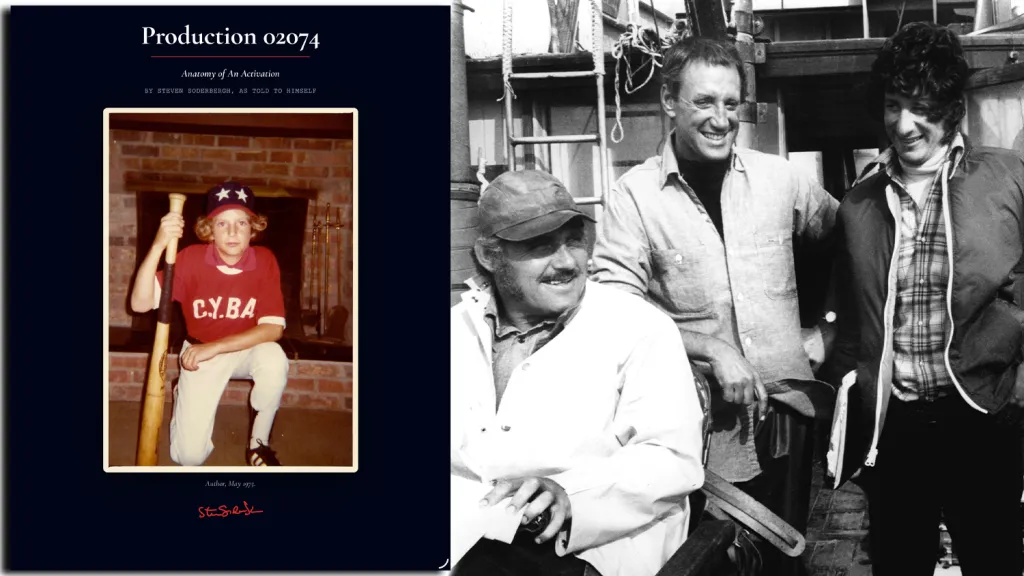
EXCLUSIVE: Steven Soderbergh was determined to publish his inventive work Production 02074 exactly 51 years after the launch of its subject, Steven Spielberg‘s 1975 classic Jaws. To do justice to the making of the movie that swung him toward an Oscar-winning filmmaking career, Soderbergh had to build out an app specifically to accomplish what is an inventive compilation of still images from the film along with Spielberg’s observations written in the production log and Soderbergh’s analysis of why Jaws is a singular cinematic accomplishment that moved him so much as a youth that he saw it 31 times in a theater and probably threefold that many times since.
It was touch-and-go, but Soderbergh got the app up in the Apple Store late on June 20, with an app for Android tablets he expects will be later this week. Relieved, Soderbergh and his wife relaxed and watched a movie — Jaws, yet again.
Soderbergh is an unassuming genius maverick who patently dismisses the suggestion that his 1989 Sundance sensation sex, lies, & videotape did for indie film what Jaws did to usher in the mainstream blockbuster. With Production 02074, Soderbergh has created a formula to dissect great films that shows us instead of tells us. Readers scroll through the images in scenes as Spielberg shot them on each of the staggering 143 production days. If you’ve seen Jaws as often as I have, you find the dialogue playing itself inside your head as you eyeball the photos. There are observations and anecdotes provided by Spielberg along the way, many of which were new to me.
The app costs $24.99, with all the proceeds going to an animal charity. It’s a true labor of love, considering what Soderbergh paid to have the app designed and built, as well as all the hours he spent dissecting Spielberg’s production logs and getting the images. Soderbergh also devotes the conclusion of the app to the lessons he learned from Jaws, and there is an epilogue written by Spielberg as he relived his stint as moviemaking’s Job, making a movie where everything that could possibly go wrong did and still turned out a movie that, along with Star Wars, ushered in the movie blockbuster. It is a primer for any aspiring moviemaker or film buff.
“There was a lot of discussion about how to do this and what I decided was if it was a book put out by a university press, it would cost twice that,” Soderbergh said. “This is 51 years of study and experience, so that’s 50 cents a year. Look at it that way. It’s a film school and an app.”
DEADLINE: At Cannes you paid tribute to John Lennon with your documentary based on his final interview and aided by AI. Now you have published Production 02074, your tribute to Steven Spielberg’s game-changing film Jaws. There have been numerous books written about the difficulties making of that classic. With Production 02074, you have created a lane for yourself by focusing on the production logs and doing it as an app and not a traditional book. The images of each shooting day flicker by, and the dialogue is so ingrained in my brain that it played back in a most satisfying way. What compelled you to tell Spielberg’s journey this way, where you don’t tell us as much as show us with all these visuals?
STEVEN SODERBERGH: I probably inherited the idea from my father, a college professor whose specialization was education and who taught teachers. The idea of passing along knowledge was something he believed in strongly. I must have swallowed that. I learned not only from watching things but from reading books about movies\ — whether they be about filmmakers or by filmmakers. When I was growing up, there wasn’t as much material to access about how things were made as there is now, but clearly that’s what led to me saying yes to the first quote-unquote lecture I ever gave about directing. That was at NYU in 2007. And over the next few years, I gave various versions of this lecture. As I say in the introduction, I stopped because it wasn’t really evolving.
I felt a compulsion to memorialize this film somehow, but it needed a hook and I didn’t have one. It didn’t have a spine. I thought, “Well, the best hook I can think of is the movie that made me want to make movies.” I started slowly working on an analysis of Jaws, but that didn’t feel complete. And then I read Stanley Kubrick’s The Shining, the making-of book that Taschen published. I thought it was stunning. It was extremely granular in a way that I enjoy, and what my thought while I was reading it was that it would be cool to be able to see what he’s describing as they shot that day. It would be cool to be able to see it when he says, “This was the shot that we did 15 takes of.” I had some discussions with people that make those kinds of books, and the cost was prohibitive, say, for somebody who’s an aspiring filmmaker. The whole idea is to pass my experience, my analysis along to people in a way that’s really accessible. Making a giant coffee table book that costs $2,500 felt counter to the impulse that made me want to do it in the first place. I want anybody to be able to buy this and get whatever they are going to get from it. So that’s when it shifted from a traditional book to an app, where you can scroll through the images and get a sense of what [Spielberg] had to go through to put this movie on screen.
DEADLINE: There are many accomplishments in Jaws. What to you are the most memorable?
SODERBERGH: An interesting thing to me is that despite all of its bravura filmmaking technique, what makes the film resonate for people to this day is the character work. Other than the pure staging aspects, what I continue to marvel at are the scenes that to me are the model of how to present exposition. The two scenes with Mayor Vaughn [Murray Hamilton], the first one on the ferry and the second one in front of the defaced billboard. Those are just clinics in how you get information across to an audience. They feel utterly real, and you don’t feel like you’re being fed information.
He stages them each in largely one shot, with characters and movement that allows you to do some editing of your own while you’re watching the scene, instead of trying to point you toward something. I talk about that in the learning section of [this app]. How, if you’ve got expositional scenes, I always feel like the fewer cuts the better, to try and undercut the idea that the audience is being fed information by taking a less-choppy approach to covering the scene. You mask the fact that you’re feeding them exposition. Take the scene with Brody and his son at the dinner table, which is just spectacular. So simple and utterly real and funny and heartfelt. Those are the things that I marvel at. That in the midst of this mayhem and chaos of the production, that Spielberg is still focused on the characters and the story. Because he knows we can do all the technical stuff in the world, but if you don’t get the story and the characters correct, nobody cares.
From left: Robert Shaw, Roy Scheider and Richard Dreyfuss in ‘Jaws’
Courtesy Everett Collection/Universal
DEADLINE: That is also evident in the scene where Hooper, Brody and wife Ellen are at the dinner table when they decide to cut open the shark to see if it ate the Kintner boy. They’re drinking, and there’s a lot of information about the predatory nature of sharks and Hooper’s reverence for them. We were not walloped over the head with exposition, but it leads us to what Hooper and Brody do with Quint that prompts the latter’s monologue about floating in the water after the USS Indianapolis sank, as hundreds of sharks tore his fellow sailors to pieces. That monologue is the knockout punch you didn’t see coming. People have criticized the animatronic shark, that it looked fake. I never cared as I watched Jaws, over and over. My payoff was always getting to those three guys on the boat. You write that teaching what you’ve learned is different than attempting to teach you something by showing it, allowing for you to filter your own taste and talent as a filmmaker because that can’t be taught. It fits in the way you present how every shooting day unfolds. This formula you created, this app, could lend itself to a different study of classics from The Godfather on down. Was realizing that your lightbulb moment on this project?
SODERBERGH: Yeah, it was. But also, it was a really positive thing to do. Spending time to put yourself inside of a piece of art that you love and that inspired you. I loved doing it. Once I started thinking about, “OK, this is how I’m going to do it” … though there was no shortcut, it never felt like you’re grinding your way through it.
It continued to teach me, the further and deeper I got into it. And it’s something I would encourage anyone to do. It’s so — life-affirming is not the right word, but it’s creatively inspiring. Once I had an idea of the vibe form it would take, I was able to really work faster and longer because I could see what it was going to be. Whereas one of the reasons I think this took so long to reach completion was that, up until a year ago, I wasn’t sure exactly what form it should take. There was this sense of, “What are we doing here? I know you want to disgorge some thoughts you have about the movie and about filmmaking, but what exactly is it?” And then when I decided it can be an app and I can do these things you can’t do in a book … it was like hearing the starter’s pistol go off. If Star Wars had gone forward, this wouldn’t have gotten finished.
DEADLINE: You mean The Hunt for Ben Solo, which you explored doing with Adam Driver before Disney canceled it…
SODERBERGH: This was in the immediate aftermath of that not happening. I started in on multiple writing projects, to both see if I could generate material to go and make as movies but also just to keep myself occupied. And literally, as soon as we got the call, “This is not happening,” I thought, “OK, it’s time to really sit down and get serious about finishing this thing.” Had I gone off and made that movie, this thing would not have gotten done.
DEADLINE: How crushing a blow was being told your Star Wars wasn’t happening?
SODERBERGH: It was baffling more than anything, but everybody just immediately moved on. It’s probably something I should have put in the app. I don’t burn a lot of calories on shit I can’t control. There’s no upside to that. And so as soon as Kathy [Kennedy] called and said, “It’s not happening,” I was like, “OK, moving on. I got to go to work.”
RELATED: Steven Soderbergh On Giving Disney Nearly Three Years Of “Free Work” For Unmade ‘Star Wars’ Sequel: “We Were All Frustrated”
DEADLINE: You had more control here, but you were relying upon the production logs and the imagery that dominates this effort. How helpful was Steven Spielberg? What were his concerns and what did you strike with him?
SODERBERGH: It wasn’t really a bargain. He just offered to help and did in some very significant ways, mostly in providing context to his emotional state and some background detail about certain sequences or interactions that was incredibly helpful. He was the definition of gracious and supportive. I was concerned when I first sent it to him that experiencing it in this way would be unpleasant, “Please allow me to walk you through step by step the most traumatic professional experience of your career.” That was the ask of him. And as he wrote [in the epilogue], he found it strangely cathartic, with the distance of time, to be able to look at what he did. I think happy is the wrong word, but “I think I certainly would’ve been proud of my younger self for withstanding the sort of pressures and the obstacles that this shoot presented.”
There were six weeks when they were very seriously wondering whether physically it was possible to do what they were trying to do. You’ve got Sid Sheinberg asking him, “Do you want to stop?” I mean, that’s insane.
DEADLINE: There’s a moment there where Spielberg looks at his guys and they all say, “This might work. We might actually have something here.” This was Day 110, and the shark broke down again the very next day. What is the closest comp in all the movies that you’ve made where it was so difficult and then the light began to shine through at the end of the tunnel?
SODERBERGH: I’ve never had anything on this level, where there were questions about whether you would even be able to finish. I’ve never been in that situation. Without question, the most demanding project I was ever on was Che. Those were just tricky and in a weird sort of way, you had to lean into how difficult they were and find some kind of pleasure in being tested every day. Otherwise, you get annihilated. The other thing that I hope comes across for aspiring filmmakers is, as in sports, the psychological component and mental toughness that is required to keep a production going in the right direction and being a leader. … That’s not the stuff that is taught, and those are things you only learn by being in that role. I hope part of the takeaway is an understanding that yeah, it’s good to do your homework in terms of technique, story and all of those things. But there’s this whole other aspect that’s hugely important, that has to do with the way that you work — the tenacity required to see any film to its completion and the responsibility that you have toward everyone involved, whether it’s the financier or the people working alongside you. This is important stuff.
DEADLINE: Spielberg didn’t film those terrifying closeups of the shark – like when Jaws pops up as Brody is shoveling the bloody chump slick in the water — until Day 92. How would you have felt if you shot a movie and it wasn’t until that far into the shoot that that you began showing why this Great White was so terrifying?
SODERBERGH: I don’t think I could have done it. I don’t think anybody else could have done it. He confirmed what I thought, that when he got to those days, he must have been super excited to see these shots that finally looked like what he had been imagining for a year. He sent back a note as he was going through all the days, saying, “That was a great day.” Suddenly we felt like we were getting it and it was going to work. And then as you said, the next day, the shark breaks. This is like Day 91 or 92, and they’ve still got 50 days left to go.
Just as a portrait of willfulness, it’s really incredible. Getting people to understand that idea, that making anything is an act of will and that at the end of the day, you really have to draw upon something within yourself to see it through. And you have to also contextualize who he is at this moment in his career.

Richard Dreyfuss, left, and Robert Shaw in ‘Jaws’
Everett Collection
DEADLINE: You allude to the touching character moments created by one take scenes that feel original. I always felt in your film Out of Sight, the love scene between George Clooney and Jennifer Lopez was about the best of its kind. So graceful and powerful, without feeling tawdry. I remember saying that to Scott Frank, who adapted the Elmore Leonard novel for you, and he said, “That was all Steven, who came in and said, ‘I got an idea.’” I thought of this when you were describing the first attempt to shoot Robert Shaw’s USS Indianapolis monologue, and that Spielberg didn’t even develop the footage. Tell me about them finding that moment, that unforgettable scene?
SODERBERGH: The story of the writing of the scene is fairly settled and all the accounts finally line up. They’d all been working on it for a long time. They knew how important it was. Shaw shaped the version that they shot. The other colorful aspect of it was Shaw’s request on that day when they were going to first try and shoot it, to imbibe to some degree. To put himself in the moment. That turned out to not be a good idea. What was interesting in going back through the production log and the line script was, there’s no question that that’s never a good idea for an actor to be drinking, period…
DEADLINE: On set.
SODERBERGH: I also noticed they’d shot a lot of other stuff prior to starting that section of the scene. It was like four in the afternoon, late in the day when they started on the monologue portion the first time. They’d shot everything prior to that, which was a lot. The notes are there. They exposed a full thousand foot magazine of film for a scene that’s a little over two minutes long. I can imagine very early on in that take Spielberg knew, we got to wrap. We got to wrap this up. And then he got the call from Shaw and they came in the next morning and by lunch they had the whole thing shot. You can see also, again, those are real world situations that as a young filmmaker, you have to learn how to navigate. In this case, Spielberg did the honorable thing, which is, I don’t want anybody ever seeing that roll of film, period. That move is an indication of his understanding, both of the business and of people. Even though in that situation, Shaw is being, I guess you would call it unprofessional, or just ill-advised in his preparation, Spielberg’s sensitivity and code of behavior made him know what the right thing to do was in that situation. Which is, we need to stop shooting and we need to have that negative destroyed.
Roy Scheider in ‘Jaws’
DEADLINE: But in the logs about Shaw’s death scene, Spielberg says, “Shaw did all the other shots himself and got properly sloshed and was in a highflying mood all day, but so out of shape that after every take we have to stop for half an hour to let Bob catch his breath.”
SODERBERGH: I didn’t interpret sloshed there to mean drunk. I thought he meant he was soaking wet and didn’t care. Like, throw me in there, let me do it. I’m into it. That’s what I interpreted. I didn’t interpret it that sloshed to mean that he was drinking. I interpreted that to mean he didn’t give a shit how wet he was.
DEADLINE: That makes sense. As a viewer, I always thought, “What a day that must have been, where Quint’s worst nightmare is realized and the shark finally gets him.” According to those logs, that death scene took like five days to shoot. How unusual is that, to have an actor keep up that level of a great death scene over that many days?
SODERBERGH: I think it shows his belief in what they were doing and in Steven Spielberg, that the guy gave 100% all the time. It shows in the film, all of them are 100% committed. I met one of Robert Shaw’s children, one of his daughters. And I asked her, I said, “What was his take during the shoot on what was going on, if you can recall?” She goes, “No, I recall.” She said, “I remember him saying, I like this guy [Spielberg]. I think he’s really smart and he has a lot of energy.” And he felt at no point did he feel whatever his comments were about the novel, at no point did he feel like they weren’t making something good. I’m sure you could take some comfort while the shark’s not working in the absolute knowledge that all of the character work that you’ve done in the movie is top level. You’ve got all those great scenes. I think it’s my favorite Richard Dreyfuss performance.
At the same time, I’m sure Universal’s going, “Yeah, we love all that character stuff too, but this is a movie about a shark. We need to see the shark. Knowing how things are going and whether it’s working or not, this level of pressure and the enormity of the things that are not controllable…I found myself imagining what it must have been like, as he describes just sitting there every day in the water. With people asking you to fire them. It’s crazy.
DEADLINE: “Feed me to the shark so I can go home. I can’t stand it anymore?”
SODERBERGH: Yeah. And you feel responsible. I mean, you feel like it’s your fault, just to have all of that sort of energy of the crew, and they’re all looking at you and you just don’t know. There must have been enough in what he was getting to keep him inspired and convinced when a lot of other people weren’t convinced. It had nothing to do with his abilities. It was just the fact that, like I said, for about six weeks, there was a question of whether or not this was physically possible, that they may have been attempting to do something that just couldn’t be done.
DEADLINE: You write that on Day 143, Spielberg talks about testing the film in Dallas, and realizing they needed to reshoot the underwater scene where Ben Gardner’s head rolls out of the hole in the hull of his boat, and Dreyfuss’ Hooper character is so shocked he drops the shark tooth. What was wrong with the original shot? Was the head just sitting there?
SODERBERGH: That’s exactly what I suspected and what Spielberg confirmed. Which is, he swims up to it, shines the light on it, and the head’s already there. At this point after the Dallas preview, everybody’s like, “Dude, walk away. Pencil’s down. It all works great. Stop.” And he rightly felt there’s a missed opportunity here, an organic jump scare to be had here, and we’ve got to do it. And they wouldn’t even pay for it. He had to pay for it.
Ben Gardner in ‘Jaws’
Universal Pictures
DEADLINE: That reminds me of when Jim Cameron once told me when he made The Terminator. His backer, Hemdale, said, “We’re out of money. End the film where Kyle Reese shoves the explosive in the pipe of that gasoline tanker truck and it blows up the cyborg.” I recall Cameron putting in his own money to continue with the factory scene and the ‘You’re terminated, f*cker’ scene. The difference between a disposable film and a classic seems razor thin, and comes down to a filmmaker’s unending belief that they have to have this.
SODERBERGH: That falls into the category of the other thing I talk about, which is managing expectations. When I hear stories like that, my reaction is not, “Oh my God, these people are such Philistines on the studio side or the finance side.” That’s not my initial response when I hear a story like that. My response is, “Well, what do you expect? Why would you expect them to have the vision that you have? If they did, they’d be doing what you’re doing.” I don’t expect enlightened visionary responses from the people that pay for movies. It’s a nice surprise when you are dealing with a studio or an executive that gets it and totally sees what you’re trying to do, and is totally supportive and backs you in whatever request you make. But I don’t expect that as the default.
DEADLINE: You bring to mind another Universal classic, American Graffiti. The top production executive there was ready to write this film off. Francis Coppola, who produced the film because George Lucas was his protege, told me he said to those execs, “You should be on your knees kissing the feet of George Lucas for what he’s given you. And if you just don’t see it, I’ll write you a check right now and I’ll take the film.” They balked at that.
SODERBERGH: That was Ned Tanen, who did something indefensible and punitive to Lucas. The contract said the film had to be 110 minutes with credits, you’re at 112. So Lucas had to cut one scene, just because this guy wanted to prove that he was in the power position. That’s terrible and that’s why George Lucas didn’t want to work at Universal.
The pettiness of that is stunning. But generally, I think I would rather encourage a filmmaker to be prepared for people to not understand at times what you’re trying to do, and not see it until they see it. That doesn’t mean you can’t trust people. It just means, don’t expect everybody to feel about it the way you feel about it. Or you’re going to be disappointed a lot. And then as I say, disappointment is not an active state. You need to keep yourself in an active state and be doing things, not just kind of mulling over stuff that you can’t control, or that is too late to change. You have to understand that you have a finite amount of real estate in your brain to give to whatever you’re making. You need to be ruthless about excluding noise that doesn’t ultimately help you make a better version of the thing.
That’s why I’m so obsessive about optimizing the process. Because you can control your process, and that means casting your crew and the people around you with the same care that you cast the roles in your film. The people around me, they are aerodynamic. All we’re thinking about is the best version of whatever we’re doing. There’s no drama outside of when the camera is rolling. That’s the only drama that we’re looking for. It’s a lifelong process of finding those people that can play in the band as a group. And when you find them, you hang onto them.
DEADLINE: Based on what we just discussed with Mount Rushmore directors like Lucas, Spielberg, Coppola and Cameron, this work of yours to me shows the importance of a filmmaker being unshakeable in believing their vision. It seems that in Jaws that Sid Sheinberg was very supportive. Now, he had a special rooting interest because his wife, Lorraine Gary, played Brody’s wife. But there is still the possibility of those punitive move you ascribed to Ned Tanen. What about a filmmaker not allowing suits to get in the way of their vision, the idea it’s better to get yelled at than ask permission? Otherwise, you look back and think, I almost had it. I should have fought harder.
SODERBERGH: At least [Spielberg] was dealing with a studio that understood what he was faced with, and the level of talent that he possessed. So the conversations were all in good faith. Nobody wanted this to be going the way it was going. I think I say at some point that there’s actually a worse version of the production of Jaws and it’s the version that isn’t directed by Steven Spielberg.
DEADLINE: Elaborate.
SODERBERGH: No one else would’ve had the vision and the tenacity to see it through. If you were dealing with any other filmmaker, I literally don’t think they wouldn’t have finished.
DEADLINE: And control falls to executives who don’t have a modicum of Spielberg’s talent?
SODERBERGH: Who knows what happens? But I think if it’s not him, this thing just doesn’t get done. It just doesn’t. I don’t know what it must’ve been like to have something that painful turn into the landscape altering success that it became. That’s got to be very strange. To have those two things braided together, the pain and then the relief. I imagine it was relief as much as pleasure. As he said, the payoff was creative freedom for the rest of his life.
DEADLINE: In a lookback piece on sex, lies, & videotape and its impact on Sundance and the indie film businesss, you told me that even after you made the movie, you were as surprised as anyone at its trajectory. When Spielberg finished, was your impression that he believed Jaws would change the movie landscape?
SODERBERGH: From a business standpoint?” You’d have to ask him. I doubt it, only because I don’t think he thinks like that. I think a lot of it must have been relief at getting to the end. The fact that it not only got finished but turned out to be a classic is what makes the story so remarkable. But I don’t think anybody fully knew what they had until the Dallas preview.
DEADLINE: How helpful is it to a filmmaker like Spielberg to survive an ordeal like Jaws and coming away feeling brave? The films that followed, including E.T. and Close Encounters all defined the blockbuster…
SODERBERGH: Well, I know one of the things that he was pleased about was it meant Close Encounters was going to get green lit. He was attempting to make the first movie about UFOs that was serious and this was not a subject that studios were willing to spend A-level money on, prior to Close Encounters. There was 2001: A Space Odyssey, but this was different. The good news was it seemed like being able to immediately turn his focus to Close Encounters, a project that he had a deep personal connection to, was the perfect gyroscope to keep him focused on his work. Because that kind of success can create problems for certain kinds of people.
DEADLINE: You think you don’t have to listen to anybody? Or you get smug and not hungry?
SODERBERGH: The fact that he’s been as prolific as he’s been [means that didn’t happen]. One of the things that outsized success can do is to create a sense of paralysis, and a sense of self-importance and he’s never fallen preyed to that. If you’re making movies at the same time as Steven Spielberg, it’s hard not to feel like Salieri. There are times when I think of that image from Amadeus, of F. Murray Abraham and the music sheets falling from his hands because he’s so overwhelmed at what he’s looking at. [Spielberg] is one of those filmmakers who have to be reckoned with if you’re a filmmaker.
DEADLINE: You write that there were disputes on how long the Jaws shoot was, and you settle on 143 days. Your epic on Che Guevara was your most sprawling exercise in storytelling, spanning two movies. How many days to shoot both?
SODERBERGH: Each of the films was 37.
DEADLINE: Remarkable to consider it took exactly twice as long for Spielberg to shoot Jaws as it did for you to shoot two entire films. Does a movie like Jaws get made in this day and age?
SODERBERGH: I don’t know. It’s a good question. I think as notorious a shoot as Jaws was, we were still in the midst of the American New Wave, where young filmmakers were making the movies that people wanted to see. As I said, his talent was self-evident and so it wasn’t like he hadn’t had experience. I think nowadays…well, as I say in the thing, nobody who knew anything about actually being on the ocean would’ve signed off on this. Anybody who knew what they were actually attempting to do, who had experience on boats and the open ocean, would’ve said, “You’re nuts. This isn’t going to work.” So in a way, their naivete was why it happened. There’s a reason that people aren’t going out and trying to do exactly what they did on this movie, because there’s no advance in technology that would solve the problems that they were confronting. You still got to have a pneumatically powered object in the open ocean that you’re trying to make work. AI ain’t going to help you. It would be as hard today as it was 50 plus years ago.
Margaret Harrick Library
DEADLINE: I was a clam digger in high school and college, a great job unless the tides were too strong for your rake to hold its place in the sand where the clams were. You’d say, “Well this is a lost day.” For Spielberg to have to say that as many times as you indicate in this work … it seems unfathomable to scrap that many days, to contrive ways to keep the crew and cast from losing hope, with the meter running the entire time.
SODERBERGH: The pressure of that, but also the sensitivity to it and the unending attempts to just keep everybody on board while they fight their way through this thing bely his age as he says, “I’m counseling people twice as old as me who are cracking.” That’s what was happening. Two things happen when you get into situations like that. People either crack, or they turn into zombies. It’s a real thing. And like I said, it’s hard to really conjure for people what an entire day or even half a day of not getting anything accomplished feels like. Every hour that passes feels like you’re pushing a boulder up a hill, to no effect. It can do very strange things to people psychologically. And the other thing is, they’re getting completely gouged by the locals because they’re trapped. They can’t leave and everybody knows it. And so there’s just money flying out the window. Having just gone through this process, I still don’t feel like I can wrap my mind around it entirely. I’ve experienced little pockets of that kind of pressure or feeling of frustration. I’m talking hours over the course of a movie, not a situation where the entire production is that, for 143 days. And then that Dallas preview, where he says, ‘we’re not done.’ Everybody else thought they were done. It was like, “We’re not done. There’s better. It can be better.”
DEADLINE: So they go back and create one of the great jump-scare moments…
SODERBERGH: There’s a lesson therein, as I say, don’t stop trying to make it better until you’re fired, or you have to contractually deliver it or…
DEADLINE: They use the Jaws of Life to pry the print from your hands so people can see it in the theater?
SODERBERGH: I’ve worked on these things right up until I literally have to turn it over, so that it can get released. I just keep going through it, looking for any areas that feel we can make it better, which is why when they’re done and I do hand them over, I’m able to not look back. Because I know I left it all on the field.
DEADLINE: You’re at peace?
SODERBERGH: I can look back five years from now and see things that could be better that I didn’t think of, and feel, well, that’s the way it goes. I did everything I could think of at that time. The nightmare scenario is to think of something, know that you’re able to do it if you want to, and you don’t do it. I don’t know how you justify that to yourself.
DEADLINE: When Francis Coppola self-financed Megalopolis, he more or less told me that it burned in him for more than a decade, and he did not want to be on his deathbed thinking, “I could have done it and I should have.” He used his vineyards to make it happen. These are true artists, aren’t they?
SODERBERGH: Yeah. And I think that’s the other thing I say at one point in this: be somebody who finishes things. Because finishing something that’s okay but not great is better than not finishing something that could have been great. If it’s not finished, it doesn’t exist. I’m a real stickler about that, and this is an example, 19 years essentially from beginning to end on this project. If I decide to start, it’s going to get done. It may not be perfect, but I can’t think of a single project that I have assigned to myself or that somebody has assigned to me that I have not completed.
DEADLINE: One more. Any observations to share about Spielberg’s reaction to this app?
SODERBERGH: I think he articulated that beautifully [Spielberg wrote the epilogue]. What’s especially impressive about it was he wrote that epilogue in the middle of his press junkets for Disclosure Day. So he’s not only got full days of press that he’s doing. He said, “Would you be okay if I wrote an epilogue to which I said yes.” And he said, “It may take me a minute because I’m still in the middle of doing all this press.” I said, “Not a problem because clearly I’ll wait for that as long as I have to wait.” Half an hour later he’d sent it exactly what you read.
DEADLINE: So this was your Ben Gardner’s head reshoot moment, executed just before deadline?
SODERBERGH: Yeah. I was like, “Oh, wow.” I guess he felt it and just did it right there, but he was literally in the middle of doing all the press for his movie. He was not only gracious but was really working overtime. I don’t know that I would’ve been as available, if I were in the same situation.
DEADLINE: What are the chances of you taking this formula and applying it to some other movies that were touchstones for you? What would you choose?
SODERBERGH: Well, I’m not sure that I would. There are lots of movies that have inspired me, but none occupied this specific place [that Jaws did]. I’d rather see somebody else who looks at this say, “I want to do that for X film.”
From left: ‘Jaws’ stars Richard Dreyfuss and Roy Scheider and director Steven Spielberg
Universal Pictures
