
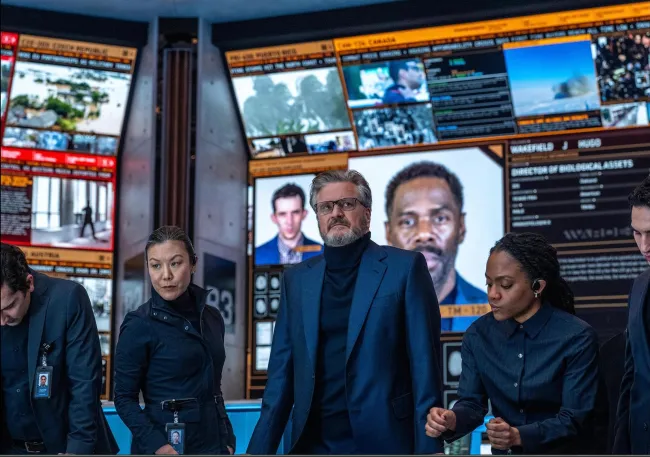
The first glimpse of the high-tech Wardex command center, which globally monitors classified intel about UFOs and extraterrestrial life on more than 300 screens, in Steven Spielberg‘s sci-fi conspiracy thriller Disclosure Day, brings to mind those fantastical James Bond sets created by the legendary production designer Ken Adam (Goldfinger, You Only Live Twice, Moonraker).
However, for the sleek, multilevel, cantilevered set built at Steiner Studios in New York, production designer Adam Stockhausen actually drew architectural and interior design inspiration from such real-world structures as the old AT&T headquarters in New York, NASA’s mission control center, images of military “war rooms,” train station hubs, and Japanese Brutalism.

“The initial discussions were just about the nature of the work that was going on there, and trying to make this exciting space for it,” explains Stockhausen, who previously collaborated with Spielberg’s Bridge of Spies, Ready Player One, and West Side Story, and, prior to that, won the Oscar for Wes Anderson’s The Grand Budapest Hotel.
The results are eye-popping with lots of reflective glass surfaces ironically defining the clandestine, sinister deep-state organization run by Colin Firth’s power-hungry Scanlon. He’s been suppressing the existence of UFOs (now called UAPs or Unidentified Anamalous Phenomena) and aliens for decades.

“A lot of what we talked about at first was the geography, the camera movement, and how, as scripted [by David Koepp], the cold room, the place where Scanlon does his [alien tech] diving, was its own place,” Stockhausen reveals. “It was a completely separate set. And we wanted, from the very first conversations, to say how we can bring this together, how we can make it a composite space where that room is actually the heart of the bigger surveillance headquarters space [below], which we called the big vortex situation room.”
Working at first with a digital model, Stockhausen and the art department team figured out the layout of this cold room and how you could also experience the main set while you were in this smaller set. “It’s this clinical space, very much like a combination operating room and pathogen lab,” he recalls. “So, in a sense, the room is a lab specifically for the handling and testing of the [alien mind control] device. And so that’s why the room exists.”
The design of the elegant alien device was handled by prop master Joel Weaver. After considering various metals and meteorites, they finally landed on durable Damascus steel, used in ancient swords and modern knives. Its shape ultimately became a six-inch hexagon, with a flared center and contours and textures that trick the eye.” In a sense, there’s nothing to it but there’s everything to it,” suggests Stockhausen. “It’s more complex than it seems and yet it can’t call too much attention to itself.”

The best use of the cold room, though, occurs when Scanlon uses the device to locate whistleblower Daniel (Josh O’Connor) by controlling the mind of his girlfriend, Jane (Eve Hewson), who’s hiding in a safe house. In fact, the room was designed to best serve the sequence.
“It was about placing the window correctly to reveal the bigger situation room beyond,” Stockhausen says, “so that when you’re going tight on Scanlon’s face and then pulling back out, you know you’re going to see it. And fitting that chair inside this room, so that when you go wide, you know how big you can go without losing the intensity and the focus on Scanlon. And you know exactly how many people are going to be standing around him.

“Once we have that, we focused on the shape of the room. Then we started beveling the room in to force the energy of all of this back onto the center so that the whole thing feels like a pressure cooker, with this huge steel door and strengthened, gusseted corners that are folded on this 45-degree angle to reinforce that it’s like a tiny bunker.”
Meanwhile, the geography of the situation room, which spanned 100 feet x 80 feet, had spokes and bays coming off of it in a baseball stadium-like left field, center field, right field configuration. It was a landscape of reflective surfaces on steroids, and the surface finish was of great importance to Stockhausen.

“We spent a long time working on it with our key scenic artist, Elizabeth Lin,” he reveals. “Should it be an automotive finish? Natural steel or some kind of natural metal? We kept looking and looking for the right thing because it wanted to be metallic. But I said the room had to be completely clean; we can’t age it. And yet I want to have life in it with movement and depth.”
After a lot of testing, Lin found a process that got very specific down to how the panels joined togethee. The material itself was a substrate of metal but completely painted, with medium-density fiberboard underneath.

“And the painting was a multistep spray of a lacquer with a thickness to it, which kind of floated as it cures,” Stockhausen explains. “And, as it cures slowly, it flattens and softens and forms this surface that kind of rolls the edges. Each individual piece was sprayed multiple times and there’s metal flake in the paint and different clear lacquers on top of that. And so you’re seeing the metal floating in a semi-transparent way over the top of the base paint.”
Then came the complex lighting for the very busy situation room. The set was lit with hundreds of LED strip lights for a cold glow, counteracted by the warm glow of incandescent lamps built into the ceiling. These could be adjusted as need by cinematographer Janusz Kamiński. Additional illumination was provided by drone lighting rigs.

In addition, all of the content and graphics seen on the screens in early scenes were provided by VFX studios Framestore and Territory five months prior to the start of shooting.The displays and playback were controlled in real-time via switchboard by 4Wall Entertainment in New York, overseen by VFX supervisor Matthew Butler. This was to match the action on set, so the actors could interact with or respond to the visual information as needed.
In effect, Wardex became its own special character. “It was really satsifying to see all of those basic geographical questions play out,” Stackhousen says. “I come from theater originally and it was like doing a live theatrical piece. So I knew we had to live in this space and the amount of performance and delicacy that was necessary to have this work. It’s so much more rich if the actors have the real world to resond to.”

