
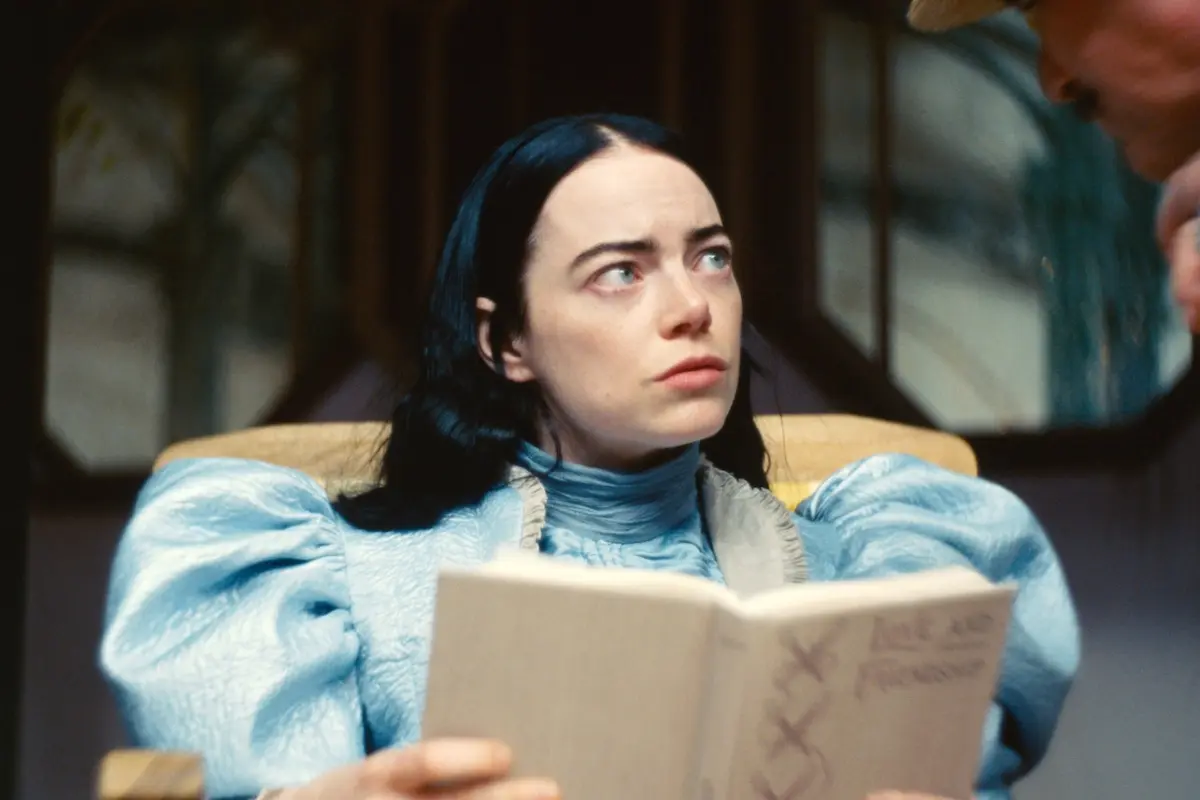
Poor Things began streaming on Netflix last weekend, which means even more people are watching this weird, wacky, and delightful 2023 movie from Greek filmmaker/certified madman Yorgos Lanthimos (Bugonia, The Favourite, The Lobster).
Written and directed by Lanthimos—adapted from Alasdair Gray’s 1992 novel of the same name—Poor Things stars Emma Stone stars as a formerly dead woman resurrected by a macabre scientist, Dr. Godwin Baxter (Willem Dafoe), who puts the brain of an infant baby in her head. It may sound like a bizarre premise, but critics and the Academy adored the film. It was nominated for 11 Oscars, and took home four wins, including best actress for Emma Stone.
Now that Poor Things is streaming on Netflix, audiences are diving into the strange world of this dark comedy. Poor Things is ultimately a feminist coming-of-age film, but we don’t blame if you get lost or confused along the way, given that that a lot of very weird stuff happens. Don’t worry, because Decider is here to help. Read on for a full analysis of the Poor Things plot summary and Poor Things ending explained, including the Poor Things movie meaning.

Poor Things movie plot summary:
The movie opens in Victorian London in the late 1800s, with a woman (Emma Stone) jumping off a bridge and taking her own life. The next scene finds that same woman in the home of a Frankenstein-esque-mad-scientist named Godwin Baxter (Willem DaFoe). He resurrected her recently-dead corpse with the brain of an infant. Godwin names his creation Bella. (And no, Poor Things is not all black and white—just the first 20 minutes.)
At first, Bella is clueless, naive, and baby-like. But her infant brain matures. She learns new words and learns about the world around her. Dr. Godwin’s assistant, a young medical student, Max McCandles (Ramy Youssef), quickly falls for Bella, in spite of (or perhaps because of) her condition. He asks Bella to marry him, and she says yes.
But Bella’s brain is still maturing rapidly. Her brain essentially enters the puberty stage, and she discovers sex and masturbation. A handsome but smarmy lawyer named Duncan (Mark Ruffalo) stops by Godwin’s house, and finds himself intrigued by Bella. He asks Bella to run away to Lisbon with him, and she accepts, after convincing her pseudo-father—whom she calls “God”—to let her leave.

For a while, in Lisbon, things between Duncan and Bella are peachy. She’s enjoying herself as a sexual being, and Duncan just so happens to be fantastic at sex. (Or so he says!) They stay at a fancy hotel, where a fellow guest seems to recognize Bella, referring to her as “Victoria Blessington.”
Duncan grows frustrated as he realizes he can’t control Bella’s behavior, and finds himself embarrassed by her lack of social grace, and jealous of her affection toward other men. In an attempt to control her, he smuggles her onto a cruise ship. Bella, angry that Duncan tricked her, avoids him and instead makes new friends with fellow passengers, Harry (Jerrod Carmichael) and Martha (Hanna Schygulla). Harry and Martha give Bella books to read, and introduce concepts of philosophy, debate, and morality. Bella is very moved by these ideas.
At a stop in Alexandria, Bella witnesses poor people in great suffering. She is so distraught, that she steals Duncan’s gambling winnings money, and asks a crew member to make sure the money gets to the poor people. The crew members promise to get the money to them, but it’s obvious they are going to steal it for themselves.
Without his money, Duncan is no longer able to pay for his passage on the ship. He and Bella are dropped of in France, without a penny to their name. Bella gets a job at a Paris brothel to help make ends meet, and Duncan is enraged that she would “whore” herself out. So Bella leaves Duncan behind.
Bella continues to work at the brothel under Madame Swiney (Kathryn Hunter), and befriends a fellow sex worker named Toinette (Suzy Bemba), and strikes up a romantic and sexual relationship with her. Toinette points out that Bella has a scar from a C-section, meaning she’s had a baby. Bella, who never knew about her former life, realizes Godwin lied to her.
Meanwhile, back in London, Godwin has created a created a new woman-with-an-infant brain, whom he names Felicity (Margaret Qualley). He’s much more cruel to her, not wanting to get attached to his “experiment” in the way he got emotionally attached to Bella. But his health is failing. When he realizes he is near death, he asks Max to find Bella and bring her home.

Poor Things movie ending explained:
Bella rushes back to London. In his death bed, Godwin finally explains the truth to Bella: She was a pregnant woman in her former life, who took her own life. When Godwin found the woman’s body, the baby in her womb was still alive. He surgically implanted the brain of the baby in the body of the recently-deceased mother. Bella is a combination of both mother and child, in one body.
Bella is angry, especially once she discovers Godwin and Max have created Felicity. But she forgives them. She decides to marry Max and become a doctor, inheriting Godwin’s surgery. But there’s one last complication. At Bella and Max’s wedding, a man named General Alfie Blessington (played by Christopher Abbot) shows up to object. He’s the husband of the woman Bella used to be, Victoria Blessington. With the help of the love-spurned Duncan, Alfie has tracked Bella down, and claims he has legal ownership over the body of the woman who was once his wife.
Bella, curious about her past life, agrees to go with Alfie, to the shock and surprises of Max and Godwin. Bella learns that Victoria was a cruel person who enjoyed tormenting the servants, alongside the equally cruel Alfie. Had Victoria lived, and Bella been birthed the normal way, she would have grown up with two cruel, abusive parents.
Alfie informs Bella not to leave his house. If she tries to leave, he’ll shoot her in the head, he promises. Bella realizes Alfie is just another man trying to trap her. She overhears Alfie’s plans to have a doctor remove her clitoris, and that they had tried to do that to Victoria before her. Bella realizes Victoria must have taken her own life to escape Alfie.
Bella drugs Alfie with the chloroform meant for her by tossing her drink in his face, and shoots him in the foot with his guns. She drags his dying body back to Godwin’s surgery, where she transplants the brain of a goat into his body. Like father, like daughter!
She returns to Godwin’s side at his death bed. As he dies, Godwin comments that, “It’s all very interesting. What’s happening.” He died with the curiosity of scientist, a trait he has passed on to Bella. In the final scene of the movie, Bella studies for upcoming anatomy exam, with Toinette by her side, experimental animal creations running around the garden, and Alfie the goat eating grass.

Poor Things movie meaning:
Underneath all the bizarre, wacky weirdness in Poor Things, there is a simple, feminist message: no man can control Emma Stone. At the beginning of the movie, Bella has the mind of a toddler, she has the body of a grown woman. Her first love interest, Max, is a sweet guy, but he clearly relishes the idea of caring for what he perceives as a very pretty, entirely helpless child.
Bella, who is maturing quickly and recently experienced her sexual awakening, has no interest in being the object of Max’s doting care. She’s visibly disappointed when Max promises not to take advantage of her. When Duncan (Mark Ruffalo) offers her freedom, she happily accepts, and runs off with Duncan. Though he’s disappointed by her departure, Godwin seems to understand Bella better than the other men in her life. He understands that he can no longer control her.
Things sour with Duncan when he realizes, like Max before him, that he simply cannot control Bella. She will do what she pleases, go where she pleases, and dance wildly with whom she pleases. In an attempt to tighten his chauvinistic leash, Duncan forces Bella onto a ship at sea. Surely now, trapped on this boat, she will be his to contain.
But Bella finds her freedom still, this time in the world of books and learning. Duncan aided in her sexual awakening, yes, but now she’s ready for her intellectual awakening. For this, she turns to Harry and Martha, who introduce concepts of philosophy, debate, and morality. Duncan is incensed, of course. How dare Bella give her attention to anything that isn’t him?
“The more autonomous she becomes, the more challenged these men seem to be by it,” Stone said in a behind-the-scenes interview for Rotten Tomatoes.
That is, when it comes down to it, the thesis of the film. Bella cannot, and will not be controlled by the men in her life. That doesn’t mean she won’t forgive some of the men in her life for trying—she loves her father, despite what he’s done to her, and she makes amends with sweet Max—but she does so on the condition that they let her be her own person. Men have been trying to control women for centuries. But at the end of the day, control is not love. And that’s the lesson Bella Baxter and Poor Things hopes to teach to the world.
