
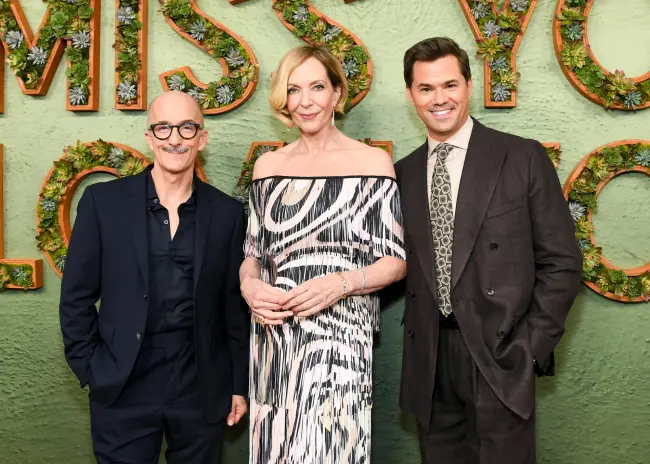
Oscar winner Jim Rash makes his solo directorial film debut with HBO‘s Miss You, Love You, a dramedy about grief and connection.
The original movie stars Allison Janney as Diane, a grieving widow who is forced to plan her husband’s funeral with a total stranger: her estranged son’s assistant, Jamie Simms, played by Andrew Rannells. Bonnie Hunt also stars as Judith Bibbs, Diane’s nosy neighbor and friend from church.
For Rash, the project hinged on its star’s involvement. If Janney had said no, Rash would have responded, “Oh no, it’s over!” But the seven-time Emmy winner agreed to portray Diane, and the rest is history. “Once you have her to your party [she appeared in The Way Way Back, co-directed by Rash and Nat Faxon], you pretty much want to invite her to all of them,” Rash tells Gold Derby. “I’m so lucky”

As for Rannells, “Knowing that this was going to be an exhausting, almost theater-like experience of shooting, he first came to my mind,” explains Rash, who won his Oscar for co-writing The Descendants. Miss You, Love You filmed over 17 days in and around Albuquerque, N.M., and the actors came prepared: “They knew it backwards and forwards, which was very beneficial to me.”
Read on for our full interview with Rash, including how he brought his original story to the screen, and why he didn’t opt to cast himself in Miss You, Love You. The project is eligible at the 2026 Emmys.

Gold Derby: How important is it in today’s climate to have an original story and not something that’s an adaptation or based on IP?
Jim Rash: It’s certainly harder to get them out there sometimes. This started as an unproduced play, just in my own mind. It’s important for these types of stories, which don’t have a title that’s identifiable, to crack through. At this particular time, it’s important. It was born out of something, and we’re all going on this special journey with it, outside of a known commodity.
How long ago did you first get the idea for the play, and why was now the right time to make it as a movie?
A group of friends started one of those accountability-type writing groups, and we were meeting for a while, and it was joyous. You know, you take turns reading each other’s stuff. And then the pandemic hit. When I was inside and theater was closed down, I thought I would take it and turn it into the movie version of it, had it been produced as a play. That’s how that got started.
If Allison had said no to this project, how would you have reacted?
“Oh no, it’s over!” [Laughs] She’s fantastic, always. I met Allison many years ago, way before all of this, not when I first got to L.A., but close. It was through mutual friends, and I just lucked out. Nat Faxon and I cast her in The Way Way Back, which she was glorious in. Once you have her to your party, you pretty much want to invite her to all of them. We’ve tried on other things, and this one just sort of lined up, and I’m so lucky.
What did she bring to the role of Diane that nobody else could have?
Diane, especially when we understand where she’s starting, is prickly and upset and filled with stuff that we start to unpack and unravel and see the context of. It is beautiful when characters come at us one way, and then once we start to understand why they’re the way they are, we find sympathy and empathy for them. With Allison, she’s just got this innate ability. Whether it’s I, Tonya, or just name any movie, she embodies it. There’s this part of her that creates these characters that you are enjoying the hell out of, even though they are caustic or hard. It’s something that generates from underneath her, and it’s hard to explain.

Let’s talk about Andrew Rannells. What made him the right person for the role of Jamie?
I didn’t know Andrew outside of enjoying and being a fan of him from afar. Knowing that this was going to be an exhausting, almost theater-like experience of shooting, he first came to my mind. There are so many actors, obviously, who have a theater background, but there’s something that’s embedded in Andrew. I thought this would be a surprising other layer to how we know him, so it felt like the right type of person for Jamie. Not that many of us probably know how it feels when we tumble into love with somebody who doesn’t return that, but I felt like he could wear that.
What was the rehearsal process like before filming began?
We only had 17 days to shoot this, so we didn’t have a ton. They came prepared. They knew it backwards and forwards, which was very beneficial to me. Obviously, there’s room for discovery. We had a couple of days in the house before we started shooting to run those larger scenes. It was almost as if we were doing it on the stage. In the mornings, we’d try to go through a quick review of it. But for the most part, it was pretty much maybe a couple of days in that house. Everything was them pre-preparing themselves.
As the writer, was there ever a version of the script where we got to meet Diane’s son, or was that always going to be a character we only heard about?
No, it was always off-camera. It would change the dynamic of the movie. I’m not saying you couldn’t write that movie, but I knew pretty early on that I wanted that sort of a “Tell-Tale Heart,” that beating use of the ding to agitate Allison’s character. I knew pretty early on this was really about a conduit story of a mother and son, and everything was linked towards this person that we don’t meet. They get to color how we know him, which is maybe unfair to Tyler, but it’s not his story.
What was the most challenging scene to film as the director?
They made things easy. It was difficult, real estate-wise, to get the large fight done. I think we only had two or three days, and it’s a lot of pages. That was challenging to make sure we get it and allow them the time. Schedule-wise, the church was probably the most difficult, because you had one day in that church, and there was a lot to shoot, and that’s the most people we ever had, as far as background and regulars. Sometimes it was just the ticking clock.

Bonnie Hunt had a small role, but a memorable role. Tell us about casting her.
There were so many reasons she was perfect. I met Bonnie during the pandemic on Zoom with a group of friends playing Mafia. We all played throughout that time, and then would have games in person once we could. When I was thinking of Judith, she was already immediately in my brain as an incredible comedic talent, improviser, writer herself, and just incredibly smart. She’s a good character actress who knows how to play a character that’s a little higher than life, but keeps her on the ground.
What was the vibe like on set? There’s some serious subject matter in this project.
It was light-hearted in the sense that those two and the crew and everybody were all on the same page. We had 17 days to do this, all squeezed into a house. The dinner party, as far as inviting all the right people, worked out perfectly. Those two got along right away. They didn’t know each other more than casually and socially, so they were doing bits pretty fast. On the emotional days, Allison’s tendency is to want to take herself into an area and be on her own, and then come to the table and do it. The big days when we were doing some of the more emotional things, like the monologue about her husband falling, that was the only time when I thought, “Let’s get through this. It’s a lot of heavy lifting today.” But for the most part, we were able to shake it off between takes.
Do you pay attention to critics’ reviews or fans’ comments, or do you try to avoid all of that?
It’s inevitable that you want to glance at all these things. For the most part, I feel I’m pretty healthy with it, because I understand that’s what you sign up for. You put something out there, and there’s going to be reactions on both sides: mixed, somewhere in between, great, terrible, whatever. Maybe it’s because of my time on The Groundlings when you joyously would bomb in a sketch and think, “Oh my God, there was so much silence, they hated me.” But then it becomes like an anecdote. For the most part, I can navigate it to the best of my ability.
Did you ever want to be in Miss You, Love You on camera?
There wasn’t anything that I really could play, you know? While a lot of me is in the writing of Jamie, that wasn’t what I wanted to do with it. I wanted to concentrate on the directing side of it, doing it my first time solo. Nat Faxon and I obviously will continue to do things together, but he was gracious enough to let me do this one alone, and he was a producer. I got so much stress from being in The Way Way Back, because Nat and I played parts. I don’t know if I’m there yet. I’m not the great Ben Stiller, being able to do both at the same time. I’d be too hard on myself. I’d tell myself to get better after each take.
This interview has been edited for length and clarity.
