
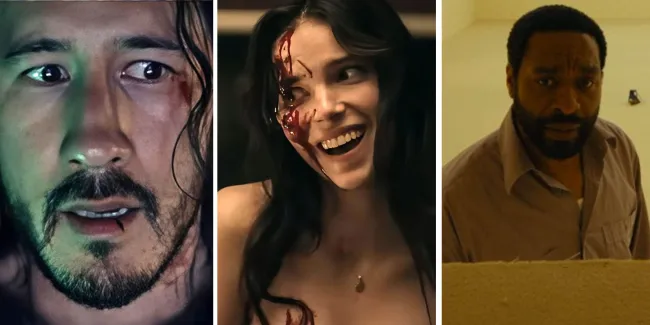
Young Hollywood wants to scare you — and the theatrical box office is proving it.
Back in January, the indie horror phenomenon Iron Lung made over $51 million from multiplexes. And as you’re reading this, the Focus Feature phenomenon Obsession has already made more than $75 million at the global box office since it premiered two weeks ago. Next up is A24’s Backrooms, which is projected to land in theaters this weekend with a $30 million-$50 million dollar debut.
And here’s another frightening fact about all three titles: They all began on YouTube.
Iron Lung was self-financed and released by YouTuber Mark “Markiplier” Fischbach, who is known for his gaming content on the platform. Meanwhile, Obsession hails from 26-year-old content creator Curry Barker, who is known for his sketch horror and comedy duo “That’s a Bad Idea.” And Backrooms is an offshoot of a viral web series overseen by 20-year-old Kane Parsons, who released his first short found-footage tour through those eerie environments in 2022.

While Markiplier and Parsons haven’t announced their next moves yet, Barker is already booked and busy. His next feature film, Anything but Ghosts starring Aaron Paul, is already cooking, and he’s been tapped by A24 to write and direct the upcoming Texas Chainsaw Massacre reboot. It was also recently reported that Barker was being offered $10 million for his next movie from an undisclosed studio, suggesting that executives are eager to work with these young filmmakers.
Gold Derby spoke with several experts about why this crop of horror from YouTube creators are resonating with young audiences, as well as what it means for the future of the awards season and the film business as a whole.
The YouTube-to-multiplex pipeline
According to research from Gen Z insights firm YPulse, the majority of teens and young adults identify as horror lovers. At the same time, YPulse’s celebrities and influencers report found that the majority (83%) of 13- to 24-year-olds are interested in seeing online celebrities in more traditional content like TV series and movies.
Tori D’Amico, managing content editor for YPulse, tells Gold Derby that Hollywood has sometimes unsuccessfully worked with influencers or content creators to star in movies. Putting them behind the camera has proven to make more sense since they’re already used to filming videos on their smartphone for short-form platforms like TikTok, YouTube Shorts, or Instagram Reels.
“Realistically, Gen Z audiences know a person doesn’t have to be in the movie to be the most interesting part of the movie,” D’Amico observes. “When they hear a creator is making a movie, they’re going to follow that process because the person involved. Being behind the camera is much more interesting — and proving to be — a more successful choice.”

D’Amico adds that that comfort of using social media means that creators are also used to making more high-quality content on less of a budget. And as Roger Corman and John Carpenter proved back in the day, horror is traditionally a perfect genre vehicle for emerging filmmakers to experiment with low risk and high reward. Of the current crop, Obsession was made on a reported budget of $750,000 and produced for $1 million.
Dr. Steve Schlozman, a child psychiatrist and associate professor at the University of Vermont Health, and author of The Zombie Autopsies: Secret Notebooks From the Apocalypse, notes that the props and settings involved with most horror productions are inexpensive or, in some cases, free.
“Empty places are cheap,” Schlozman says. “You can go to the countryside and there might be an old house and if no one’s looking, you can make your movie.”
Sign o’ the times
D’Amico says that the trio of Iron Lung, Obsession, and Backrooms are resonating with young fans because the filmmakers are exploring themes that connect with that generation. For example, Barker’s film — which follows a hopeless romantic (Michael Johnston) who wishes for his crush (Inde Navarrette) to fall in love with him — explores the fear and anxiety around modern dating in addition to serving up plenty of gory scares.
“There’s all these different perspectives constantly coming out in headlines about why Gen Z doesn’t have a dating life,” she notes. “Whether it’s that they’re afraid people will judge them, that asking someone out feels way too high-risk socially, because they just don’t think the relationship is going to be worth their time, or they’re protecting their peace.”
Iron Lung and Backrooms are set in liminal spaces, which D’Amico says reflects young people’s feelings of isolation and feeling trapped due to the COVID-19 pandemic and the current state of the world. While the Backrooms first emerged in the early 2000s, it became more popular across the creepypasta and 4chan communities in 2019 and the aesthetic saw a resurgence during the pandemic lockdowns.
“That feeling of being trapped is so tension-inducing and makes for a perfect horror movie setting,” D’Amico remarks.

Coltan Scrivner, PhD, a psychologist and author of Morbidly Curious: A Scientist Explains Why We Can’t Look Away, says horror has always reflected what’s going on with the current generation of moviegoers.
“Horror stories are memorable because they reflect the anxieties often in that generation whether it was teens in the ‘50s and ‘60s,” Scrivner explains. “Right after Roswell, World War II and the atomic bomb, there were 15 years of extraterrestrial and nuclear apocalyptic worlds that became popular in film.”
Slashers like Halloween and The Texas Chainsaw Massacre were popular in the 1970s and 1980s because of the uptick in serial killers and tabloid-amplifying murders. With this generation, Scrivner says that liminal spaces represent the environments where people used to gather — like malls — and have since become abandoned, which is why they seem nostalgic to younger audiences.
“People in their 30s and older remember malls as still thriving and a place to go,” he notes. “For younger people, liminal spaces also represent this forbidden or closed off place that they are not allowed to go to.”
But Schlozman emphasizes that a successful horror movie is also about good storytelling as opposed to purely the time period. “You write for the time in which you’re telling the story, but it doesn’t have to be during the same time,” he observes. “Plenty of Gothic horror films that have come out have been reflective of the time in which the movie was made rather than of the Gothic period itself.”
It’s no secret that horror movies have often been sidelined when it comes to the Academy Awards. While films like The Exorcist, The Silence of the Lambs, and The Sixth Sense have broken through in the past, it’s still a genre that struggles for recognition.
But that’s started to change in recent years. Jordan Peele’s Get Out won the Best Original Screenplay statuette in 2018. Coralie Fargeat’s The Substance received several nominations in major categories at the 2024 Oscars, including Best Director and Best Actress for Demi Moore’s performance, and took home the prize for Best Makeup and Hairstyling. And earlier this year, Amy Madigan won Best Supporting Actress category for Zach Cregger’s Weapons — the first horror winner in that category since Ruth Gordon in Rosemary’s Baby way back in 1969.
The repercussions of Madigan’s win are still being felt. One look at social media reveals that Navarrette’s performance in Obsession has quickly become so beloved that many fans and critics are calling for her to be nominated for Best Actress at the 2027 Oscars. And while Barker, Fischbach, and Parsons aren’t being eyed as serious Best Director candidates, there will come a day when a filmmaker who got their start on YouTube ends up in Oscar contention.
Scrivner notes that studios like A24 working with directors like Parsons is a positive sign for young creators and audiences alike. “It’s an example of how you can find incredible success without following the traditional path in film,” he says. “These are people who are not traditional filmmakers and it’s really fascinating for a younger audience to see and learn from — and for people — in general.”

But these filmmakers are still facing some skepticism for their non-traditional origins. In the run-up to the release of Backrooms, online discourse ran rampant about whether Parsons actually directed the film, leading actor-director Mark Duplass — who has a small role in the movie — to come to the young director’s defense.
Myles McNutt, associate professor of communication and theater arts at Old Dominion University, said he is concerned that those conversations are reductive to young creators and filmmakers in the industry.
“So much has changed in terms of theatrical marketplace and audience behavior,” he explains. “We saw the massive success of that [self-distribution] initiative and a clear sense of betting on yourself and making that happen. What we’re seeing in these other circumstances are young creators who are building in that space of YouTube but then seeking opportunities in the studio environment of wanting to become directors.”
“We’re going to have to get used to it because the next generation of directors are going to have access to the tools, access to distribution, and access to the right audiences, especially in horror as a thriving genre built on discovery,” McNutt continues. “This is where directors were always going to come from. They weren’t only just going to come from film school. If we don’t get used to that, we’re limiting ourselves in terms of what can be created.”
McNutt also says that with the Oscars migrating to YouTube in 2029, it might put more pressure on Academy voters to better understand the space they’ll be operating in.
“It goes against everything that the Academy Awards have historically been for,” he observes. “Which is who matters enough to decide what type of films are taken seriously, and the notion that they are now going to be in the very space that is challenging that, is something these films bring to the surface. We’ll see come 2029 whether both — or neither — of these filmmakers have produced something that could help spark that conversation when it’s most integral.”
