
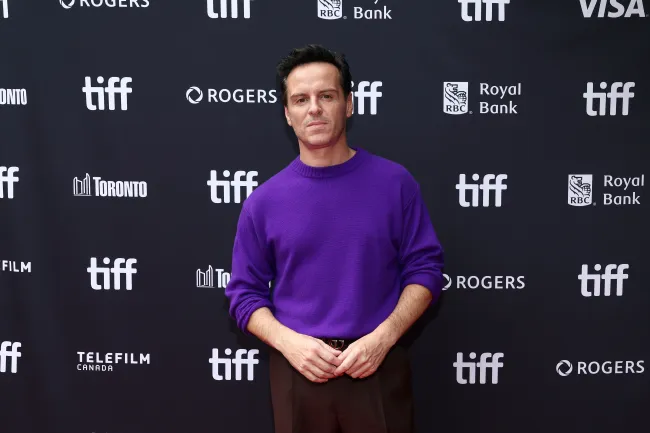
As one might expect from his riveting screen performances, Andrew Scott has a lot of layers to his career and his approach to acting.
He peeled back some of them for a packed house at Toronto’s Royal Alexandria Theater at the 51st Toronto International Film Festival on Saturday. Scott was there for the Canadian premiere of Elsinore, which recently had its world premiere at the Telluride Film Festival, where Scott drew instant Oscar buzz.
In the film, Scott plays Ian Charleson, the British actor who stepped in for Daniel Day-Lewis in a 1980s production of Hamlet. Charleson was dying of AIDS while taking on the beast of the role, arguably one of the most difficult in theater history.

The project marks Scott’s first outing as a producer, a choice he said he made because of his passion for Charleson’s story and a fear that someone else might get it wrong. The film comments on many of the things that Scott holds most dear, particularly the community of the theater and the sense of found family it can provide.
Here’s six things we learned about Andrew Scott from the conversation.

He discovered acting through speech lessons
Though now beloved for his lilting Irish brogue, Scott had a very strong lisp as a child. His mother sent him for elocution lessons when he was just 7 years old. The lessons were through a speech and drama program, and it was there that Scott first encountered acting.
“You were able to improvise in front of other kids and say poetry, do extracts,” he said. “Something just happened to me when I was doing it, and I sort of fell in love with that. Acting amplified something that I thought was dormant. For that reason, I’ve always associated acting with playing.”
Scott didn’t go to drama school or receive formal training, so he points to these courses and his childlike sense of play as his “method.”
He thought he’d be fired from Sherlock
Many viewers first discovered Scott on BBC’s Sherlock, in his numerous guest star appearances as Sherlock’s rival, evil mastermind Moriarty, opposite Benedict Cumberbatch. But Scott, who now proudly proclaims, “I don’t have the internet,” learned the hard way not to read the comment section.
“It was my first experience with public opinion,” he explained, “Twitter was very popular at the time, and you could read it, and they said some mean s–t. Really terrible, awful s–t.”

Scott said the comments were so harsh that he started to believe the show would recast the role and replace him.
While he believes that wanting to read what others write about you is part of human nature, he said the experience made him realize how much of it is just noise. “You learn it doesn’t really matter,” he said. “I did still work. I didn’t get recast. Everything turned out to be OK. You learn to give it less power.”
Fleabag let him get romantic
Scott has a self-described “romantic nature,” but for a time, he feared he’d never get to do the type of romantic comedy he longed for.
Until his former colleague Phoebe Waller-Bridge reached out to him about playing a priest on the second season of Fleabag.
“I was yearning to play someone that was nearer myself,” he explained, after having risen to fame in a string of villainous roles. “I really love romantic comedy. I have a romantic nature and just to be able to express that in some way, it’s wonderful.”
Scott had come out publicly a few years before, and he worried it might prevent him from booking certain types of characters (namely, straight male love interests). “There was a fear I wouldn’t be able to be cast in those roles,” he said. “It was in no way typical for me to play those parts.”

But he believes that narrow-minded casting approach stems from one that assumes the audience is stupid and unable to suspend their disbelief. Something he said he observed was very obviously not true while working in theater and talking to audiences at the stage door.
“People aren’t going to go, ‘Oh my god, the hot priest is gay,'” he continued. “We don’t go to see Batman and go, ‘Oh my god, I can’t believe he’s not a bat!’ You willingly go to a theater to see a story.”
He had to relearn all of Hamlet’s soliloquies for Elsinore
Hamlet and his lengthy soliloquies are a bear for any actor to learn, but imagine having to do it twice. That’s what Scott faced taking on the role of Ian Charleson in Elsinore. Scott previously portrayed Hamlet on stage in London; he gave 150 performances. But he still had to relearn the melancholy Dane’s speeches specifically through the lens of Charleson’s eyes.
“One of the difficulties was trying to unlearn the stuff I had learned,” he explained. “I had to learn all of the soliloquies again, and to try to learn them with what his thought process would’ve been.”

Charleson’s doctors advised him not to take on the role of Hamlet for the sake of his health, and throughout his experience of playing Hamlet, he grappled with his own mortality. Elsinore explores Charleson’s desire to choose a quality of life, rather than merely extending the quantity of it.
Scott said that playing this part has deeply reshaped his own relationship to how he thinks about time. “It doesn’t end well for any of us,” he said. “That’s just the truth. So, why don’t you just pay attention to the things that make you really, really happy? Try to enjoy life.”
Still, in telling Charleson’s story and focusing on his immense courage in this moment, Scott also wanted to take care to “not fetishize his death but celebrate his life.”

He wants to be in a musical
Scott was asked about what type of project he hasn’t done yet that he would like to tackle. “I’d love to do a musical,” he replied. “I just don’t have any confidence in myself as a singer.”
He favors big-budget, splashy musicals with a large dance ensemble. Think classic MGM fodder with a kickline. Though his primary request would be to play a part where he could act-sing (in the vein of a Henry Higgins or Harold Hill).
He has more dream Shakespeare roles
Elsinore brings Scott back into conversation with Hamlet, which is the dream role for many actors. But he still has several Shakespearean roles remaining on his bucket list. He’d like to play Iago in ‘Othello,’ (which I think we can all agree would be brilliant).
He also expressed interest in playing Benedick in Much Ado About Nothing, indulging his love for romantic comedy. Then, there’s the Richards, both the II and the III.
While the awards season circuit is sure to keep Scott busy for the next several months, hopefully, for his next venture, the play’s the thing.
