
When it comes to the Toronto International Film Festival, 51 is the new 50. Last year’s landmark Golden Anniversary edition of TIFF allowed the annual event to take stock of its five-decade journey from being a hometown celebration for movie buffs to a major international hub for global cinema.
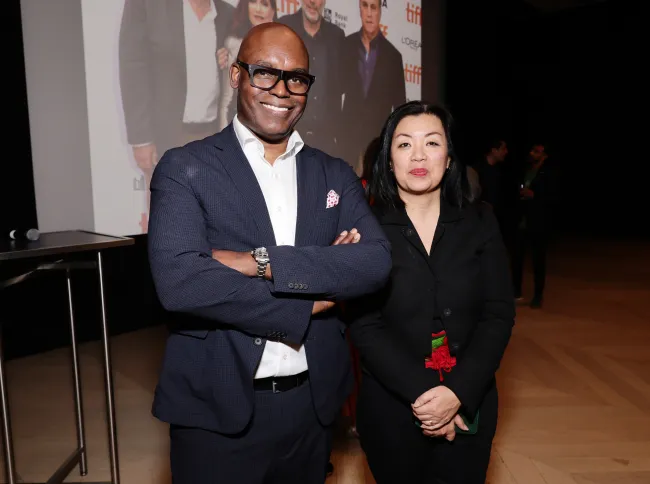
Heading into its 51st year, though, TIFF’s longtime CEO Cameron Bailey and the festival’s chief programming officer Anita Lee knew that they had to turn the page forward, not backward. “This year is about us looking forward into the future,” confirms Bailey.
In a conversation with Gold Derby, the duo peer days into the future and share five things to look out for as TIFF 51 gets underway on Sept. 10

The doctor is in

Asked to identify any specific themes that they see emerging out of a program that boasts nearly 300 titles, Bailey says that “accessibility” is an idea that runs through many of this year’s offerings. And that starts with the opening-night selection, Siân Heder’s Being Heumann, a biographical drama about pioneering disability rights activist, Judith Heumann, that was filmed in Toronto.
“It’s such an energizing ride,” Bailey raves of Heder’s follow-up to her Best Picture winner, CODA. “We’ve also got Man in Motion, a great documentary about Rick Hansen, the Canadian athlete and disability rights activist. There’s Run Terry Run, which has hours of new footage with marathoner Terry Fox. And Onwards and Sideways is a great drama about two characters played by Rhys Ifans and Laura Linney who are dealing with Parkinson’s. All of those films converge on being about what happens when the world around us is no longer suited for how we have to move through it.”
For her part, Lee teases that the programmers have noticed an unexpected theme coursing through this year’s selections — surgery. “I’m just going to leave it at that,” she teases with a laugh. “But I do feel it’s a little more connected to the fact that we have more genre films in the festival this year, as well as more of the young filmmakers who are working in that space.”
Chalk that up to the “Obsession Effect.” Last year, Curry Barker debuted his horror blockbuster at TIFF where it was snapped up by Focus Features and became one of the defining hits of this past summer. Both Barker and Best Actress-bound star Inde Navarrette, will be back in Toronto this year for a celebratory panel and special screening. Warning: you may have to use your own One Wish Willow to score a ticket to either of those events.
Representation matters

Speaking at the Venice Film Festival recently, main competition jury president and filmmaker, Maggie Gyllenhaal, spotlighted the paucity of female directors on the Lido, and elsewhere on the fall festival circuit. “[It’s] a systemic problem,” the director of The Bride! noted.
But it’s arguably less of a problem at TIFF, where the work of female filmmakers account for 35% of the program. “I don’t think 35% is good enough,” Lee emphasizes. “But it is a slight increase from previous years, and that’s very intentional.”
“We were one of many organizations that signed a 50-50 pledge many years ago that included many different things,” Bailey echoes. “We’re always looking for great movies directed by women, but it goes beyond that. It’s also about who is on our stage speaking as an industry expert or as part of a talent program. We’re always making sure that at least 50-percent of them are women.”
Besides Being Heumann, Bailey and Lee point to films like Rachel Morrison’s Love of Your Life, Courteney Cox’s Evil Genius, Rebel Wilson’s Girl Group and Rebeca Huntt’s Rapinoe as examples of putting the women of female directors front and center. “We’re looking to do that in a very intentional way,” says Bailey.
To market, to market

The festival’s future will be defined, in part, by the introduction of TIFF: The Market, a full-scale marketplace in the vein of the famed Marché du Film at Cannes. Bailey says that over a thousand delegates will be making the journey to Canada this year and filling up nearly 100,000 feet of exhibition space in the Metro Toronto Convention Center.
“It’s going to be a really hopping place for the people who are coming to do business to meet fellow professionals and to advance their own work in the industry,” Bailey notes, adding that the Market will feature its own suite of programming and live events featuring notable guests like Slow Horses star Gary Oldman, Ink director Danny Boyle and Warner Bros. executives Pam Abdy and Michael De Luca.
“There will be talks, panels, talent development workshops, labs, and an immersive space as well for really innovative new media as well,” Bailey enthuses. Lee notes that TIFF is also launching its first-ever project market, which will facilitate meetings between producers and financiers. “These are decisions makers and mentors that are being brought in specifically to support the project market selections and other programming,” she says.
Hollywood ending

One of the dominant narratives this year from Cannes to TIFF has involved the films that aren’t showing up at the major film festivals: star-powered productions from the legacy Hollywood studios. Once upon a time, movies like Sony’s The Social Reckoning or the trilogy-capping Dune: Part Three from Warner Bros. would have included a red carpet festival premiere as part of their release strategy, but those days appear to be behind us… for now, at least. (Notably, the first entry in Denis Villeneuve’s Dune franchise played both Venice and TIFF when it was released in 2021.)
“There’s always a transition in terms of the players that are most active in the festival world,” Bailey says of that shift. “Studio presence has gone up and down, but studios also aren’t just the big umbrella companies, but the specialty arms as well.”
So while Sony and Warner Bros. may be sitting TIFF out this year, Sony Pictures Classics is bringing several films to Toronto, including Sundance acquisitions Ha-Chan, Shake Your Booty! and Bedford Park. Meanwhile, Sony’s music arm, Sony Music Vision, is world premiering the documentary Always Lalisa about the Blackpink fan favorite. As for Warner Bros., the studio’s newly announced specialty arm, Clockwork, will be on hand to screen a remastered version of Ken Russell’s still-controversial 1971 cult film The Devils.
“We’re still engaged with the studios,” Bailey says. “The landscape is changing all the time, though.”
Do you hear the people vote?

One legacy studio that is going to be in Toronto — albeit in its updated form — is MGM, which is now part of the fledgling streaming-studio business that is Amazon MGM Studios. After screening Hedda and John Candy: I Like Me at TIFF last year, this year’s Amazon MGM offerings are a pair of crowd-pleasers with serious awards ambitions: Peter Farrelly’s I Play Rocky and Bassam Tariq’s Your Mother Your Mother Your Mother starring two-time Best Supporting Actor winner, Mahershala Ali.
Don’t hold them to it, but both of those films happen to be among Bailey and Lee’s early predictions for what could win TIFF’s coveted People’s Choice Award, an honor bestowed on such past Best Picture nominees as Hamnet, The Fabelmans, and Farrelly’s own Best Picture-winning Green Book.
“We think those will be huge surprises coming out of TIFF,” says Lee, who also cites Chris Rock’s Misty Green and Simon Stone’s Elsinore as awards contenders to watch. She’s also anticipating that one or more titles from the Platform category — the winner of which will automatically qualify for the Best International Feature category per a recent rule change — will find their way into the conversation.
“There’s a film from India called Angh in the Platform section that has images it that I’ve never seen before,” Bailey marvels. “It’s shot in a region where they don’t make films, so it offers something really unique and the audiences who get to experience it first is something I’m looking forward to hearing about.”
Bailey also has his own dark horse pick for the People’s Choice prize, and it’s about as Canadian as you can get: Matthew Rankin’s impressionistic political documentary, Ladies and Gentlemen, Brian Mulroney, about the rise of the country’s 18th prime minister. “It might look very local, but there’s an artistry and expertise I think people will admire,” he says. “It’s delightful, fun, and very educational.”
