
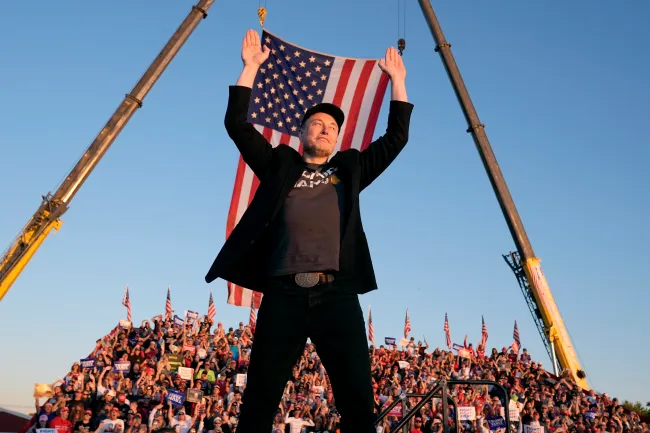
Despite its nearly four-hour runtime, Alex Gibney’s new documentary, Musk, is never slow. Elon Musk himself might even like the segment about his founding of SpaceX. When the company’s third rocket fails, and they go for a fourth launch with no more money in the coffers, I daresay you’re rooting for the guy. Of course, there’s not much more of that.
One of Gibney’s most successful theorems is that the richest man in the world likely believes we all live in a simulation. In Musk’s simulation he is the first-person shooter and everyone else is an NPC — a “nonplayer character” in video game parlance. Thus, we are either helpmates or obstacles and it doesn’t really pay for him to have empathy either way. In fact, empathy is irrelevant.

Gibney’s film also points out that Musk — whatever you think of him — did run two massive, exploratory companies, Tesla and SpaceX, simultaneously. Although the filmmaker also has footage of Musk admitting that he spends most of his time on his aerospace concerns and much less on his once-popular electric car.
Because Musk proclaimed Gibney’s doc a “hit piece” during its production, he did not agree to be interviewed. In his place, the filmmakers have created a Musk avatar who says things that the real man said. The avatar’s head is huge and looksmaxxed, while its arms are atrophied and shortened. Musk’s real-life pronouncements sound even more wild coming from the avatar — but only just.

Instead of a tech titan, or what his fans call “visionary genius,” Gibney strives to convince us that Musk is little more than a confidence man. Musk insisted he was a founder of Tesla, but the film instead reveals that he kept failing upward in the organization. That section of the film reminded me of Francis Ford Coppola’s 1988 film Tucker: The Man and His Dream. And if you ever watched the 2006 documentary Who Killed the Electric Car?, you also know that we’re driving EVs because of Musk’s persistance… as well as his flimflammery.
The latter half of Musk deals with his support of President Donald Trump and the creation of the Department of Government Efficiency or DOGE, a cost-cutting effort dreamed up by Musk and the incoming Trump administration. As the documentary makes clear, DOGE failed almost as quickly as it started, but not before bulldozing into 22 of the regulatory agencies who were investigating Musk’s various companies.
DOGE specifically fell apart when Musk recoiled at Trump’s so-called “Big Beautiful Bill,” which the once faithful soldier plainly saw as representing more government overreach and overspending. Musk later went on to claim he was starting the “America Party,” a third party to challenge Trump. Whatever happened to that? It’s also worth noting that Gibney doesn’t include Trump’s Truth Social posts excoriating Musk when he turned against him.

It’s a shame that too much time is spent on the weakest element of Gibney’s documentary, animated segments that resemble a first-person shooter game where Musk’s hands sometimes emitting rays that vaporize other figures onscreen. It goes on too long, particularly since there was so much more to cover.
While Musk himself wasn’t interviewed, Gibney does speak with his first wife, Justine, and gives a surprising, if brief, emotional hook to the Musk of old. She chokes up recalling their early days when they would get books and just quietly read together. The most lacerating interview is with Ashley St. Clair, who delivered Musk’s 13th child. The one-time conservative influencer rejected a $40 million non-disclosure agreement to be able to participate in documentaries like this one.
St. Clair gives us plenty of reasons to fear Musk’s influence on the global stage, including the suggesting that he knew the outcome of the 2024 election before it had been announced, the fact that he essentially has 10,000 lasers in space pointing at Earth, his insistence on colonizing Mars, and his continuing erratic behavior. She sums up the feeling you get after watching Musk: “Elon is a nuke.”
