
It was the summer of 2020 when writer-director Marie Kreutzer (Corsage) read an article in the German newspaper, Die Zeit, about an investigation into a big ring of criminals suspected of pedophilia and child pornography. It shook her deep to her core. And she did the math based on the horrendous the statistics. “I just realized that I must not only know victims of child sexual abuse, but also perpetrators. Statistically speaking, there’s no other way,” she tells Gold Derby during the Telluride Film Festival, where her stunning feature, Gentle Monster, is continuing its festival run after its Cannes premiere last May, when it was acquired by Netflix.

We are having this deep conversation about her latest movie on a shuttle bus, taking us through some narrow mountain roads with stunning views as the backdrop, peaceful and tranquil. Every now and then, Kreutzer stops to admire the scenery, take a photo of the imposing trees, or greet the region’s elk in excitement like the rest of the festival attendees in the vehicle. The purity of nature around is almost instantly in deep contrast to her unsettling movie inspired by that newspaper article. The story is chiefly about a musician, Lucy, (the great Léa Seydoux in the Oscar conversation for her disquieting performance), coming to terms with the fact that her husband, Philip, might have committed some unspeakable crimes. Did he really? And how could Lucy best protect her young son and maintain some semblance of order in her life? Elsewhere, a young police officer, Elsa (Jella Haase) is tasked with investigating Philip’s case while going through her own share of patriarchy-driven issues at home.
Gold Derby: I recall this news story about your Corsage actor, Florian Teichtmeister, who was later charged with possessing child pornography materials. That must have come as a deep shock.
Marie Kreutzer: I had already been working on Gentle Monster for a year and a half when that happened. And that actually proved my point because it was someone I knew, someone I had worked with. It didn’t inspire the film. On the contrary, I thought I couldn’t make the film anymore as when all that came up, our film was still in the cinemas and was doing very well and was Oscar-shortlisted. So we were very much in the focus of attention, although that actor had obviously worked with many directors, on many films and theater plays before. So I thought being now connected to this whole case and subject matter, I cannot do this film anymore. And then it didn’t take too long for me to realize that maybe I have to make it even more now. It didn’t really shape the story in any way because I already had the plot of the film and the characters and all that, but I think it stayed with us in a more atmospheric way. Some of my actors had known that actor. So we were coming back to that case and that story again and again while we were working on the film.
What Lucy is going through in the film, to me, mirrors the stages of grief when her husband is accused of these crimes. Stages like shock, denial, anger, acceptance when someone you love dies. It felt similar.
Yes, I thought what would be relatable for everyone even if you hopefully didn’t have to go through something specific like that. We’ve all lost people in our lives and we’ve all been disappointed by people, and we’ve all had to learn that someone was maybe not what we thought they were or what we expected them to be. And so I think this is very human and universal, to have to deal with losing someone.
What was your process of braiding together Lucy’s and the police officer Elsa’s stories? They’re two very different kind of women, shaped by different experiences shadowed by male figures in their lives.
My research really started with conversations with police investigators who are specialized in these cases. And I was so impressed by them, by how passionate they were about their work. They just knew that what they were doing was really important. So I wanted a police investigator to be a part of the story from the very early moment on—if I would only tell the story of Lucy and Philip, people could think, “This has nothing to do with me.” With Elsa, we learn that it’s one of the many, many, many cases she has to deal with every day. And for me, it was important to make the scale of the problem clear. I also think it’s just women’s reality to be confronted with many layers of patriarchy throughout their lives and careers. So telling two stories about two women in this system allowed me to elaborate more on that.
Léa Seydoux gives a truly astonishing performance. A lot of her big moments hinge on silent reactions of her observing and becoming aware of things around her, recalibrating what she thought she knew about Philip and her life.
Casting is very emotional in the end. We were of course only talking to actresses of a certain caliber. And with every actress I was thinking about, it would’ve been a different film. So when Léa‘s name was brought up for the first time, it immediately felt right, like a piece of a puzzle falling into place. I had seen many of her films and had always admired her as an actress. We had a brief conversation on Zoom and it was clear after a few minutes. When working with any actor, you have to adapt to their way of working and have to find a common ground and a common language. And that’s a big part of my work, it never gets old. With Léa, it was great because she’s so in the moment when the camera is rolling; that is for me the most important quality of an actor to just really be there. I want to give actors a lot of space and flexibility for their own interpretation. I was always standing right by the camera, watching her — not watching the monitor, but watching her, which I always do with actors — and it was so unpredictable what she would do and how she would say the lines. Like, “I forgot to breathe.”
How did you shape Lucy’s art, her music, singing these songs like “Would I Lie To You” and “Groovy Kind of Love” in her own way?
From the very beginning, she was a piano player in the script, and I came up with the idea of her playing pop songs — I love pop, and I’m much more familiar with it than with classical music. And I thought it would also give her the opportunity to do something that I would love to do if I was able to play music. Then the songs came together. I had a playlist, and while I was writing, I was trying out scenes with different songs. And then I realized at some point that most of the songs on my playlist were written and performed by men. That was really interesting because I thought about how our culture is shaped by so many songs about love, but written and sung by men. Men are generally not known for being very open about their emotions, at least that’s my experience. So I incorporated that into the as Lucy’s concept to question these lyrics by men and work with them. And then I worked on the music with Camille, who is a composer, artist and singer I had already worked with on Corsage. And in the meantime, she had won an Oscar for Emilia Pérez, a very special and unique musician.
There were various interesting instruments in her music-making that I haven’t seen before. I think there were these water glasses that Lucy uses at some point and they create a beautiful sound.
In the first draft of the script, she was basically sometimes playing on two or more pianos, and then the idea came up that it could also be other instruments that would be piano-like. I learned from Camille that there are so many other instruments that work a little bit like a piano, but look different and sound different. I watched a lot of videos of different instruments, and then it came down to the harmonica, which she plays in another concert scene where she plays “Groovy Kind of Love.” And the glass harmonium is something very specific that only very few people can play. There are only very few instruments in this world of that kind. And I loved to have something so specific and so unique for her. When Léa (who doesn’t play the piano) touched it for the first time, it made a sound, and everyone was like, “Wow. You’re a natural at this.” [Laughs]
It was interesting how Lucy and Elsa have different musical tastes. Lucy is into pop, while Elsa listens to rap and hip-hop.
For me, listening to music on loudspeakers in your car on your own, it’s therapeutic. I think it’s better than therapy, actually. From very early on in the script, it said “loud music” when she was in the car, because I thought that was her way of coping and being herself, just having a moment for herself. I asked Jella, playing Elsa Kühn, “What music do you think Elsa would listen to?” And so we sent songs back and forth and ended up with that genre, which is called, in German, Fotzenrap. I really liked that for her: it’s very feminist, very angry, and yeah, I thought it’s also a good counterpart to what Lucy is doing as a musician.
I love how intentional you were in your production design in that movie. I think with a period piece like Corsage, everybody pays attention to those details. But in a contemporary movie like this, less so. I love the orderly chaos of Lucy and Philip’s farmhouse. And then you go to Philip’s parents’ lake house, and the choices are different. This couple occupy different worlds through these spaces.
Thank you for noticing and mentioning it, because as you say, in a period film, there’s a lot of talk about production design and costume design. But contemporary films are often even harder to achieve because everyone who sees a contemporary film, knows what it refers to. We all know how a house could look or should look, what would be natural. For us, it was very important for the whole film to be very naturalistic and not heightened or stylized, so that we could always feel close to the characters as if they could be our friends or someone we know. And so that’s basically what we were trying to achieve with production and costume design and makeup and hair and everything. Making it look natural is also a lot of work. The idea was that the old house they moved to in the countryside was a light-filled place with a lot of options because it was not renovated yet. It should feel warm and also like a blank canvas where you could still create something. And then it changes over the course of the story because then it’s like a ghost house because it’s just left as it was. When you show how someone lives, it tells us a lot about the characters. It’s also important to have these contrasts with where someone lives now and where they actually come from.
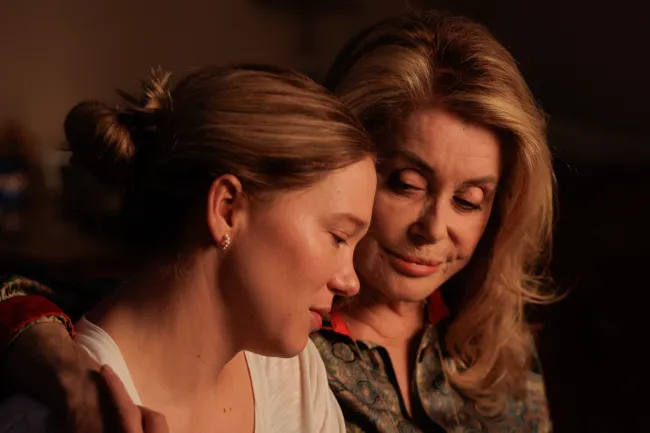
The legendary Catherine Deneuve plays Eloise, Lucy’s mother. What does it take to get her to say yes to a project these days?
The great thing about someone like Catherine Deneuve is that she doesn’t have to give a s–t about what she’s doing because she is a legend and an icon. Even more so in France than in the rest of the world. She can just do what she wants. We went for coffee and she immediately said yes. She had seen my previous film. She goes to the cinema every week. She’s a real cinephile. She knows everything about films. She said, “I’ve not shot a film in two years because there was just no good script and this script is really good and I want to do it.” And she also wanted to work with Léa. They had known each other, but never worked together. So it was really easy actually to get her on board, which I was also surprised by. [Laughs]
How did you protect your young actor Malo Blanchet, who plays Lucy and Philip’s son Johnny, from some of the darker themes of the movie?
I was very lucky finding not only him, but also his family and his parents. When you work with children on a film, there’s always a thin line that you cannot cross. It’s hard work and you have to be conscious about how you work with them and what you let them go through and not. A very important fact is also the parents and the family—I’ve seen parents who wanted their kids to be in films because they thought it was cool and they put a subtle pressure on the kids with that. Malo’s family is not like that at all.
It’s really him who wants to do that and they make it possible. They were very supportive and we were in touch all the time about the subject matter and what we tell him, what we don’t tell him. I really let it his parents decide how much he would learn about the subject matter. I said, “I don’t know him as you know him. I don’t know how he will cope with that, how he will respond to that. So let’s discuss what you think is right.” When he had asked what the film is about, what the story of the parents is about, they said they are going through a difficult time and eventually they separate. And he was like, “Oh, okay.” Because he of course knows that from friends, so it was something he could relate to. So we decided not to tell him in detail. So his version is a little bit different. And he has seen the film in an edited version with only his scenes, so he knows a little bit, but not everything.
I really love the ending of the film. Especially the second time around when I watched it, I feel like you both have a certain level of certainty, but you also don’t because it’s ambiguous.
I always like an ending that is ambiguous and sad and beautiful at the same time. And I think in this specific case, it was important for me that there wouldn’t be a clean, everything’s-answered ending, because it’s just not realistic. Earlier we were talking about how we are disappointed by people in our lives and how we are left behind or how we leave behind someone. Very often there’s unanswered questions and very often there’s a conversation we think we will have at some point, and that never happens. Very often we split ways with people and we have to live with not knowing their side of the story. So that’s the human experience. Having to live with someone without resolution, without closure. And that was what I wanted to say with this ending.
