
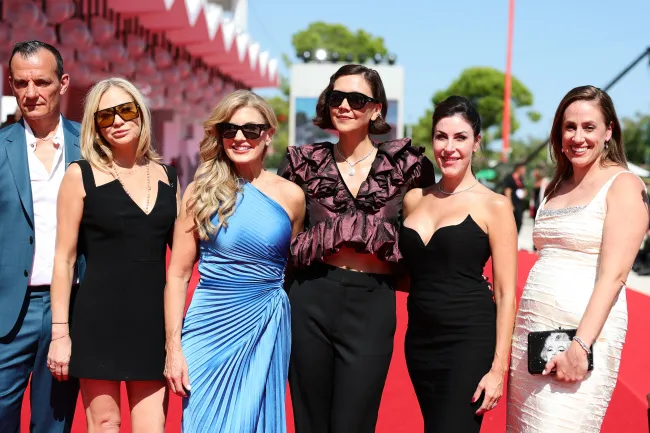
Maggie Gyllenhaal is currently about as busy as a person can be. Not only is she is the president of the main jury at the 83rd Venice Film Festival — where a diet of three films a day is common, along with official duties such as opening the festival — but she has also written and directed a short film that’s making its debut on the Lido, Flesh Impact.
The 21-minute film casts 93-year-old screen legend Ellen Burstyn as the apparition of another Hollywood icon — Marilyn Monroe, who celebrated what would have been her 100th birthday earlier this year. Burstyn was also in Venice this year, receiving the Golden Lion For Lifetime Achievement Award for a decades-spanning career that includes six Oscar nominations and one Best Actress statuette.

In Flesh Impact, Burstyn’s Monroe is seen auditioning for a contemporary production of Tennessee Williams’ Orpheus Descending. The grizzled New York director who allows her to give it her best shot is wryly and charmingly played by Gyllenhaal’s husband, actor Peter Sarsgaard. Burstyn proceeds to recount her younger years — illustrated by flashbacks with Monroe played by Dakota Johnson, who previously collaborated with Gyllenhaal on the Oscar-nominated 2021 film, The Lost Daughter — providing anecdotes about her time with Lee Strasberg, Arthur Miller, and Billy Wilder, who came up with the description of Monroe that gives the short its title.
Gold Derby spoke with Gyllenhaal about the film, and the enduring mystique of Marilyn Monroe.

Gold Derby: What drew you to this story?
Maggie Gyllenhaal: This was actually something that was brought to me. Most of the other things I’ve made have just come from my own mind. This was something I was asked to consider. Would I consider making a film about Marilyn Monroe to commemorate what would have been her 100th birthday? And also in the ask was: Could we offer her an opportunity to act in a way that she wasn’t able to do when she was alive?
I actually thought about it for a while. I was editing The Bride! at the time this came around, and I was thinking, “I don’t know. Could I do this?” I didn’t know more about Marilyn Monroe than your average Jane. I was compelled by her, as most people are; not just her beauty and her sex appeal, which is very powerful, but something else in her, too, which I think is in all of her performances. There’s something very sad, heartbreaking, and funny about her.
I’ve never read the Norman Mailer piece, which Burstyn’s Marilyn references.
I did. It’s so interesting; he’s such a great writer, but he’s writing from such a very particular perspective. I read it, and then I thought: “Okay, let me just give myself a minute and see if something valuable comes up. You know, if this is worth me being the person to do this.”
I basically wrote it in a weekend, which is a little bit of an exaggeration. Then I went back and took things out and put things in. But I kind of went, “Let me see if something that’s worth taking time with comes up.” This is what came up — this weird story of this audition, and Marilyn actually being 100. And then I fell in love with it.

Why does she audition for the role of Carol in Orpheus Descending?
It’s a really good question. For me, when I’m writing or when I’m acting or when I’m directing, so much of it is making space for the unconscious to bubble up. I actually played Carol in high school, so I knew that monologue somewhere deep in the annals of my mind. It just came to me, and I thought there were a few things to say about this.
One thought was that it was Marilyn’s story being told by Tennessee Williams in the mouth of a beautiful 25-year-old woman. If you talk to Ellen, she talks a lot about her training at the Actors Studio. I didn’t train as an actress, but I had a teacher who completely changed my work and my life. I didn’t know she was teaching me the Method, but she was. And she is actually a friend of Ellen’s. This idea that a role I played would resonate unconsciously in something I’m writing to offer to Ellen is very much in the language of the kind of work that we do.
I also loved how off the wall it was to have Ellen Burstyn, at this moment, play Carol in Orpheus Descending, and yet to have it resonate so totally and fully in her mouth at the end. That was a great challenge to set for myself.
Why title the movie Flesh Impact?
Well, that description really hit me somehow. Billy Wilder is brilliant, and I love his movies, and I love Marilyn in his movies. But something about that both impacted me and also felt a little off. We definitely look at all sides of that comment in the movie. I didn’t really know how, exactly, so that was another thing that I just kind of put into the pot and started to think about. It’s amazing to be able to feel that you could reach out and touch someone when you watch them onscreen. But what is the cost for the person that’s being touched, even mentally?

You also have a quote that Marilyn says about how Arthur Miller described her.
Arthur Miller says, “Sleep was my demon.” It’s definitely a real quote. Everything in the film is true, at least as far as I understand it. But then there’s this aspect of imagined fantasy on top of it, because she’s 100 years old and basically back from the dead. So that combination was really compelling to me. If we know, “Billy Wilder really said this, Arthur Miller really said this, and Marilyn Monroe really said this,” that kind of grounds our wild imaginings.
Another quote that I absolutely adored was, “A little powder on the nose turns a weed into a rose.”
Do you know what? I made that up! That was not even in the script. I was working with a little girl and we were playing with the camera and the light, and I was just giving this young actress things to say while I was standing there next to the camera. I don’t know where that rhyme came from: “A little powder on the nose turns a weed into a rose.” I wrote that.
But that’s a real story Marilyn told about a woman who was in this orphanage. Marilyn had gotten into trouble, and she thought this woman was going to beat her. Instead, she was kind to her and let her use her makeup. And then the makeup became a kind of lovely thing for her. I took it there, but I think that was the implication.

How is it being the president of the jury?
Very generally, it’s amazing. It’s really amazing to sit and watch three movies a day.
What was your first Venice?
My first Venice was with Jake [Gyllenhaal], when he was here for Brokeback Mountain. But really, the major impact for me was when I was here for The Lost Daughter.
Also with Dakota.
I love Dakota. I know that she wasn’t able to be here, even though she would have loved to. She’s a dear friend of mine. Ellen, of course, is really the center of the piece, but I also just love Dakota in this. I think her spirit, her mind, and her artistry are on full display. I think she does really special work in this little short movie.
This interview has been edited and condensed.
