
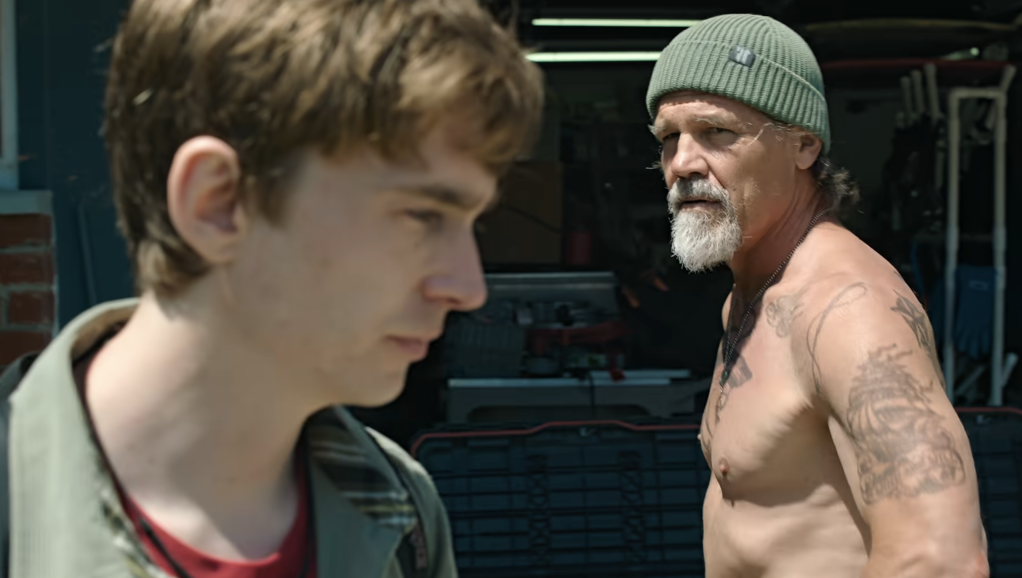
In a time when many film and television productions shoot in other states or countries despite having their roots of development in Hollywood, 20th Century Studios has taken a big swing with its upcoming feature Whalefall, which arrives in theaters October 16.
Starring Austin Abrams, Josh Brolin, Elisabeth Shue, John Ortiz, Jane Levy and Emily Rudd, the film adaptation of Daniel Kraus’ book shot in a couple California locations — from Monterey to San Pedro — before finishing up at Radford Studios, where Deadline visited set during production last September.
Executive producer Doug Merrifield, whose credits stretch from 2023’s Candy Cane Lane and The Shallows (2016) all the way back to associate producer on 1993’s Free Willy, revealed that he compared schedules and budgets in both California and Louisiana as shooting locations side by side before production began.
“On paper, Louisiana was a little cheaper — six figures cheaper, not seven figures cheaper — but at the end of the day, we were able to convince 20th Century that the best creative teams are here for this kind of picture,” Merrifield told Deadline a little over a year ago. “To their credit, even though it was a little more expensive to make the movie in California, they agreed to do that.”
Merrifeld added that — at the end of the day —should the film have shot in New Orleans, the cost comparison would have been a wash if not more expensive, once specialists were brought in.
RELATED: California Lawmakers Officially Carve Out Compromises For Film Industry On Corporate Tax Credit Cap
“We had the ratio between the cost above the line, below the line, and then visual effects with Guillaume [Rocheron]. In California, you don’t get an incentive on above the line, but we had enough in post and visual effects to offset the loss of what we didn’t get from above the line,” Merrifield continued.
The visual effects, set design and other “specialty skills” in Merrifield’s words were important in a story with a premise like Whalefall’s, where Austin Abrams’ character spends an hour in a whale’s stomach after diving deep in the ocean looking for his father’s (Josh Brolin) remains. Said whale stomach models were built by the Wētā Workshop in New Zealand, but the head, throat, esophagus and larynx were constructed in California because they were too big to ship to set in time. The 12-foot-tall 18-foot-long whale head was manufactured by StudioArt & Technology.
“It’s so unfortunately rare to have the opportunity to shoot here, that when people know that a movie’s shooting in L.A., that is their first choice,” said producer on the Imagine Entertainment side of things, Allen Mendelbaum. “They can come home at night, see their families and everything. Why not? I think we’re really punching above our weight in this movie, because the crew is as good as it gets.”
RELATED: California Lawmakers Officially Secure $750M Annually For Film & TV Tax Credit Program With Final Budget Vote
For 50 days — which later turned into 62 — of filming, with a cast of 11 and a crew of 180 plus 409 background players, the film received nearly $11 million in tax credits on $50M total qualified expenditures. For the crew members living in the valley, including director Brian Duffield, production at Radford Studios was a huge plus, especially with stacked stage levels for easy access when shifting between shooting environments like the tank that simulates the ocean Jay (Abrams) dives in and then the whale’s head, throat and stomach, where he spends most of his time in the story.
“We originally were looking at L.A. Center, which was sort of a split [geographically]. [Radford] made us a great deal. And the fact that we had all these four stages [during production.] The tank [was] on 17, we had all the [whale] stomachs on 16, and then we had our special lead throat, and the 360 rigs on 12 across the way,” Merrifield said. “We were fortunate that it is at this time we were able to make such a good deal. But unfortunately, it is because it’s so slow right now.”
Whalefall benefited from a $330 million round of funding that preceded the newly approved expansion of the California Film & TV Tax Credit program, which included a total of $750 million in incentive funding.
RELATED: ‘The Pitt’ S3, Kimmel EP’d Game Show, ‘High Potential’ S3, & ‘Stewie’ Score California Tax Credits
“I’ve seen, where it’s started [to] already help the increase to television. For features. ultimately, if we want more feature work here, we’re going to have to have some sort of ATL (above the line) incentive credit, which you don’t get here right now. So if you have a big above the line, it doesn’t make sense to shoot here,” Merrifield who worked on the Free Willy films in Mexico City, shared.
With a smaller cast, Whalefall could make production in California work, but for other major projects with heavy-hitting stars attached, above-the-line costs are a different story.
“Things take time to trickle down, but I think in a year, we’ll have a much better idea how the new, increased incentive here has helped, not only television, but I’m hoping, in features,” Merrifield added.
RELATED: Big Money! Jobs! Newsom Boasts Big Bucks Film/TV Tax Credits “Delivering Results”; Eddie Murphy’s ‘Donkey,’ Disney & Ben Affleck Flicks Get Incentives
California is currently in the middle of both film and television application cycles for the state’s tax credit program. Applications close in September for feature films and independent productions, while the window for television series runs into October. Though production in California remains low, several other projects that have benefited from the California Film Commission’s incentive will release this fall alongside Whalefall.
On the anniversary of the program’s funding rising to $750 million in July, projects like Ben Affleck’s upcoming Gingerbread Men produced with Matt Damon and their Artists Equity banner as well as Disney’s Hexed coming this fall were among 41 films that received $187 million in incentives over the summer.
Recent developments around efforts to shift production back to the heart of Hollywood have involved a 35% incentive for postproduction to move to the Golden State. President Donald Trump has also voiced vague intentions to back a federal film and tv tax credit as well.
Last July, the California Film Commission allocated its $40 million of funding since the increase went into play to Dan Fogelman ($20.8M) and Ryan Murphy ($17.9M) for their upcoming television projects. Mid-March 2026, The Pitt, High Potential and Season 2 of Bill Lawrence’s Rooster comedy were among 14 small-screen projects to receive tax credits.
RELATED: California Lawmakers Introduce Compromise For Film Industry On Corporate Tax Credit Cap
December 2024’s round of distributed funding, which totaled to $108.6 million awarded to 10 film and TV projects including Whalefall, also saw Season 2 of Bill Lawrence’s Bad Monkey, which returns this December, get part of that funding for 93 filming days in California with the production generating $82 million in qualified expenditures and employing 460 cast and crew members and 4,290 background performers.
Whalefall joins such big studio projects shooting in Callifornia as the multi-Oscar winning Paul Thomas Anderson $140M feature production, One Battle After Another, Netflix’s The Further Mis-adventures of Cliff Booth (which had $105.9M in qualified tax expenditures), as well as this year’s 13 Going on 30 reboot at Netflix ($10.9M for $31.2M in qualified expenditures) and the It Follows (2014) sequel They Follow ( $7M for $20M in qualified expenditures).
Last April, 38 features were given California state credits. Back in October 2025, there were over 50 films approved for such tax incentives including Amazon MGM Studios’ Heat 2 ($104.1M in qualified expenditures) and the upcoming Jumanji: Open World sequel ($161.5M in qualified expenditures).
RELATED: ‘Whalefall’ Trailer: Austin Abrams Has An Hour Of Oxygen To Get Out Of A Sperm Whale’s Stomach
