
Pop quiz, hotshot: What’s the only awards contender that’s playing all four major fall film festivals this cycle? (No peeking at Gold Derby’s official festival scorecard until after you answer.)
The film in question, of course, is Werner Herzog‘s Bucking Fastard, the much-loved German auteur’s first narrative feature in seven years. Starring sisters Kate and Rooney Mara in their first-ever onscreen collaboration, the film just had its world premiere at the Venice Film Festival and will move on to play Telluride, Toronto, and New York.
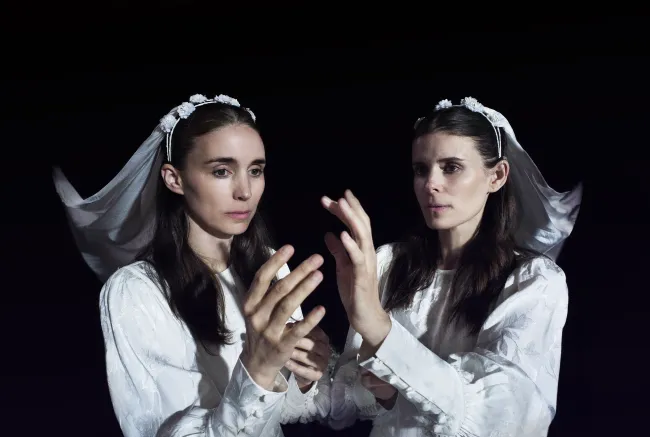
As in real life, the Mara siblings play a pair of sisters named Jean and Joan Holbrooke. But in a cinematic twist, the duo’s onscreen alter egos share everything; they say the same things, wear the same things, and fall for the same man, played by Orlando Bloom. When that love triangle lands the sisters in court, they have to defend their way of life in the harsh glare of the public spotlight.


Bucking Fastard is also in the spotlight following its Venice premiere, with the first wave of reviews signaling a mixed reaction as the film seeks a U.S. distributor brave enough to mount an awards campaign for Herzog’s latest bit of eccentric whimsy. Believe it or not, the filmmaker behind classics like Aguirre, the Wrath of God and Fitzcarraldo only has one Oscar nomination to his name — a 2008 Best Documentary Feature nod for his made-in-Antarctica documentary, Encounters at the End of the World.
With Venice critics reporting in, Bucking Fastard currently has a 70-percent fresh rating on Rotten Tomatoes and a 60 rating on Metacritic. We’ll see if those numbers improve after more reviews wash up from Telluride, TIFF, and NYFF. Here’s a sampling of the reaction to Herzog’s wild tale of two sisters.
The good
Time‘s Stephanie Zacharek is a fig ban… uh, big fan of Bucking Fastard and the performances by the Mara sisters in particular. “Almost nothing in Werner Herzog’s fractured fairytale Bucking Fastard… makes literal sense,” she writes. But it all makes a kind of sideways sense, especially if, before watching, you can will yourself into a Herzogian brainspace.
“The Mara sisters are brilliant here,” Zacharek continues. “Their eyes as hungry and haunted as those of an orphan in a Keane painting. You laugh with them, not at them. …But there’s also something deeply touching about their refusal to give up on love. There’s a metaphorical idea shimmering beneath the surface of Bucking Fastard: it’s as if, through this strange and somewhat simple story, Herzog were trying to explore the things women want but don’t dare demand.”
Indiewire’s Ryan Lattanzo is also feeling the Fastard vibe, writing: “[The film] ends on a note that quite literally shuts us out of the door upon the Holbrookes that’s been opened, the sisters’ journey toward a sense of belonging in a world other than each other’s left unfinished. Why shouldn’t it? The 83-year-old Herzog’s wryly funny, touchingly eccentric, and uncompromisingly bats–t feature — wait, aren’t they all like that? — will enchant and dismay in likely equivalent proportions.”
And over in Screen International, Tim Grierson says: “The Mara sisters do a remarkable job of wearing similar facial expressions along with their matching wardrobes, although it is interesting to observe how each actor’s personality occasionally asserts itself. Kate Mara’s generally warmer demeanour is faintly noticeable alongside her sister’s slightly more cerebral approach, and yet the two performers feel entirely in sync as their characters share the same vocal responses and childlike manner.
“For an artist who has often championed outcasts and misfits, Bucking Fastard is clearly besotted with these two women who have never known anything besides each other,” Grierson concludes.
The bad
The Hollywood Reporter‘s David Rooney stayed grounded during this flight of fancy, calling the film “nutty but thin,” in his middling review.
“This bizarro fable about unfulfilled love, oversized knitwear and abandoned story threads frays beyond repair, well before it reaches an abrupt and perplexing halt,” he argues, adding: What cannot be faulted is how fully the Mara sisters commit to the psychological and physical symbiosis of their precisely synced characters. But although the mysterious connections between siblings are an area ripe for exploration, Herzog doesn’t seem all that interested beyond the quirk factor, making the film seem precious rather than perceptive.”
Variety‘s Jessica Kiang also felt on the outside looking in while watching Herzog work his peculiar magic. “Occasionally sublime, often ridiculous and always extravagantly weird, Werner Herzog‘s Bucking Fastard, unlike its gorgeously interlinked protagonists, is a film of multiple personalities that only rarely speak in unison,” she remarks.
“It feels almost heretical to wish that a Werner Herzog film were just a little less outlandish,” Kiang adds. “But while Bucking Fastard gives us, in the Mara sisters’ uncannily synced-up performances, a novelty worth the price of admission alone, it is mired in so much mythology and mystery that by the end, the fact of the sisters being two who respond and react as one becomes all but immaterial.”
And writing in The Playlist, Marshall Shaffer offers up an outright pan. “The film flails without a firm genre framework or consistent tone to guide our interpretation of Jean and Joan’s behavior,” he writes. “It never clarifies whether their insistence on operating in tandem is supernatural, superstitious, or purely metaphorical. If the Irish setting offers any folklore that could ground the story as a fable, Herzog never gives it enough attention to contextualize the proceedings.”
