
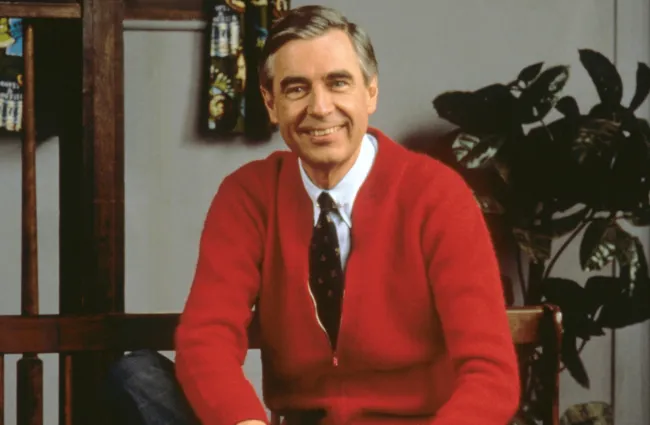
Like a good neighbor, it felt like Fred Rogers was always going to be there. Across some 30 years, 55 Daytime Emmy nominations, and 900-plus episodes of television, the Pittsburgh-born educator and entertainer used his much-loved and much-lauded PBS series Mister Rogers’ Neighborhood to teach multiple generations of young viewers such signature values as the importance of kindness, the power of make believe, and the simple joy of a comfortable cardigan sweater.
But no neighborhood can stay the same forever. Twenty-five years ago, on Aug. 31, 2001, Mister Rogers welcomed his friends into his TV home one last time for the show’s series finale. But at the behest of the homeowner himself, that farewell episode deliberately avoided any overt farewells. There were no teary goodbyes, no surprise guest stars, and no resolutions to any existing storylines — in short, no indication that this was anything but another day in the neighborhood.

“At one point, we talked about having people come on the last episode that had been on before,” longtime Mister Rogers’ Neighborhood producer Margy Whitmer tells Gold Derby now, outlining a version of the last episode that sounds more akin to Seinfeld‘s parade of finale guest stars. “But then we realized that would have made it seem really final. And Fred wanted the cycle to continue, so the show’s library of episodes could continue forever and ever and ever.”
As much as he may have wanted to, Rogers knew that he couldn’t go on making new episodes forever and ever. Born in 1928, the host had recently celebrated his 72nd birthday when he made the difficult decision to end the series in the latter half of 2000, nearly one full year before the last episode would air. “I know he was tired,” Whitmer recalls, noting that Rogers was later diagnosed with stomach cancer in 2002 and passed away the following year.
“But it was a bittersweet decision,” she adds. “A lot of our crew were freelancers for whom we were their main source of income, so we made sure to let them know early so they could plan for the future.”
“Fred was so empathetic, and didn’t want people to feel sad,” emphasizes David Newell, who originally joined the series as a public relations manager, but also ended up with a job in front of the camera as Mr. McFeely, the good-natured postman who specializes in speedy deliveries. “I think he was trying to let us all down gently, because he knew that everyone who worked on Mister Rogers’ Neighborhood loved their job. He was just trying to do his best.”
Whitmer and Newell were both on the Mister Rogers’ Neighborhood set for the very last day of production — Dec. 1, 2000 — and in separate interviews they shared their memories about the series finale, and what came after.

The art of being Fred Rogers
Given how much Rogers’s entire team treasured being part of his Neighborhood, it’s only natural that they were filled with last day jitters when they reported for work that Dec. 1. “I was wound really tight,” Whitmer, now 74, admits. “I tried to tell myself, ‘It’s just another production, it’s just another production.”
Fortunately, one crew member came up with a novel idea to break the tension. “We would have dress up days in the studio, and our floor manager, Nick Tallo, had us all dress up like Fred with a sweater and a necktie,” the producer says, laughing. “When he walked into the studio, he laughed and said, ‘You all look great!'”

The last batch of shows, including the finale, were part of a theme week devoted to the arts. With all of the interview and puppet segments set in the Neighborhood of Make-Believe already in the can — the demands of post-production required that those sequences be filmed first — the only material left to shoot were the scenes with Rogers in his make believe house.
Whitmer and Newell both remember that the original Dec. 1 production schedule only called for them to film the interior scenes for the penultimate episode, but they wrapped that material in the morning and Rogers made the call to devote the afternoon to shooting what remained of the finale rather than wait until the next day. “Fred looked at his watch and said, ‘We’ve got two hours and we’re paying for studio time. I want to finish everything,'” Newell recalls. “I think he was relieved in some way, because he probably didn’t want to go home still thinking about the very last show.”
“He really wanted to get it over with,” Whitmer concurs. “Ending the show was a sad, hard thing. It was his life.”

Despite the emotional weight of the day, Whitmer says that Rogers made a point of ensuring the mood on set remained “low-key” as was his wont. “Fred really was Daniel Tiger,” she says, referring to one of the show’s most popular and enduring characters. “He just wanted to do the work and walk away quietly.”
A Speedy handshake

During the afternoon portion of that last shooting day, Newell filmed his final mail delivery as Mr. McFeely, dropping off a VHS tape that had one of the pre-taped artist segments that viewers at home would later see. And while he took his cue from Rogers in terms of keeping their last scene together low-key, he also slipped a subtle farewell into his performance.
“Usually, I would say, ‘See you around the neighborhood, Mr. Rogers — I’ll be back with more deliveries,'” Newell says. “But on that day, as I was leaving, I shook his hand. I had never shaken his hand on the show before, because I’d always be back the next day. So shaking his hand was me saying ‘Thank you’ to him for all those years, and that was very satisfying. That’s how I got through that last day, by thanking him for that handshake — and my ‘Thank you’ is there forever.”

Funnily enough, Rogers had his own surprise for Newell. After McFeely performs a solo rendition of his “Speedy Delivery” song, Mister Rogers asks him to sing it again so he — and the viewers at home — could join in. While that might seem like Rogers intended that to be his own subtle version of a farewell, Newell says it was more likely a result of the host’s expertly-honed production instinct.
“Fred would always look at the floor manager to see how much time we’d have left in the segment, and if we had extra minutes, he would tell me to sing the ‘Speedy Delivery’ song,” he explains. “And if we had more time after that, then he would join in. So that’s probably what happened that day — he knew we had more time to fill.”
Other eagle-eyed viewers have noticed that Mister Rogers says, “Congratulations” to McFeely as the mailman exits the house — perhaps as another acknowledgement of their years together — but Newell says he and Rogers never discussed that exchange. “That may have been his way of saying ‘Thank you,'” he muses. “When I think about that last day, the only word I think of is ‘splendid.’ You didn’t work for Fred Rogers; you worked with him, and he was always with you.”
The proud family
As was typically the case for an average Mister Rogers’ Neighborhood episode, the interior scenes in Mister Rogers’ house were filmed in sequence. That means that one of the last things the host filmed was his final direct address to the children on the other side of the screen.
“There are so many ways of saying who you are and how your feel,” Mister Rogers tells them. “Ways that are so helpful; ways that don’t hurt yourself or anyone else. That’s how you can tell when you’re grown up inside. You’re sure that what you’re planning and doing are things that can be a real help to you and your neighbor.”
“I’m proud of you — you know that,” he adds, segueing into one of the show’s staple songs, “I’m Proud of You,” before the curtain came down. “I was not anxious to hear that speech and song, because I knew I was going to cry,” Whitmer says, adding that Rogers filmed those last words to the audience in one take.
After the final scene was shot, Rogers and the crew — along with several members of the Rogers family, including his wife, Joanne — gathered together in the studio for hugs and snacks, with the official wrap party held a week later at Whitmer’s home. Neither time did Rogers offer up some kind of grand summation for what they had accomplished together. “It was hard for Fred to toot his own horn,” his producer says. “But I’m sure he was proud of what he did. How could he not be?”
It’s worth noting that the final season of Mister Rogers’ Neighborhood received two nominations at the 2002 Daytime Emmys for Best Writing and Best Host, although it didn’t win either statuette. “We got nominated a lot, but we didn’t win a lot,” Whitmer says with a smile about the show’s awards track record. “But Fred wasn’t into competition. He was honored to be honored, but the show as never about winning awards to him. His reason for doing it was to make a good program for kids.”
When September ends
Even if it the production of the Mister Rogers’ Neighborhood series finale was muted, the episode was accompanied by a wave of media fanfare when it aired on Aug. 31, 2001. A little over a week later, though, the world was turned upside down by the Sept. 11 terrorist attacks, which dominated the airwaves with wall-to-wall news coverage. Amidst the chaos and confusion, some viewers found solace in Rogers’ words in that last episode about what it means to be a good neighbor.
That response encouraged Whitmer and Rogers to make a series of PSAs specifically for children to help them make sense of what they were hearing on the news and from their parents. Those PSAs were circulated on PBS stations both at home and abroad.
“One of the things that disturbed Fred was that TV sets would be on in homes a lot for news, and parents didn’t always realize that kids were picking up on that,” Whitmer explains. “He was nervous about them thinking that because the news kept showing the attacks, young children would think it was happening again.”
Newell says that the Sept. 11 PSAs are just another example of Rogers’s ability to help children process difficult emotions. “I remember that one of his most unique programs tackled the death of a fish,” he says. “He discovered that one of the tropical fish in his fish thank had died, and he talked about it in the episode and then wrapped it in paper and took it outside to bury it. That’s a classic Mister Rogers program, and only Fred could have handled it that way.”
The neighborhood endures

Following the Mister Rogers’ Neighborhood series finale, Rogers himself largely stepped out of the spotlight, while the staff of Fred Rogers Productions and the Fred Rogers Institute took up the mantle of his legacy. Newell toured the country on behalf of the show and represented Rogers at an event in Dallas when the host’s illness kept him from making the trip.
“When I got home, Fred called me to say thank you, and we talked for a little bit,” he remembers. “He was leaving the hospital and I told him that I’d see him at his home. But things started to go downhill and he ultimately passed away, so that was my last time speaking with him. I’m so glad I had that moment, because it was such a nice conversation.”
Meanwhile, Whitmer helped usher in the next chapter of Fred Rogers Productions when she joined the creative team behind Daniel Tiger’s Neighborhood, an animated spin-off series starring Rogers’ alter ego that launched in 2012 and is still running on PBS today. Full episodes of Mister Rogers’ Neighborhood — although not all 900 of them — can be found on the show’s official YouTube page.
These days, Whitmer is retired from children’s television, but still considers herself a lucky resident of Mister Rogers’ Neighborhood. “I remember one day years before we were thinking about ending the show where everything was just going wrong, and I thought, ‘I can’t wait to get out of this studio,'” she says. “But then I remember thinking, ‘You are going to treasure this day and this time of your life, even if you’re not doing it now.’ So, yes, I feel very privileged and very happy that that’s how I spent most of my adult career.”
