
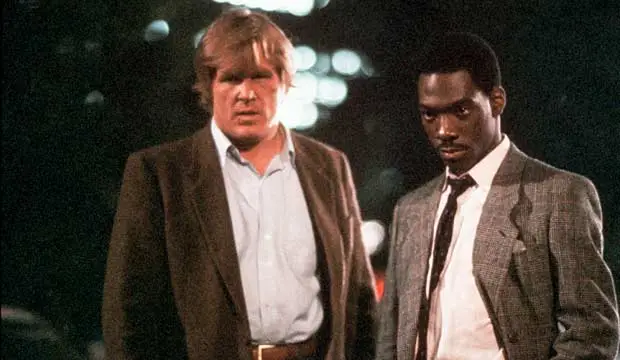
48 Hrs. was Eddie Murphy’s feature film debut, launching a string of smash hits and establishing the blueprint for modern buddy action-comedies. Director Walter Hill held court at a screening at the American Cinematheque’s Aero Theatre on Wednesday night to discuss the 1982 classic.
Before diving into the film, Hill shared a memory of the late Dolly Parton. Thirty-five years ago, Hill and his wife attended a cocktail party in Parton’s honor. When they were introduced, Parton was already familiar with Hill’s filmography — which by 1990 included The Warriors, Extreme Prejudice, and Red Heat. Parton’s own acting career was already thriving with hits like 9 to 5 and Steel Magnolias.

“She kind of pulls me aside,” Hill began. “She says, ‘I want you to go home and start writing a movie for us. We could work together and I think it would be very nice. I’d like to do it and I’d like you to write a story for me.‘ And she said, ‘But when we do our movie, we don’t have to shoot anybody.’ It’s the only time I ever met her. She was really something. I like that moment.”

In 48 Hrs., Nick Nolte plays San Francisco Det. Jack Cates, who tracks down an escaped convict (James Remar) and his accomplice (Sonny Landham) after they kill two police officers. To find them, Cates releases their former associate, Reggie Hammond (Murphy), from prison for two days. The original script, initiated by producer Lawrence Gordon, shared only one element with the final film: pairing a cop with a convict.
“Larry had an idea which he sold to Columbia Pictures which took place in Louisiana where the governor’s daughter was kidnapped by a viscious, terrible man who tied a stick of dynamite to her head,” Hill said. “The toughest policeman in New Orleans is sent out on this case. He went to the last cellmate of this terrible man who’d done this terrible thing to the governor’s daughter.”
Hill came aboard when Gordon moved the project to Paramount, the studio that ultimately released the film. However, several other high-profile stars were considered before Nolte and Murphy were cast.
“They wanted me to write it for Clint Eastwood,” Hill said. “Larry and I got in a little plane. We flew up to Carmel and met with Mr. Eastwood. He said he liked the idea but he had to be the convict because if he was the cop it’s Dirty Harry. He was quite right on that.”
While Hill retooled the script to fit Eastwood in the role that eventually became Reggie Hammond, Eastwood left to film the prison drama Escape From Alcatraz.
“Well, we knew he wasn’t going to do two prisoners in a row,” Hill said. “So I then changed the script and wrote it for a Black man to be the prisoner and suggested Richard Pryor.”
By the time Paramount was ready to greenlight production, Pryor was a headliner following hits like Silver Streak, Stir Crazy, and Bustin’ Loose, making him unlikely to accept a co-starring role.
“We went to Gregory Hines who’s a very fine actor, Broadway performer,” Hill said. “He wanted to do the movie but he was in Sophisticated Ladies, the road company.”
Hill next met with Nolte for the role of Cates. It was Hill’s then-girlfriend (and now wife), talent agent Hildy Gottlieb, who suggested Murphy for Hammond after showing Hill tapes of Murphy’s work on Saturday Night Live.
Murphy’s standout sequence takes place in a country-western bar, where Hammond borrows Cates’ badge to impersonate an officer and confront the patrons.
“In the scene they call the redneck bar scene, I purposely way exaggerated the redneck qualities of the people there but it made it a better scene,” Hill said. “You have to know when to push and pull reality. All movies operate in their own special world. Just pick and choose how you want to deliver that special world. Even the ones that seem to be brutally realistic, they aren’t.”
Hill credits Murphy’s comedic delivery with carrying the film’s humor, noting that the script itself contained few traditional jokes. After watching a few takes of the bar scene, Hill knew they had a hit on their hands.
“I remember after Eddie did it a couple times, Larry was standing close by, I would go to Larry and I said, ‘We’re rich,’” Hill said. “What I should’ve said was ‘the studio’s rich’ or ‘Eddie’s rich.’”
The bar patrons aren’t the only ones displaying bigotry in the film; Cates himself uses racial slurs against Hammond throughout their partnership. Hill believes this underlying racial tension is a key reason 48 Hrs. retains its edge.
“The racial tension within the story created a kind of energy and interior tension that was unusual in an action movie,” Hill said. “I think that our country is not free of this dialogue and racial tension even to this day, but I think that has a lot to do with it. It’s a movie. It’s a story. It’s an action film.”
Hill also credited Murphy with improvising another iconic scene. When Cates first visits Hammond in prison, he finds him singing “Roxanne” by The Police. Hill recalled that the scene as written wasn’t landing, so he encouraged Murphy to improvise.
“We kept rehearsing the scene and finally I had it,” Hill said. “I said, ‘Look, this thing stinks. This is a very important scene. We’re introducing the character and it’s just really f–king dull. We’ve got to do something.’ I said to Eddie, ‘Make some goddamn noise. Sing something.’ And so we started. He just started singing ‘Roxanne.’”
Murphy’s choice of song caused immediate panic at the studio, but Hill held his ground.
“The producer we had on the set immediately called the studio and said, ‘Eddie Murphy’s singing ‘Roxanne.’ What do we do? We don’t have the rights,’” Hill said. “The order came back that I was to stop shooting instantly. Well, you see the movie. I said, ‘No, I liked it. Go buy the song.’ They did in the end because we printed it and moved on. But the song came from Eddie. It was his spark. It’s his moment.”
Hill noted that Murphy was “a star about to happen,” while Nolte was already riding high off the success of TV’s Rich Man, Poor Man. While Hill was flattered to see countless action films try to replicate the 48 Hrs. formula over the years, he felt most fell short.
“It was a much imitated movie which I always thought was great, very flattering,” Hill said. “But, I always thought almost all these imitators that I ever saw missed the whole point of what made this movie special. They usually had two people bantering but they were friendly. There wasn’t any real tension to it.”
