
Kareem Rahma has a take: his Emmy-nominated series Subway Takes isn’t “new media,” “digital media,” or “streaming media” — it’s just media.
“I don’t even think it’s that hot a take,” the Egypt-born ex-journalist tells Gold Derby matter-of-factly about where his quick bite talk show — which almost certainly pops up in your various feeds be it on Instagram, TikTok or YouTube — fits into the current entertainment ecosystem. “It’s literally the reality of what we do; anything that streams is a streaming show, and it’s all digital video. There’s been a flattening of what entertainment is and what that work even means; it’s a really exciting time.”

An exciting time for independent entrepreneurs like Rahma anyway. Legacy media companies are still finding their way through the industry’s evolution in real time, and insurgent success stories like Subway Takes often inspire a mixture of emotions, including surprise, confusion, and envy. That’s apparent in much of the coverage that Rahma has received since his series exploded in a big way.
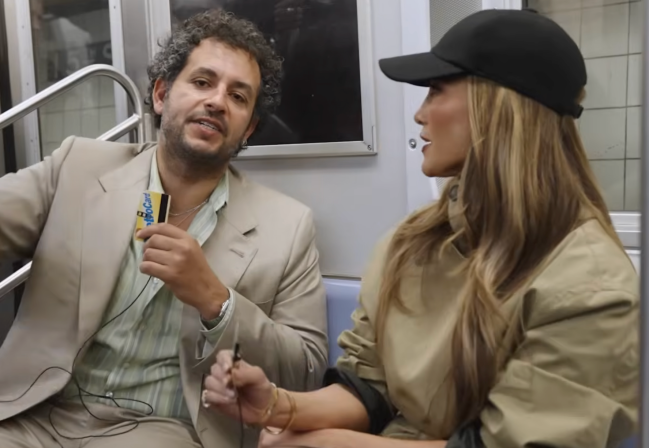
Within the past year, major celebrities like Jennifer Lopez, Matt Damon, Charlize Theron, and Woody Harrelson have joined him on one of New York’s many long and winding subway lines, happily disclosing their own hot takes. For the record, Raham says that the hilarious Harrelson chat, along with a Jason Bateman conversation, are among the episodes he submitted for Emmy consideration. “Those are two of my favorites,” he says. “Both of them were so dynamic as guests and just had a lot of fun. I’m really proud of the personality that I got out of them.”
The quality — and virality — of Subway Takes has paid off in the show’s first-ever Emmy nomination. Subway Takes is nominated for Best Short-Form Comedy, Drama or Variety Series, a statuette that will be awarded at the two-night Creative Arts Emmy ceremony held on Sept. 5 and 6.
Informed that many of the traditional media stories we’ve read about Raham present both him and the series as some kind of unicorn-like exotic creature, the host smiles and nods knowingly. “That’s been happening my whole life,” he admits. “I don’t need them to understand me right away; I’m happy when they do, but it takes time. I’m a digital native who has been doing this since I was a kid, but we’re in a period of time for media where everyone is just really confused.
“Still, I feel like it’s OK to be confused,” he adds. “We don’t have to have a perfect answer; we can all coexist in our different ways making this content.”
Funnily enough, the kind of confused coexistance that Raham is talking about is encapsulated by his fellow short-form nominees. Subway Takes is one of two creator-made YouTube series up for the award, the other being The Randy Rainbow Show, which has five previous nominations going back to 2019. Then there’s Tom Segura’s Bad Thoughts, which streams on Netflix, as well as two extensions of linear late-night television series that are made to be consumed on YouTube: The Daily Show: Desi Lydic Foxsplains and Colbert Before Air, a behind-the-scenes look at the now-defunct CBS franchise created by David Letterman and inherited by Stephen Colbert.
Asked about that wild mixture of nominees from a wild mix of outlets, Raham calls out a common thread they happen to share. “These are all original shows made to be short-form,” he emphasizes. “If you look at the history of the category, there was a time when Between Two Ferns [Zach Galifianakis’s much-loved Funny or Die series], and The Eric Andre Show [Andre’s rambunctious Adult Swim sketch series] won. And then it was overtaken by Carpool Karoke for years; that’s a good show, but it’s not a native show — it was part of another show [The Late Late Show With James Corden].
“So I’m excited that this category is nominating original shows again,” Raham continues. “And I believe there’s a possibility that next year, YouTube nominees might appear beyond the short-form category; they’ll be up for non-scripted show or original scripted show. Actually, that might be more like 10 years from now — the budgets are different on those series.”
On the other hand, Raham could find himself in the Best Variety Series category well before a decade has elapsed. While Subway Takes originated as a short-form series, he and his collaborators have been creating long-form versions — called Subway Takes Uncut — on YouTube. Asked if that’s his ultimate goal with the franchise, Raham is circumspect. “Maybe,” he allows, before calling out his other long-form YouTube series, Keep the Meter Running, where he goes on extended ride alongs with cab drivers in New York as well as further flung locations like the Syrian capital, Damascus.
“I think that show is a really good candidate for an unscripted Emmy,” he says. “We just launched it, so were too late for consideration this year. But that series is undeniably television, and if you look at the comments on the videos, you see people saying things like, ‘This is the best thing on YouTube; I can’t believe I get to watch it for free.’ That’s the beauty of the platform to me; the whole world can watch our content.”
As for Subway Takes Uncut, Raham says that series remains something of a work in progress. “We’ve done three or four versions of that show,” he admits. “One version was a 60-minute episode with no cuts or edits. Then we had one that was more produced where I would go bowling with Bill Burr or go to a restaurant with Rami Yusuf. Eventually, we landed on this idea of featuring multiple takes like the one with Ethan Hawke, and that format seems to work. So we’ll do the short-form show, and then we’ll continue shooting. It’s a full-blown media operation that’s making this one product.”
Subway Takes is a product that more and more celebrities are eager to be part of as the traditional press tour evolves along with the media landscape. And Raham says that he never wrestled with the idea of welcoming A-listers onto a series that once passed the mic to less famous faces. “It’s never been a ‘man on the street’ show,” he notes. “It’s always been booked and we’ve always had comedians, writers, and musicians.
“But then I slowly started in sprinkling people that I wanted to meet,” he explains. “Like, if I have the opportunity to meet Javier Bardem and spend an hour-and-a-half with one of the most interesting actors in the world, it’s not selfish of me to do so. He’s amazing! And, a lot of the celebrities who come on aren’t even doing the press circuit. They’re just like, ‘I want to try it.'”
In fact, Raham says he sometimes has to prompt celebrities to mention the thing they’re supposed to be promoting — like casually mentioning Cape Fear to Bardem when one of the subway stations they pass through features advertisements for the Apple TV series. And then there are guests like Damon, who used his Subway Takes platform this past summer to talk about his water conservation activism rather than setting sail on Christopher Nolan’s The Odyssey.
“Matt said, ‘I’m on a mission right now to talk about the water thing,’ and we were like, ‘No problem.'” Raham says, noting that his series strives to be a “positive force on the internet” by advocating for organizations like Teach for America and Artists for Humanity. “Subway Takes is the opposite of internet rage bait, because most of the takes aren’t even that hot; they’re more like Larry David-isms.”
Larry David, of course, has long since transformed his brand of hot takes into an Emmy-generating machine with 31 career nominations and two wins. And if Subway Takes claims this year’s short-form Emmy, it’ll no doubt be viewed as another data point in the larger discussion about what is or isn’t media and entertainment these days. But as he’s already made clear, Raham considers that debate settled.
“I look at this year’s category as being a watershed moment for independent entertainment, and I see myself as being part of independent entertainment,” he says. “I’m not against Hollywood; I would love to figure out ways that we can work together. But the old model was to find a huge personality and put them on a movie or series, and that’s obviously not the way to do it anymore. Now it’s about finding a great storyteller who can craft the same kind of stories and put them online or in a movie theater.
“The Emmys weren’t my goal when I started this show,” Raham adds. “But I kept meeting all these amazing people, and at the end of every episode, I’d say, ‘See you at the Emmys,’ and they’d say, ‘I’ll see you there.’ And then one day, I was like, ‘Wait, what if I really did see them at the Emmys?’ That was an exciting moment — and it led to this.”
