
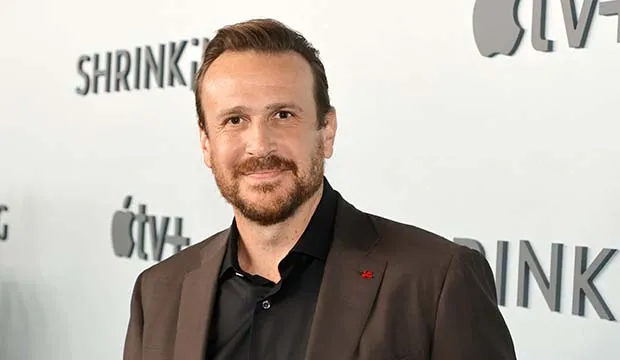
When preparing to play therapist Jimmy on Shrinking — a man struggling with the sudden loss of his wife while trying to raise his teenage daughter, treat clients, and maintain his closely held friendships — Jason Segel found an unusual way into the character.
“I kept thinking about a badly twisted ankle. When you first get a twisted ankle, you’re allowed to talk about it and how it happened and then after a while, everyone has their own life, and you have to get on with your life. But you are privately in pain and you are reminded with every step you take that your ankle hurts constantly.
“I know that’s a strange analogy, but I felt like that was the Jimmy that needed to be there in all of the scenes no matter what was happening — you can’t see it right now, but my ankle is killing me.”

The Emmy nominee routinely draws on lessons from his own life when writing the hit comedy series alongside co-creators Bill Lawrence and Brett Goldstein. Below, Segel opens up about his “twisty-turny” life, balancing humor with grief, and what lies ahead for Jimmy in Season 4.
GOLD DERBY: For most of the series, we’ve seen Jimmy defined by grief and dealing with it. At the end of Season 3, he starts to move forward. Is moving forward almost scarier in a way?
JASON SEGEL: I’ve had my version of a twisty-turny life. Luckily, nothing like Jimmy went through, but I do think that it’s a very interesting and really clumsy moment when you’re like, “OK, I am ready now to go give this a shot.” And then you go out the front door and very quickly you’re like, “No, I wasn’t. This was much easier in front of the mirror.” So yeah, it’s really fun this season. Someone deciding to be happy presents its own world of challenges.
How have you personally changed from playing this character?
I think, thematically, the show has been very reflective of a place I wanted to arrive at in my life. There were two things — making art, and then also meeting my fiancée — where all of a sudden I look at my life and think, “Oh, it was all for this. You can’t change a thing now.”
How do you take moments from your own life and incorporate them into the show?
I had this moment where I had to go do something with people who I knew from 20 years ago. I was talking to my therapist, who is one of the people the show is based on, and I said, “I’m a little embarrassed to show up at this thing, because I am showing up to this room all covered in scars.” And without missing a beat he said, “What a shame it would be to show up anywhere at 45 years old not covered in scars.”
I immediately called Bill Lawrence and Neil Goldman, who runs the writers’ room, and I said, “Guys, I know how the show ends. It’s this conversation between Jimmy and Paul [Harrison Ford], because that is the last thing stopping Jimmy from moving forward.” It’s like, “Who wants this? Who could ever want this now?”

Every episode of Shrinking hits notes that are both heartwarming and heartbreaking. How do you strike that balance?
I have this idea that I call “the dirty underneath.” What is the thing that the person is too scared to say? You have all the lines, but that’s what a person is willing to say — just like life. I always try to figure out, what is the dirty underneath of this thing? And when they say that, that’s when you get the lump in your throat.
Do you ever experience internal conflict acting in a show that you also write?
The only time I have an issue is when I feel a writer, including myself, is trying to show how smart or clever they are. I have a hard time playing that. I’m like, “A person doesn’t talk this way. People aren’t this ready.” Other than that, I consider it my job to figure it out.
I heard Paul Thomas Anderson give an interview once where he said, “If an actor is having a hard time with the scene, it probably is my fault as the writer for not being honest.” I don’t really have that problem on Shrinking ever. The writing staff is very honest about these issues. By the time it arrives at my desk, it’s like, “Wow, someone has really put their insides outside on this script.”
What do fans say to you most often when they recognize you on the street?
People have come up and said, “Hey, I lost somebody and watching your character navigate it has been very helpful to me,” which is really nice. Sometimes somebody will come up to me who I think is my core audience from the period when I was making rom-coms and I’ll be ready for some cool compliment, and then they’ll say, “Oh, my grandmother loves you.” How did this happen?
When did you decide it was time in your career to step outside of rom-coms and try other genres?
I could have ridden the rom-com train until it hit the wall. I got pretty close and realized, this doesn’t feel good. People were starting to come up and say, “Hey, I liked this movie you made,” and in my heart I’m feeling like, “Oh no, not that one.”
I have been very inspired by people who do stuff that is reflective of where they are in their life — the David Bowie of it all. This is what I think is good, and you catch up. I think that is the leap of faith of a real artist. Sometimes you find out you’re wrong. But since I made the decision, even for stuff that didn’t work, I’m like, “Well, we gave it a really interesting try.”
