
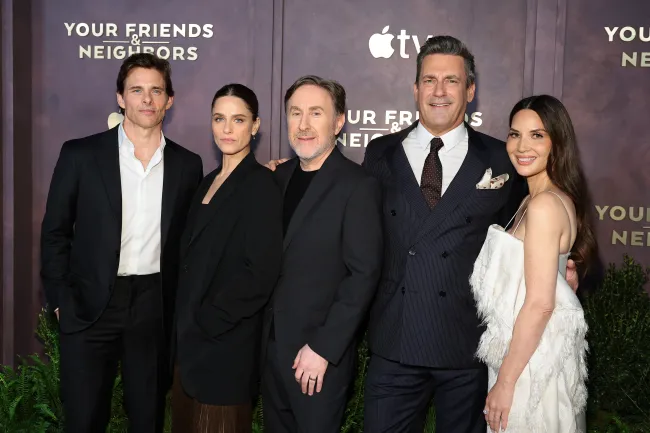
When the Emmy nominations were read out on the morning of July 8, Jonathan Tropper wasn’t watching. He was in Europe, on set with Jon Hamm, wrapping a shooting day for Your Friends and Neighbors Season 3, several time zones removed from the buzz of Hollywood.
“I got a text from someone at Apple congratulating me, and I didn’t know what it was about,” Tropper tells Gold Derby. “Then I got another one. So I called, and they said, ‘Yeah, Best Drama.'” He hadn’t realized that nominations were being announced that day. He caught Hamm in the driveway and told him in person — “we had a moment talking about it” — and pretty soon his phone started blowing up.

It’s technically the show’s second Emmy nomination overall. Season 1 picked up a solo nod for Best Original Main Title Theme Music, but this is the first time Your Friends and Neighbors has broken into a top series category. Best Drama Series was the show’s only nomination. No writing. No directing. Not even Hamm, who has 19 career Emmy nominations to his name.
Tropper has a theory about that, or at least a metaphor. “The way I kind of look at it, we won the popular vote as opposed to the electoral vote,” he says. “I do wish the actors in particular were noticed, and the writing and directing, obviously — but I guess if you’re going to get noticed for something, it might as well be the big one.”
He also has a harder-nosed read on why the recognition hasn’t trickled down further: the show doesn’t fit anywhere cleanly. “The fact that we’re in the drama category, but we’re up against much more straightforward, hard-hitting dramas. You look at a show like The Pitt, that’s a drama. It’s hard to compete when we’re not the same kind. We’re a comedic drama,” he says. “But if you put us in the comedy section, where we’re up against shows like Hacks or Widow’s Bay, we’re not really a comedy either. I think there really isn’t quite a category for us.”
Gold Derby sat down with Tropper to talk through the second season — that finale, saying goodbye to James Marsden’s Owen Ashe, what’s ahead in Season 3 — and how he’s suddenly juggling the suburbs of Your Friends and Neighbors with a galaxy far, far away.

Gold Derby: Coming off Season 1, what did you feel like you wanted to accomplish this season — did you feel like you had to change anything?
Jonathan Tropper: No. When we finished Season 1, I had that rare feeling that we’d made nine episodes that were all of a piece — it felt very cohesive, and I felt really good about what we’d made. I was excited about how it was received. So I think the first mandate for Season 2 was: do no harm. Stick with what we’re doing, keep telling that story, and at the same time, make sure we don’t repeat ourselves.
James Marsden’s Owen Ashe kind of upends the whole neighborhood this season. What did bringing him in as a disruptor add to the mix?
Exactly that — a disruptive energy. Bringing in a character who hadn’t been in Season 1, who comes in and immediately changes the dynamic between a number of the actors. The way we looked at it: in Season 1, Coop (Hamm) himself was the disruptor. In Season 2, we needed someone to come in and disrupt his new ecosystem. So we brought in someone who’s sort of the apotheosis of everything this town stands for — the wealth, the material goods, the good looks — the end result of all that run amok. Having him interact with everyone felt like a great way to keep exploring the show’s themes.

There’s a lot packed into that finale — Ashe’s death, the paranoia circling everyone. Walk me through building that episode. Where did it land for you?
I always knew from the beginning that the season would end with the three friends (Coop, Barney, and Nick) — and in this case, Samantha too — thrown into a situation where they now have to keep a secret together. The whole idea of what a really dark secret can do to a friendship. Coop has stepped into it again, with consequences he could’ve foreseen when the season started — and now, after everything that happened to him in Season 1, it’s actually reasonable for him to weigh hiding a body against taking his chances with the truth. We always knew we wanted it to end that way. We also knew we were saying goodbye to Ashe at the end of Season 2 — we didn’t have James beyond that. And the idea was that his death wouldn’t be a simple death, but would create an energy, a dynamic, a dysfunction that carries into Season 3.
That Night of the Hunter parallel is a sharp piece of foreshadowing. Did you have a personal connection to the film?
I didn’t — Jamie Rosengard, who writes the show with me, had the connection. Her movie knowledge goes deeper than mine. But the imagery worked so well with what we were doing. It’s a great little Easter egg, but also kind of obvious in a way — looking over the boat into the lake and seeing that car below, you can’t get much more on the nose than that.
That scene where Ashe wakes up and it all goes wrong in the car, leading to the crash — was that one of the tougher shoots of the season?
Yeah, tough — we had to shoot it in two places. All the choreography and fighting was done on our stages with blue screen; we shot the car itself on location separately. Lighting was a big deal, making it look organic since we were putting the night whizzing by in post — much easier to fake for night than day. It was choreographing a fight inside a car, which is difficult mechanically, but you also can’t really use stunt people — the cameras are too close, there’s no way to hide faces. So it was all actor action. A lot of rehearsal, trying to keep everyone from accidentally hurting each other, and getting a real performance out of them when the car’s not actually moving. It was Stephanie Laing directing, plus our stunt coordinator, and a really collaborative effort to pull off.
What about the underwater sequence, moving Ashe from the back seat to the front?
That was our last day of shooting — the day the show wrapped, because we only needed the four actors left. It was done in a tank up in Connecticut. A lot of detail and planning, guys in scuba suits everywhere with safety oxygen and lighting. I’ve done tank shoots before, but never one where all my principal actors were the ones going underwater. A little nerve-wracking, but also a lot of fun.
You’ve built the whole show around Hamm walking the line between the guy you’re rooting for and someone genuinely dangerous. How much of that is him?
I actually don’t think there are villains on the show — I think there’s a lot of damaged people. But when I conceived of the show, he was really the only actor I wanted to do it with. I didn’t write it until I’d met with him and gotten at least an inclination he’d be up for it. What he brings is a certain relatability — a likability, for lack of a better word — where even when he’s behaving badly, there’s a vulnerability that keeps you in his corner.
Where do things stand for Season 3? You’re currently filming — same timeline as the last two seasons?
Roughly the same. I forget our exact air date — it’ll be a month or two later than the annual cycle, just because Season 1 was nine episodes and Season 2 was 10, which pushed things a little. So we could start Season 3 a bit later than we started Season 2. I think it’ll air a few months after the one-year mark — I don’t know exactly when yet.
We know Michelle Monaghan and Joshua Jackson are joining. What energy are they bringing?
Michelle brings a very different energy than Marsden — tonally, it’s a different arc for Coop. We were all really excited working together, and she immediately felt like she belonged in the world. Josh comes in to play a very specific role — we courted both of them for exactly what they bring. His character takes us into an arena we haven’t been in before. I’m excited for people to see it.
You’ve also got Lucky on Apple TV right now with Anya Taylor-Joy. What’s that shift like, going back and forth?
I’m always working on multiple things, but this was rare — we shot Lucky at the same time as Season 2 of Your Friends and Neighbors, which doesn’t usually happen, and I hope it never happens again. I had to let go a little to maintain my sanity — I couldn’t shuttle back and forth between LA and New York. I was very involved in scripting and post on Lucky, but my co-showrunner Cassie Pappas was on set every day. We also had Hello Sunshine producing with us, so we got a lot of help there. Your Friends and Neighbors has been my baby from the start — no outside producers. They’re very different shows, so it’s not like I accidentally wrote something for one that belonged in the other. It was just juggling two sets of production, two call sheets, two post schedules. A lot. Something I hope not to do again, at least not in the showrunning role.
What’s the toughest thing about showrunning that people outside the industry might not understand?
Two things. First, how all-encompassing it is — you don’t quit at five, you’re on for all the hours the show is shooting, which is a 12-and-a-half-hour day, plus meetings before and after, catching up on weekends with script revisions. We do production meetings during lunch breaks, wherever we happen to be shooting — we’ve done them in churches, gyms, classrooms. And second, managing people. A lot of writers aren’t interested in that part, but showrunning means being on top of every script and every production while also being a people person — sensitive to people, but able to lead. There’s a lot of people management that happens between action and cut.
We’ve seen upsets before — last year Jeff Hiller won in Supporting Comedy Actor from seventh place in the odds. What would an upset mean for you here?
It would mean the universe, as I understand it, is wrong. I don’t see us winning. I think we’re all going to enjoy the night more because we’re not sitting there wondering if we’ll win. We’re pretty certain we won’t. It’s more about having broken through into the conversation, and the hope that being Emmy-nominated leads people to consider our actors more seriously, along with the writing, directing, and other categories. We have a phenomenal costume department, but they’re doing contemporary work, and that doesn’t always get noticed as fast as period pieces do. I’d love for this to be the point of the spear that gets our departments noticed at the other awards — the winter awards — and puts us in a better position the next time Emmy nominations roll around.

You’re having a wild stretch — Lucky‘s airing, this show’s mid-Emmy campaign, you’re in post on Star Wars: Starfighter, and you just landed Ghost Rider with Ryan Gosling. Where’s the time for all this? And what would your younger self think about you being in the Marvel and Star Wars universes?
It wasn’t necessarily the plan. It wasn’t on my radar. I started screenwriting in my late 30s, not my 20s like a lot of people, and I spent years getting hired to write things that never got made. I’d guess what didn’t get made far outweighs what did. But after spending years trying and failing to get things made, there’s something satisfying about being in a spot now where I can pick projects with a much better shot at getting made, and where I can influence whether they get made at all.
It feels validating after all those years of feeling powerless when something didn’t get greenlit because we didn’t have the right filmmaker, or actor, or the studio said X, or the network said Y. Now I can preempt a lot of that, circumvent it, and stack my projects in a way that gives them a better chance. Walking into Apple with Your Friends and Neighbors, with Hamm already attached — being able to up your odds like that significantly — it feels good to be in that spot.
What flipped the switch for you from novelist to screenwriter?
They kept optioning my books for movies, and the movies weren’t getting made. I got curious why people were paying what seemed like a tremendous amount of money for things that weren’t happening, so I started reading scripts and thought, I feel like I could do this. It started with wanting to get my own books turned into movies. One of the first scripts I wrote was the adaptation of my novel This Is Where I Leave You, which actually got made. It began as a way to try to get my books adapted, and then I just fell in love with the art form, and with how collaborative it is compared to novel writing.
So they weren’t adapting your books very well?
They were trying — I don’t know if they were doing them all justice — but they weren’t getting made. I had five books optioned, and only one got made, and that was the one I wrote myself. I think there was something about my books that made them hard to adapt, or maybe Hollywood just wasn’t that interested. This was pre-streaming, so there wasn’t that channel to move projects into. Either the studios were optioning books that were never going to be studio films, or there was just a disconnect.
Can you tease anything for Season 3?
I think it’s a different season than Season 2. The danger is greater for Coop and his family. But there’s also something more romantic about it — it’s a more passionate season. More romance, but also more danger than he was in in Season 2.
This interview has been edited for length and clarity.
Your Friends and Neighbors Seasons 1 and 2 are streaming now on Apple TV. Season 3 is currently in production.
