
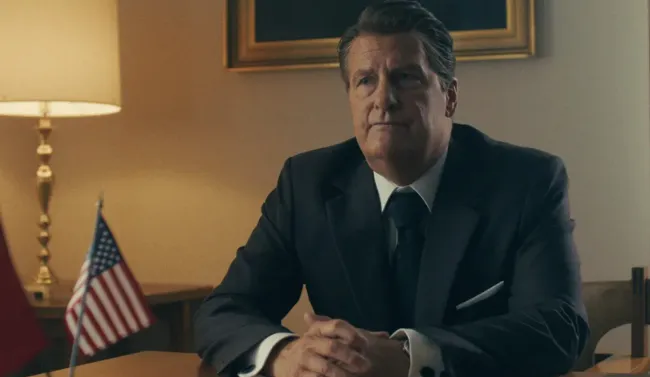
The Brink of War opens nationwide this Friday, dramatizing one of the tensest and least-remembered turning points of the Cold War: the October 1986 Reykjavik Summit, where Ronald Reagan and Mikhail Gorbachev spent a weekend at a small house on the Icelandic coast flirting with an agreement to eliminate nuclear weapons. They walked away with no deal signed at all. Jeff Daniels plays Reagan opposite Jared Harris’ Gorbachev, with Hope Davis as Nancy Reagan, Branka Katic as Raisa Gorbachev, and J.K. Simmons as Secretary of State George Shultz, in Michael Russell Gunn‘s feature directorial debut.
The production shot 18 of its 20 days inside the actual Höfði House in Reykjavik — the same building where the real summit took place — with Daniels and Harris sitting in the original chairs Reagan and Gorbachev used back in 1986.

The weight of the material stuck with Daniels well past filming. “We’re kind of heading backwards away from what Reagan and Gorbachev were trying to do in Reykjavik in ’86,” he says, pointing to the growing number of countries developing nuclear weapons today. “We’re heading back towards a mutually assured destruction of the only planet we have.”
Daniels joined Gold Derby ahead of the release to talk about what drew him to Reagan — this is actually his third time playing a man who’s held the presidency, after voicing Thomas Jefferson for Ken Burns’ The American Revolution and playing George Washington in The Crossing — and what he’s thinking about audiences who might resist a movie humanizing Reagan it today’s political climate.
Gold Derby: What was it about this exact moment in history that excited you or motivated you as an actor?
Jeff Daniels: It didn’t. It had nothing to do with taking this role. It was the role. It was, how do you do Reagan? And when you find out it was based on an actual meeting that happened in ’86, now it’s a little bit like doing Gettysburg or something like that — you’re doing a historical piece, looking for the authenticity of back then. And then as you dive into it, you find out how dangerous the world was then, and the threat of nuclear weapons then. And that’s all you focus on. You focus on that weekend and trying to create — or recreate — your version of what Reagan was thinking and feeling.
After you’re done with it, you look around now and it’s still a dangerous world. And the nuclear weapons — more countries have them, some are developing them, some want to develop them. We’re kind of heading backwards away from what Reagan and Gorbachev were trying to do in Reykjavik in ’86. We’re heading back towards a mutually assured destruction of the only planet we have. And you hope that there are leaders around the world who will remember what happened that weekend in October ’86, and be able to get in a room and realize that the redundancy of so many nuclear weapons doesn’t have anything to do with being superior. We talk about that in the film. It’s about what do we have to do as a world to make this a safer place for all of us? Because it isn’t.
It’s difficult to imagine this happening now, if I’m being honest. Can we get hope from this film, or is it more just showing us a path that used to be possible?
I think there would probably be more players today, and maybe there are more extremes today with what’s going on. But it was as dangerous, if not more so, in ’86. Seventy thousand warheads from the two superpowers were pointed at each other, in the U.S. and our allies on both sides, with no missile shield, no Star Wars [Reagan’s proposed missile-defense system, nicknamed for its sci-fi ambitions]. So the only thing both leaders had was: if Russia launched six nuclear warheads at six U.S. cities, Reagan’s only defense was to launch six back the other way. There are some protections now — inspections, the effort to separate nuclear energy from nuclear weapons — so it’s more complicated today, but it was as dangerous, if not more so, than it is now. Do we have the leaders? I hope so. There’s the hope.
Because if Reagan and Gorbachev — who were bitter rivals, from countries that did not trust each other at all — can get there, you have to hope that maybe there are people around the world who could get there again, if we reach that point. I hope so. I hope so.

You’ve played presidents before — Washington in The Crossing. You voiced Jefferson in Ken Burns’ The American Revolution. Are you a U.S. history buff? Are you drawn to presidents specifically, or what brings you back down this path?
No, they come to me. I was thrilled to play — I guess I played Washington first, for A&E, back when they made television movies. That was diving into research — there’s no YouTube visual mix of George Washington giving speeches, so you had to take that from the history books. Chamberlain (Gettysburg, 1993) was a joy to play, who led the 20th Maine at Gettysburg. Then Ken Burns calls and says, “Do you want to voice Thomas Jefferson?” What are you going to do, say no? “No, I’ve done enough presidents, thank you, Kenny.” No, no — you dive in and work with Ken Burns on what that voice is. And then Michael Gunn calls about Ronald Reagan. Honestly, at this point, I take roles.
I say yes, and then try to figure out how to do it. I don’t have an automatic, “Oh, I know how to do this, I can start shooting it Monday.” That’s a yes. I kind of enjoy the ones where I may fail — I may not be able to pull it off. The challenge at this point in my career is challenging myself, and maybe even at times surprising myself. But when you say yes, you say yes, and then you try to figure out how to do it. For me, at this point, that’s where the fun is.
Does it bother you at all that we’re in such a polarized country right now, where people will probably just be annoyed with you for playing Ronald Reagan at all?
I can’t control what people think I am. I would hope that they can see past the politics of whatever they think I am, or what I believe, or what they believe. That’s part of the problem — if you can’t look past that and see what the story of that weekend in Reykjavik is, oh well. But I did. There are things Reagan believes that I don’t, but that didn’t matter to me. I’m playing this great moment in American and Russian history, and I’m playing how Ronald Reagan worked his way through it. That has nothing to do with what I believe, or what I think, or what any audience member or somebody on social media might think. It’s irrelevant to me. I’m about playing characters — believing what they believe, saying what they believe and what they think. That’s my job. And I hope as many people see the movie and enjoy it — enjoy the political thriller we made of something that actually happened. But if you can’t get there, okay.
This interview has been edited for length and clarity.
The Brink of War opens in theaters nationwide Friday, Aug. 14.
