
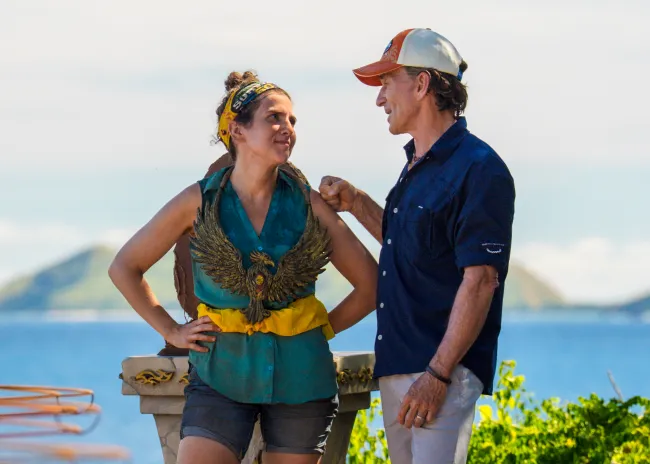
From an early age, Aubry Bracco remembers the vivid colors of Survivor and how the visuals “popped out of the screen.”
Now, after winning the $2 million prize for Survivor 50, Bracco has a deeper understanding of how that immersive experience is created — and it’s all thanks to Emmy-nominated cinematographer Scott Duncan, who’s been with the show since Day 1.
The duo take us behind the lens of Survivor 50, from the instant-classic “Blood Moon” episode (which is being rerun on CBS on Aug. 11), to the cinematic images featured in the iconic main title sequence.
After living with the cameras for a day or two, they seem to completely disappear for Bracco and the other castaways. “They just kind of mold into the background” and become “part of the tapestry of the jungle,” she tells Gold Derby. “You don’t see anything [at Tribal Council]. They have a way of shape-shifting into the moment, and they’re gone.”

For Duncan, his crew is always experimenting with new cameras and finding unique ways to tell stories that make the audience feel like they’re part of the action. “The evolution has always been about good, better, best,” he says. “Keep moving forward. What is the next step?”

Gold Derby: Aubry, before you ever appeared on the show in Season 32, what do you remember most about the visual style as a viewer?
Aubry Bracco: I remember when I was 14 years old for Season 1, and Survivor‘s colors were more vibrant than anything I’d ever seen. They popped out of the screen for me. It’s like when there’s a piece of film and it burns so bright that it’s burning through the film and it felt like you were there. I always felt like the show welcomed you into the screen, and that’s what caught me.
Scott, you’ve been with Survivor since the beginning. How has the look of the show evolved over 50 seasons, beginning with Borneo?
Scott Duncan: A lot has happened in 50 seasons, but from day one, hour one, second one — even prior, talking to Jeff Probst and Mark Burnett — my mindset was that this was going to be so special, so authentic. I wanted to make the visuals so strong, so memorable. From Season 1, I always wanted the challenges to be a memorable, athletic, cinematic, one-of-a-kind combination in the recipe for the stew. We were really passionate about creating something new.
The evolution has always been about good, better, best. Keep moving forward. What is the next step? Even when we got into the 20s, the 30s, we’re not sitting still. Let’s keep evolving. Jeff was evolving. I was evolving the look for the energy, so the viewer could feel what the contestants were going through. We kept it as visceral as possible.
Then technology started to come into play more. On the first 10 seasons, I shot a lot on motion picture film to give it a cinematic feeling. As technology evolved, we got drones, new cameras, lenses, low-light cameras, and more night vision cameras. Every year, I try to bring two or three new cameras to test, even if it’s going to be three or four seasons that I’ll start actually using it in the show. I’m testing now, actually, for the future.
Aubry, as a contestant, how often do the cameras get in your way, or how long does it take you to stop noticing them?
Bracco: The first day, you’re gonna notice them — before the game starts. I will say, this guy comes packing with some new camera and I’m always like, “Where did that come from, or what’s this bubble thing that goes in the water?” But very quickly, the camera crews aren’t there anymore. You don’t even see them. It’s almost like that Homer Simpson meme where he goes into the bush and he’s gone.
They just kind of mold into the background. Duncan and everyone on the crew really become part of the tapestry of the jungle. When you hear how many cameras are actually at Tribal, it’s shocking, because they’re literally nestled everywhere, but you don’t see anything. They have a way of shape-shifting into the moment, and they’re gone.

What was the process of learning how to hide the cameras?
Duncan: From the early seasons until now, our camera operators and documentarians are literally some of the best in the world at disappearing, like Aubry said. Tribal is a set, but we try to make it feel real without any cameras. I’ve minimized so many things trying to elevate and hide the illusion of Tribal in the last 10 or 20 years, to get it to where it’s at now in 50. What is real and what’s not? That’s what’s fun about it.
Bracco: On Survivor 50, I remember going with Stephenie and Jonathan to catch crabs in a beautiful cave on the merge beach. The crew was like mountain goats. You don’t even see them, but they’re on the rocks following you wherever you want to go. We’re not restricted at all, which is crazy, because they’re moving as fast as we do with so many pounds of equipment.
Duncan: We try to move faster, because over the years the crews have become so experienced. We’re trying to think about what you’re thinking, to maybe get one step ahead. But it’s also fun to follow when you don’t know. That’s true vérité reality filmmaking, and the operators enjoy that storytelling challenge.
One episode we wanted to talk about was “Blood Moon,” Episode 6, where three people went home — Kamilla, Genevieve, and Colby. Scott, how do you approach something unique like that?
Duncan: When Jeff told me about the “Blood Moon” concept, I loved it. Again, it’s evolving, evolution, ideas, challenges. It comes back to when Aubry is gonna walk in: her mindset is focused, she’s got her game plan going, but now there’s a red color tone to it. It just helps put the weight a little bit more on how serious this whole storyline is. Visually, you want to go for it, but you don’t want to go over the top. You want to give it touches of a turning point. After some testing ahead of time, the players will come in and feel something special and different happening.
Did you feel that as a contestant?
Bracco: Oh yeah, I remember that night distinctly. That was my first time back at Tribal Council since I got blindsided with an idol in my pocket [in Survivor: Game Changers]. And I had an idol in my pocket, and it was sort of a face-off with the person at that point who was kind of my mortal enemy in the game, and I do remember walking in and being like, “What did they do? This is different. And I don’t think it’s my state of mind.” There’s something in the emotional texture in the space that felt a little bit heavier and had more gravitas than it normally does. It was like, “Whoa, I’m walking into something tense here.”
Scott, do you ever find yourself rooting for one contestant over another? Do you get invested like we do as the viewers?
Duncan: No, I love them all. First-time players, multi-time players — what we offer them, and what they offer us, it’s just a phenomenal experience. We want the experience to be pure and authentic for them. Using Jeff’s words, it’s their game. We’re challenged to enjoy and to capture it honestly and clear for the storytelling. But am I rooting for Aubry? [Laughs.] I’m equal to it all, because they all bring something special to the whole experience for me, top to bottom.
Bracco: There’s something about just the beauty of the process. I had to come to peace with Survivor after 38, because I did so badly and had to do a lot of personal work to get to a good place. I was thinking, “This is the beauty of Survivor.” There are 24 people here, and right now, anything could happen. This is where I’m really excited to just watch now and be a fan again. You don’t know what you’re gonna get when you get into that box of Survivor chocolates.
Scott, can you break down how you shoot the contestants for the main title credits? In particular, Coach’s image in the cave stood out to me as so beautiful.
Duncan: Since the beginning and until now, I always want a memorable moment that shares something about the players. For Coach in Season 50 in the cave, it’s like capturing those verité moments within the space and representing his individual personality. The key I try to go for is how can I capture an in-game moment that shows them independently as their own. I gather three or four different layers within the recipe, and then through editing, you want the main title to insanely jump off the screen and be memorable. You want to watch it again and again and again. That’s always my goal.
Bracco: I loved Q’s this year, I have to say. That one was so cool. And there’s a shark before me, and I think, “That feels right.” You don’t see me coming when I pull you under.
Scott, do you have a favorite main title shot or sequence over the 50 seasons?
Duncan: Even the years we didn’t make main titles, I was kind of making main titles a little bit, shooting-wise. I remember some of the early seasons, like Gabon was a crazy location in the world. I can’t pick out one — they’re all your favorite children, because you try to outdo each one. The first season in the Philippines was a crazy journey. When we were changing countries, I tried to capture more of the culture and landscape so viewers could feel where we are in this region of the world. Cambodia was like that.
Coming to Fiji, it’s now even opened up more. We know we’re in the most tropical island, blue-green paradise. Now I’ve been able to take it even further with animals and wildlife, or much more underwater filming, and that’s been exciting. Some of maybe my favorite ones might be out of Fiji even. They’re all just a fun journey to go on. Working with Russ [Landau] to do the sound design of those, we always add a little bit of tweak and twist and bend in there to each season in the soundtrack for the main title. Every time, we look at it as a fresh palette. How can we keep reinventing it visually?
Aubry, why do you think Emmy voters should vote for Survivor 50 this year?
Bracco: I keep going back to what Duncan said about evolution. I really feel that when I’m there. I’ve had the blessing of being on Survivor over a decade. I mean, my 30s were Survivor. The way to which Jeff and this entire team have pushed their life’s work to the next level, they deserve all the accolades they get. It’s a savage business, and I think they’ve demonstrated that they outlast everybody.

‘Big Brother 28’ cast: Meet the 17 houseguests including a ‘BB’ icon, 2 ‘Survivor’ legends, and a ‘Drag Race’ All Star
One last off-topic question: Are you watching Devens and Dee on Big Brother, and what do you think of their games?
Bracco: I think Devens is finally getting the kudos that he deserves. I’m very proud of him. He’s always been the same Devens to me, but I’m proud of how he’s adjusted his pacing for Big Brother and how he’s just the nice dad in that house. He seems to have done very well figuring out where he fits in that particular group of people. I think he’s playing a great game. Dee is a savage, surgical player. She scares me! She’s an amazing player, and her charisma just leaps off the screen. So I’m really proud of both of them.
This interview has been edited for length and clarity.
