
For Cameron Moody, Washington Black offered the kind of opportunity composers spend years hoping for: a sweeping, unabashedly melodic canvas large enough to match the scope of its story. His score rises and soars alongside Washington’s journey, carrying themes of flight, wonder and resilience through every episode. “To get the chance to lay it all out and have a big orchestra and be able to write in that kind of classic style, especially on your first show, I think any composer would be pinching themselves,” Moody tells Gold Derby in our recent composers’ Spotlight panel.
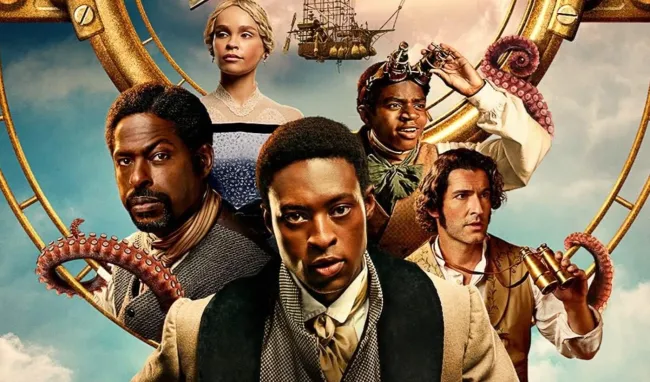
Based on Esi Edugyan’s bestselling novel, Hulu’s Washington Black follows George Washington “Wash” Black (Ernest Kingsley Jr.), an 11-year-old boy born on a Barbados sugar plantation whose scientific imagination sends him on a globe-spanning journey shaped by family, freedom and love. Moody is nominated for Best Limited Series Music Composition for the finale, “If You See My Mama, Whisper Her This…”

Rather than score the story like a travelogue, following Wash from Barbados to Nova Scotia, London, Morocco and Dahomey through regional instrumentation, Moody chooses to follow Wash inward. He grounds the score in the character’s emotional life, finding a musical language for curiosity, longing and self-discovery that can mature across the series without losing its essential shape. “The power of dreams can take us farther than our mind could possibly imagine,” he says of the show’s guiding idea.
Below, Moody discusses leaning into big orchestral feeling, shaping a theme that grows with Wash, the terrifying ambition of the “Building the Wind Sailor/Flight/To Dahomey” sequence and the finale cue that becomes the emotional summit of the score. Watch the full video interview above and read the complete Q&A below.
Gold Derby: This score is so earnestly sweeping, melodic and unabashedly emotional. At a time when so much television scoring is restrained or atmospheric, was it liberating to lean into big themes and big orchestral storytelling?
Cameron Moody: It absolutely was. Like you said, there’s a trend happening in television where you’re not really getting asked to do that kind of thing very often. So to get the chance to lay it all out and have a big orchestra and be able to write in that kind of classic style, especially on your first show, I think any composer would be pinching themselves to get that opportunity. I know I certainly was and still am. It was incredibly freeing to not feel like I had to fight uphill for any of the ideas that I wanted to inject into the music. But it was also something that was very intentional on the part of the filmmakers. They made it very clear that that was what they wanted. That was the best way to service the emotion in the story and to be able to communicate all of the necessary narrative and musical beats. I was thankful that the creative team and myself were all trending in the same direction. It made it totally easy and seamless the entire time. I really couldn’t have asked for a better process.
There’s a particular choice you made by instead of going to Barbados or Nova Scotia or London or Morocco in your instrumentation, you’re following his emotional journey. How did that idea shape the whole architecture of the score?
It took some of the pressure off, to be honest. When you’re staring down the barrel of all these different locations, it can be really daunting to think, “OK, I have to approximate all these different cultures and try to use instruments and influences from all these different countries.” It could be very easy to screw that up or for it to come off as affectation or pastiche. To be able to take a broader emotional approach was very liberating because I could just focus on the goings-on of all these characters rather than trying to make sure that I’m signalling the appropriate region. It made it simpler, but then the challenge became how to communicate all of the character movements with a singular piece of material.
One of the big narrative themes in the show is this idea that the power of dreams can take us farther than our mind could possibly imagine. For Wash, starting out as a child in captivity and having the dream of being his own person and being free, the idea that within those constraints you could find something that piques your interest; science, discovery, the wonderment associated with that, was something that I latched onto as a guiding post for developing his material. I remember in my own life what it felt like when you have that aha moment or the light bulb goes off with respect to discovering music, how that made me feel and how much I wanted to be completely enveloped in that. To be able to look at this character who has his own journey, it made it more relatable. Obviously, the circumstances are wildly different, but the message I think was pretty universal. That was my way in to developing his material.
The other part that was a challenge was how to mature it with the character because it’s not a typical 16, 24, 32-bar theme with a B section and development and reprise at the end. Trying to figure out a way to communicate something in a very short sequence of notes that could then be augmented, maybe played louder, softer, with the whole orchestra, with just an instrument, but that can also signal the growth in the character, that was a tricky thing. Once it landed and once it was working, I think it really had a positive impact on the show.
The climactic track from the finale called “Building the Wind Sailor/Flight/To Dahomey” is one of the score’s most expansive pieces. Talk us through building a cue that has to function simultaneously as adventure, emotional payoff and thematic culmination.
It was terrifying. That sequence is maybe six or seven minutes of almost no dialogue. The music is the only source of propulsion, of energy, of orientation as to where we are in the process of him building this wind sailor. For me, it was a very daunting task to approach, and that was one of the cues that I saved for the end because you want to have enough of the other stuff approved, working and under your belt before you tackle this big one. But eventually I ran out of other cues to write, and I had to face it.
The first part of that sequence, of them building the wind sailor, was probably the easiest part because it felt like all of the previous seven episodes were leading to that moment. This is the final act of them trying to achieve flight, which is Wash’s whole objective. For me, it felt like that final push, that fourth quarter, to use a sports analogy, where you’re just trying to grit through it and get to the finish line. It also reflected my own life of being in the eighth and final episode of a show and just trying to land the plane successfully. The opening of that sequence, the first maybe two minutes, was about gathering all your materials, rallying the troops and getting the job done. But once it pays off and they build it, achieve flight and end up back in Dahomey, rather than having the music be a showstopper, it was about pulling back a little more and letting the narrative, letting the visuals be the centerpiece and letting the music respond to that.
Specifically with the transition, because we have two or maybe three of those little map sequences, the kind of Indiana Jones thing, which I love, the first time we do it in Episode 8, I got a chance to do a full-on Spielberg-ian homage with them going to Morocco. But the second time, as we’re traveling across different parts of Africa and then we end up in Dahomey, it was less about trying to be big and more about setting the table for what we’re about to see, which is him coming home essentially and feeling all of the feelings of coming to a place that he never knew, but someone, being his mother, was tied to and connected to for so long.
Entering into a piece of your history that you never understood, that you never got to be a part of, was really the objective of the latter half of that sequence. It was a real challenge to figure out a way to not overplay it and not border on comical, but also supply all of the necessary energy and the pulse that you need in order to feel like they’re actually achieving something.
The finale of the series feels almost spiritual to me. You said the word “homecoming” before, and all of us know what that feels like to be going home. There’s grief, reconciliation, discovery and optimism all coexisting in the same space. When you arrived at those last few minutes of music, what absolutely had to be present for the ending to feel truthful?
I think you hit the nail on the head. All of the words that you just used had to be laced into the music. We had to feel the grief because at this point Wash has now discovered that the woman who took care of him since he was a child, who he ultimately had to leave behind, was his mother. That is a heavy thing to carry around. In the sequence just before the finale, he communes with his mother in a sort of vision as his wife is now giving birth to their child. He’s having to reconcile the fact that he was the child of someone who he ultimately had to abandon. It’s heavy and poignant, and all of the feelings of grief, sadness and loss are woven into it.
At the same time, in the beginning of the finale sequence, Tanna gives birth and they see their child and they name their child after his mother. Then he looks over and there’s a really beautiful shot where she’s standing on the bank of the water and she gives a little smile. At that point, it’s like, “OK, we’ve made peace. We understand that this is a part of the story and we can now move on and move forward.” The part of that sequence that made me the most emotional or the part that I responded to the most was when all the different characters that we’ve seen in the show are telling Wash to fly. Some of them have passed away, some of them he’s just left in pursuit of his purpose in life, but they’re all in this moment coming back to him and telling him to fly and go off and live his life. I think there’s something very universal about that feeling of having the support system, having that team behind you, that network, whatever you want to call it, who ultimately raise you up and send you off with all the experiences, all the love and the care they could possibly give you. For me, it was about honoring that in the music.
From a technical standpoint, I wanted to write something that felt familiar to the world of the show, but something we hadn’t heard before, really for no other reason than because it’s the finale. You get one chance to put a bow on everything. I wanted something that felt fresh and that could make you feel as though you’ve just been on a journey with these characters and it’s coming to an end. You feel like you’re a part of it. You feel like you’re a fly on the wall or you’re in the backseat. For me, it was a real joy to get to sit down. Again, it’s a sequence with very little dialogue. Looking at that and trying to spot it was tricky because you go, “OK, they’re not saying anything there. They’re still not saying anything, and they’re still not saying anything,” but somehow you have to pace it. It has to feel natural. It can’t be rushed. It can’t be too slow.
Thankfully, it was one of those rare moments I think for any composer, but certainly for myself, where the notes just came. I didn’t have to force it or labor over it. It felt like I had a direct line to the muse, so to speak. I was able to communicate my ideas very quickly and latch on to a piece of material that I could then use as the foundation for the entire five-minute sequence. In its totality, that was the very last cue that I wrote in the entire process. I’m happy to say that was the first iteration of it. That’s not something that happens to me very often. To get that feeling of finality and also have it land out of the gate was really special. If there was one piece of music or one cue that I had to hang my hat on for Washington Black, it would be the finale.
This article and video are presented by Hulu.
