
Warning: This story contains major spoilers for House of the Dragon Season 3, Episode 8. Please proceed with caution!
Happy endings in Westeros are hard to come by.
As Cersei Lannister said, “When you play the game of thrones, you win or you die. There is no middle ground.” But that doesn’t mean it gets any easier for audiences to watch a beloved character leave. Over the last three seasons on House of the Dragon, actress Phia Saban made Helaena Targaryen an undeniable fan favorite, imbuing the ethereal princess with quiet confidence and compassion for all creatures, big and small.
This season, Helaena comes into her own as a “dragon dreamer” — a rare oracle in Thrones lore who can see into the future. Exactly the kind of gift Queen Rhaneyra (Emma D’Arcy) wants all for herself.

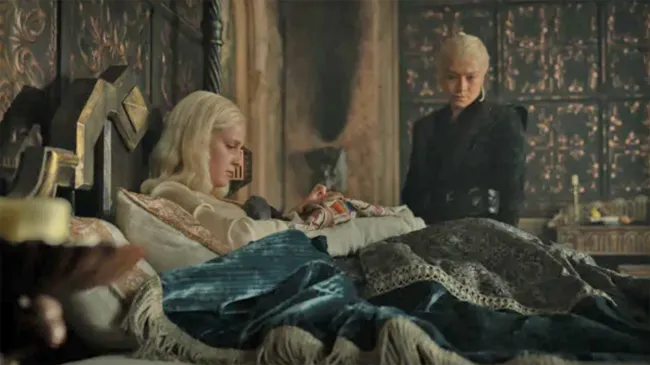
In Sunday’s epic season finale, Helaena finally squares off against Rhaneyra. “All the things you care about are ugly,” she tells her half-sister. “Our father would hate you for this.” Rather than stay in King’s Landing as Rhaneyra’s pawn, Helaena chooses to take her own life by jumping out the window.
Gold Derby spoke to Saban about finding “freedom” in Helaena’s ending, why those visions “all feel quite damning,” and what it’s like to play a pacifist in a power-hungry universe.

Gold Derby: What was your reaction when you learned Helaena’s fate?
Phia Saban: It’s kind of something I was always aware of because it’s very, very hard to find out things about these characters without the big bullet points hitting you. As soon as I got the job, I was doing a lot of research about her, so it was something I always knew was coming. It’s quite a bucket list to die on TV — especially in the Game of Thrones universe. I’ve been quite excited, really.
Have you felt the love from fans over the last three seasons?
It’s really nice and surprising. I really have. It’s lovely.
How satisfying was it to go toe-to-toe with Rhaenyra in this finale?
It’s always great when you can really sink your teeth into something. I’ve been so lucky to have really talented scene partners. I think that’s something about House of the Dragon; I can’t believe my luck that so early in my career I’ve gotten to be in the room with really sick actors. Getting to do a whole TV show with mostly Olivia Cooke is such an actor’s dream.
But that dynamic with Rhaenyra is really juicy because it’s something I’ve always kept in mind for Helaena all three seasons. I find it really interesting how she might feel about Rhaenyra being the other female child of Viserys; how Helaena might compare herself to Rhaenyra; and obviously, the context of the murdering of her child; how sensitive she feels toward Alicent, and how Alicent’s relationship with Rhaenyra is clearly so intense. Rhaenyra is actually someone that Helaena has given a lot of thought to, so getting to be in that scene, and getting to speak truth to Rhaenyra was really satisfying. And obviously it’s so fun to work with Emma — and it’s something I’ve been wanting to do the whole time I’ve been on the show.
What’s it like playing the only character in the show who doesn’t want power?
It’s really fun to play a character where how they feel about themselves and what’s expected of them — the gap between those things — are big. Because there’s so much juice there. Do they feel insecure or humiliated that they don’t live up to what’s expected of them? What are their coping mechanisms? It feels like it’s been a really nice hotbed, that specific thing about power and the throne, through which to quietly make a lot of decisions about Helaena.
Also, as she states to Rhaenyra, she sees great beauty and use and power in parts of the world that no one she knows has any interest in. So, in a sense, that’s also in there. It’s not like she’s void of a relationship with power. Maybe she loves the idea of the microcosm of insects and this microscopic world because it’s a way she feels she can have a relationship with structures that’s not overwhelming. There are so many fun ways to interpret how she’s an outlier.
We finally get to see some of Helaena’s premonitions. Are these possible futures? What’s your interpretation?
Yeah, that is my interpretation. It’s a damning series of events. It’s about freedom, isn’t it? Here are the worlds where I live beyond what’s happening to me right now. One of them is Helaena on a dragon — and she’s destroying people. To see and vividly feel all of those options is, I think, definitely something else that brings Helaena closer to understanding the situation she’s in. They all feel quite damning to her.
Helaena tells Rhaneyra the dragons “alter” the Targaryens. On some level, she seems scared of becoming corrupted. What does it say about her that she ultimately chose not to ride Dreamfyre again?
I think that Helaena is an incredibly sensitive person and feels the shifts in her, and in others – on quite microscopic scales that other people might not, but sometimes misses bigger shifts. Her paradigm is very intense and specific. In my imagination, she probably absolutely adores and loves Dreamfyre, but has had that experience of feeling the start of something changing in her, and just knowing the danger in that. I think it’s sad for her that she can’t be with Dreamfyre as much as she wants, but in that way, she just knows herself.
One of the pivotal moments for Helaena is after her son is murdered, and all she says is: “They killed the boy.” It’s a chilling scene — what was that like to film?
Gosh, that feels like so long ago now. It was so intense. That was Episode 1 of Season 2 [“A Son for a Son”]. It was really exciting and scary. I personally am still learning about how to treat myself nicer with acting sometimes, because you just want to do the character justice. That’s something that I’ve learned a lot through Helaena — trying to trust and believe that like, if you’ve nurtured and developed this character, then you do know them, and you can’t make wrong choices as long as you’re being as open and truthful as you can. That scene was a big learning curve, because I was just trying not to freak myself out that this felt like a big moment.

Helaena confronts Alicent (Olivia Cooke) about being forced to marry her brother. These two have come a long way, but how do you see their dynamic in this third season?
I think it’s really interesting. I love playing that dynamic with Olivia. They know each other really well and in a sense, they’re each other’s only friends. I think that’s a really interesting element to a mother-daughter relationship, because it tells you a lot about those people. As if this universe wasn’t intense enough, there’s all sorts of resentments about codependency and decisions being made. I think Helaena starts seeing that Alicent is very much in a phase of her life where she’s reflecting on things like, “What could I have done differently? How could I have been different? How could I have spared my children what happened to me?” Helaena feels a lot of love and sensitivity toward that, but also rightly is feeling existential, and is like, “Did you do this to me?” I think whether or not wrong decisions or right decisions, I do personally think that Alicent just does her best.
What has the experience of being in the Game of Thrones universe meant to you?
It’s been the biggest, longest experience of my career so far. It sounds like a cliché, but it’s all true. I am just so happy and grateful. I love this character, and I feel that I’ve been able to do lots of fun stuff and also work on this crazy scale. So much goes into this show — so many creative people — every millimeter is covered in detail and meaning. Getting to work with those people and develop a character with those people is the biggest gift ever. It’s very hard — I feel like I haven’t worked out how to do my parting words. I still feel like I’m inside it and connected to it, but I am just really grateful for it, and I really can’t wait to see it carry on, and to see the work that all my friends do on that show. I hope it just gets even more mad, weird, and better — I think it will.
This interview has been edited for length and clarity.
