
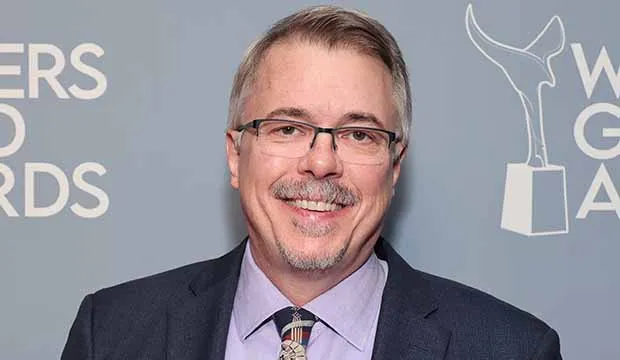
When creating his Emmy-nominated series Pluribus, Vince Gilligan admits he was “nervous” going into it.
“I figured the safe bet would be to do another Breaking Bad-related show,” Gilligan said at a Paley Media Council conversation in Beverly Hills on Thursday night. “That would have maybe been a smarter way to go, but I wanted to see if I had something else in me.”
In a cheeky nod to his first hit series Breaking Bad, about a high school chemistry teacher who cooks meth to make ends meet, the writer-director said, “I was scared to try something new, because you figure, you get that hit of crack that is success. You know, you want more.”

The award-winning multihyphenate also discussed his surprise at the incredibly positive reception to his Apple TV series (18 Emmy nominations’ worth!), the characters he considered killing off in Breaking Bad and Better Call Saul, his time on The X-Files, and what he thinks about AI’s role in Hollywood.

Looking back at his first hit series, which starred Bryan Cranston and Aaron Paul, Gilligan revealed that he had considered killing Paul’s character, Jesse, a former student of Cranston’s Walter White who becomes his right-hand man.
“I thought, ‘This is what happens when you think you know where a story is going. Yeah, we’ll kill him off at the end of Season 1 because it’ll be exciting. There’s nothing against the character. I just thought, ‘This’ll be great. You want a big cliffhanger at the end of your first season.’”
However, he said that changed pretty quickly. “But then, very shortly into the process, I got to know and love Aaron Paul,” he said, “and I was like, ‘There’s no way I’m going to kill this guy off.’”
That’s exactly what Gilligan said he loves about the process of creating television.
“It’s a living, breathing thing if you allow it to be,” he said. “You could stifle it, you could shoehorn it in a box, and we could have killed off Jesse Pinkman, because we could have said, ‘No, we’ve got this idea, and it’ll be great,’ and it would have been to our detriment, it would have been a big mistake.”
The same goes for Pluribus star Rhea Seehorn in her Emmy-nominated role as Kim in Gilligan’s acclaimed Breaking Bad spinoff, Better Call Saul.

Jimmy McGill, aka Saul Goodman, played by star Bob Odenkirk, “probably needs a love interest,” Gilligan said “We’ll cast this young woman [Seehorn] none of us were familiar with. She came in, she wowed us. ‘Maybe she’s the one, and if she’s not, we’ll get rid of that character.’”
That’s how TV gets made, Gilligan said. “At least the way we do it, and it sounds haphazard, half-assed, but we are lucky when we have enough time, and we’ve been graced with that from Sony, our studio, and then AMC,” he said.

The Emmy-winning creator admitted that his much-lauded second hit series, co-created with Breaking Bad writer Peter Gould, had a similarly haphazard beginning.
“We were coming off this high of Breaking Bad, and anything Breaking Bad-related was an instant yes, and we went to Sony and AMC and said, ‘I think we want to do it,’” Gilligan said. “And they’re like, ‘Yes!’ I didn’t even know what the damn show was.”
Gilligan got his start in television as a writer and eventual producer on the landmark series The X-Files from creator Chris Carter, which he said was like “going to film school and getting paid to attend.”
While the Virginia-born Gilligan had attended film school at New York University and written the 1998 film Home Fries, starring Drew Barrymore and Luke Wilson, he admitted that working in a TV writers’ room helped give him the discipline he needed to consistently create.
“I had no self-discipline,” he said about his time writing film scripts. “And if I hadn’t wound up working in TV, I don’t think I’d be here tonight, I would have slowed down my output of scripts. I was not enough of a self-starter to be a movie writer, and working in writers’ rooms, starting with The X-Files, it kind of saved me.”
This came after Gilligan had originally turned down Carter’s offer for him to move to Los Angeles to join the writing staff of The X-Files. “I was a little scared of moving, a little intimidated by living in Los Angeles,” Gilligan said. “It was just inertia, but I wound up turning the job down originally, and thank God it was still available to me six months later, because in the meantime, I lost my Writer’s Guild insurance.”
That’s when he called Carter back a few months after turning down his initial offer.
“I said, ‘Is that offer still available?’” he said. “Thank God it was, and my life changed.”
Gilligan reflected on how the television landscape has shifted in terms of episode output per season, explaining that The X-Files was producing between 22 and 26 episodes over the course of about 11 months. Pluribus, by contrast, had a nine-episode first season.
“I don’t even know how this works, and I don’t even want to say it out loud, I don’t want to jinx it,” he said. “I love money, I love capitalism, I try to understand the business end of things. I don’t know how the hell you can do nine or 10 episodes in two, three years and make a go of it.”
That said, he also didn’t want to question it too much. “I don’t know how it works, but I’m going to ride this f—ing gravy train until the wheels fall off the engine.”

When it comes to artificial intelligence — a topic that has been a consistent talking point in Hollywood surrounding rights, ethics, and storytelling — Gilligan said that he didn’t “want to step on any toes” because a lot of “brilliant people” are creating it.
However, despite having “valid uses” (Gilligan suggested recycling-minded robots), he said that writing stories is a bridge too far: “Our stories, that’s the most human thing there is, is a human being telling another human being their story.”
As far as his own stories go, the Emmy winner acknowledges his unique success.
“I feel like I’ve won the lottery three times now,” he said, “and I don’t feel like I deserve it or anything, but I’m very happy and feel very lucky and fortunate.”
