
Over the past decade, popular music has undergone a radical transformation. What once were omnipresent hits defining global culture are now perceived as fragments of a more diverse ecosystem, driven by the rise of streaming, the continuing influence of social media, and the multiplicity of platforms. The much-lamented, much-debated “death of monoculture” has become a subject of concern, and one of the key factors behind this shift is the decline of strategic artist collaborations, aka “featurings.” In fact, the slow disappearance of monoculture is reflected in the Grammys‘ Best Pop Duo/Group Performance category. The category is a barometer of how voters perceive hit music, the blending of styles, and the cultural impact of collaborations, and the parade of winners from the past 10 years has shown how the contemporary music industry has evolved accordingly.

The combination of streaming platforms and social has democratized the distribution of music. Artists and labels can deliver music directly to fans rather than having to rely on radio airplay, which was typically a barrier for artists and smaller labels without the means of the corporate record companies. Whereas in the past, radio programmers were the cultural gatekeepers, picking a relatively small selection of songs tracks destined to dominate the charts, the emergence of social and streaming had led to a more diffuse musical landscape. A song has multiple paths to the charts, and instead of the industry mobilizing behind a handful of hits — the tunes that would traditionally comprise the monoculture — artists can appeal directly to a niche audience.
So how has the approach to collabs changed and how have featurings evolved in an era dominated by streaming?
There has been a paradigm shift in how artists are perceived, putting an emphasis on solo success. Performers are seen as more legitimate if they succeed on their own merits rather than coattail-riding on a popular colleague. Several of the most talked-about projects of the year don’t even include a featuring. Among these are Harry Styles latest album, Kiss All the Time, Disco Occasionally, Slayyyter’s acclaimed Worst Girl in America, and Ariana Grande’s Petal — each puts the emphasis firmly on the headline act.
But the artist-first trend limits exposure and weakens the collaborative culture that once united genres, languages, and audiences. A clear example is Album of the Year winner Bad Bunny, who gained significant visibility in the Anglo industry thanks to featurings with established artists, such as “I Like It” with Cardi B and J Balvin, and “Un Día (One Day)” with Dua Lipa, Tainy, and J Balvin.

Globally massive hits like the “Despacito” (Remix) by Luis Fonsi, Daddy Yankee, and Justin Bieber reflect the impact of cultural union, earning a nomination in the Best Pop Duo/Group Performance category in 2018. Other successes like Shakira and Wyclef Jean’s “Hips Don’t Lie” and Jennifer Lopez and Pitbull’s “On the Floor” had undeniable worldwide popularity and are still remembered today.
On the other hand, many artists who do featurings tend to collaborate with colleagues who share the same target audience, genre, and language. Examples include “I Can’t Love You Anymore” by Ella Langley and Morgan Wallen, or “WAP” by Cardi B and Megan Thee Stallion. These songs achieved notable popularity, as demonstrated by their performance on Billboard‘s Hot 100, but it is fair to say that their audiences overlap, meaning these featurings don’t necessarily diversify their target. Looking directly at the 2026 nominees for Best Pop Duo/Group Performance, another example is the acclaimed hit “30 for 30” by Kendrick Lamar and SZA, where the similarity of audiences is undeniable, unlike 10 years earlier, with nominations that include featurings such as “See You Again” by Wiz Khalifa and Charlie Puth, or “Bad Blood” by Taylor Swift and Kendrick Lamar, solid examples of featurings that united different audiences and broke cultural barriers. Without a doubt, the union of audiences not only benefits artists but also enriches culture, improving diversity representation and contributing to equal opportunity in terms of visibility in the market.

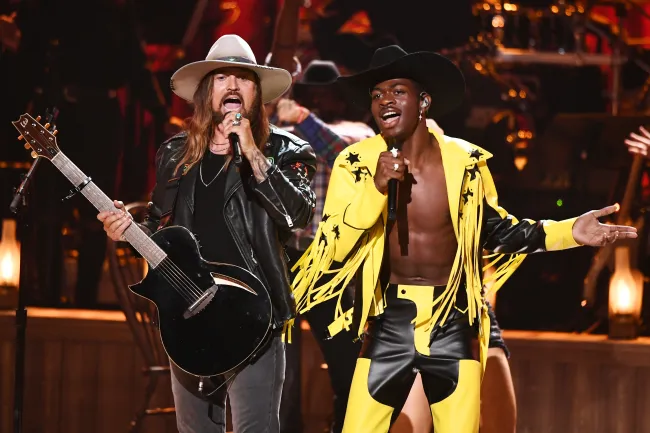
A look at the Pop Duo/Group winners’ list from the past 10 years reveals only two genuinely zeitgeist-defining blockbuster hits in Mark Ronson’s “Uptown Funk” featuring Bruno Mars and Lil Nas X’s “Old Town Road” with Billy Ray Cyrus. Ronson was a DJ and producer before becoming a recording artist on his own and has the collaborative spirit in his DNA, while Mars is always good for a team-up. And the Lil Nas X-Billy Ray Cyrus version of “Old Town Road” virtually created the subgenre of country rap, bridging two disparate worlds.
| Year | Artists | Song |
| 2016 | Mark Ronson featuring Bruno Mars |
“Uptown Funk” |
| 2017 | Twenty One Pilots | “Stressed Out” |
| 2018 | Portugal. The Man | “Feel It Still” |
| 2019 | Lady Gaga and Bradley Cooper | “Shallow” |
| 2020 | Lil Nas X featuring Billy Ray Cyrus |
“Old Town Road” |
| 2021 | Lady Gaga and Ariana Grande | “Rain on Me” |
| 2022 | Doja Cat and SZA | “Kiss Me More” |
| 2023 | Sam Smith and Kim Petras | “Unholy” |
| 2024 | SZA and Phoebe Bridgers | “Ghost in the Machine” |
| 2025 | Lady Gaga and Bruno Mars | “Die With a Smile” |
| 2026 | Cynthia Erivo and Ariana Grande | “Defying Gravity” |
Otherwise, the list is a grab bag of band performances (Twenty One Pilots’ “Stressed Out” and Portugal. The Man’s “Feel It Still”), soundtrack cuts from hit films (Lady Gaga and Bradley Cooper’s “Shallow” and Cynthia Erivo and Ariana Grande’s “Defying Gravity”), hit duets from like-minded artists, and even an album track (the SZA-Phoebe Bridgers team-up “Ghost in the Machine”).
With artists eschewing collabs and the continued splintering of music audiences, the days of five culture-defining, genre-spanning hits comprising the Pop Duo/Group field might be in the rearview. Instead, we have been making due with mid-sized successes or album tracks by Grammy favorites, like in 2024, where all five of the nominees were just deep cuts or warmly received songs by General Field nominees.
But even while we mourn monoculture, the Grammys might find a way back to encouraging more compelling collabs. By expanding the Recording Academy and creating new categories embracing Asian and Latin music, more artists could be motivated to take chances and collaborate outside their comfort zones. With the Grammy-nomination voting coming up soon, we’ll have our first clue as to whether there will be a resurgence of featurings, perhaps marking a slowdown of monoculture’s demise.
