
Stephen Root remembers his first onscreen role, lying flat on his back with fake blood on his face and a real monkey licking his forehead. He says he should have known then, appearing in George A. Romero’s 1988 horror thriller Monkey Shines, that the profession of acting was going to take him to some very strange places.
Now he has washed ashore in the strangest of all: Apple TV’s breakout hit and surprise awards juggernaut Widow’s Bay, about a small island town that is like an immense fishing net that snags all manner of the macabre and peculiar. In many ways, Root has been training his entire life for the role of the wise-but-cantankerous fisherman Wyck Crawford.


That first movie role with the madman monkey started Root on a path that led to Oscar winners like No Country for Old Men and Get Out, cult hits such as the big-screen Buffy the Vampire Slayer and Office Space, and TV shows like News Radio and The Man in the High Castle. Root has spent four decades as a reliable oddball and scene-stealer, but one of the unusual things about his career is that, despite decades of memorable work, Root only previously received one major award nomination.
That was an Emmy nod in 2019 for outstanding supporting actor in a comedy for playing the assassin handler Monroe Fuches in Barry. Now he’s finally up for another Emmy in the same category for Widow’s Bay, and his nomination is much more than just one among the 19 that the supernatural series has amassed. This marks a chance for the industry to finally recognize a reliable “That Guy” character actor who has been giving it his all and playing film and TV characters who are varyingly meek, menacing and messy — but always memorable.

All these years later, he says he might be hesitant to take a chance on such a volatile profession. “Just becoming an actor was an adventure,” he told me and my co-host Eric Vespe on our Stephen King-themed podcast The Kingcast. “There’s really no reason to become one to make a living — because you probably won’t. Ninety-five percent of us don’t work very often. But if you have to do it, you have to do it. I was adventurous.”
If he could go back in time, he’d offer his younger self this reassurance: “Don’t worry about the monkey. Just worry about the paycheck and whether or not you’ll get a job right after that, which I did.”

That next role was more lighthearted than his deleted simian death scene from Monkey Shines, but you wouldn’t say it was more dignified. Instead of being terrorized by a malevolent capuchin, Root was threatened by Paul Hogan in Crocodile Dundee II. Credited as “DEA Agent (Toilet),” there was no licking this time. “But there was a big knife about to cut my John Thomas off,” Root recalls.
His agent is caught mid-stream by the Outback hero, who extracts information by holding his That’s-Not-A-Knife-THIS-Is-A-Knife blade to Root’s character’s private parts. It was also released in 1988, right before Monkey Shines, although it was filmed afterward. Root jokes that he thought: “Bring the monkeys back. They’re at least not going to put a knife under there.”
Every journeyman actor starts somewhere, and after years of paying his dues in theater, Root was happy to pay his dues on the big screen with these offbeat roles. “It was very exciting to have a role in a big movie,” he says. “And then I got Ghost after that.” This proved to be a more formidable and dramatic part, playing the lead investigator who warns Demi Moore to avoid “charlatan” psychics while he works to solve Patrick Swayze’s murder.

Root felt like he was finally on his way. “I’m thinking, ’Well, I’m just going to have this lovely movie career,’” he says. “Of course, after that, I got nothing for many years.”
He made ends meet with single-episode roles in TV shows, like the sitcom Head of the Class and the crime drama Wiseguy. There were occasional movie roles, but they were bit parts — a studio security guard in the Hollywood Blacklist drama Guilty by Suspicion and a sleazy sausage salesman in the Kathleen Turner detective comedy V.I. Warshawski. Root’s next substantial role came by way of Stephen King himself in the CBS miniseries Golden Years, the first original TV project penned by the best-selling author.
With Golden Years, Root was back in the supernatural business. King’s influence on Widow’s Bay is undeniable, which made this another step for the actor in the direction of that present-day hit. “I think in the audition I did meet Stephen King. He was there looking at people,” Root says. “That was a big thing for me because it was a recurring role and something that was a good paycheck back in 1990, for sure.”
Root played a military bureaucrat named Major Moreland who oversees an elderly janitor who begins aging in reverse after an accident at the experimental facility. “He was kind of a nasty guy and he was really fun to do,” Root says. “I hadn’t played that kind of thing yet on TV.”

Golden Years wasn’t a hit, however. “It was supposed to have a second season because [the network] was real big on it, and then it just didn’t do very well because people didn’t, I guess, understand what a miniseries was,” Root says. “At the time, they’re like, ‘Well, this is weird.’ And they watched two and then they were gone.”
More small TV parts followed, like guest roles on Home Improvement, Jake and the Fatman, and Star Trek: The Next Generation. There were occasional detours back into the otherworldly, like a Halloween episode of Night Court in which Root played a defendant who claimed to be the Grim Reaper.
Another harbinger of his eventual role in Widow’s Bay was Root’s guest spot in the kid-friendly Twilight Zone-like anthology Eerie, Indiana. He played a farmer who, as they say on Widow’s Bay, was bitten by an animal and became that animal. Root’s character was named Mr. Chaney. (As in Lon Chaney Jr., get it?) “I was the werewolf,” he says. “It was one of my favorite things.”

It was also historic, from a visual effects point of view in 1992. His transformation into the creature was one of the first times that CGI was used on TV to visualize shapeshifting. Michael Jackson had pioneered the tech in his video for “Black or White” a year earlier, and Eerie, Indiana was among the first shows to harness the technique in a narrative. “They said that was one of the first ‘morphs’ on TV that wasn’t in a film,” Root says.
After that came another memorable film role, the oblivious principal in the big-screen version of Buffy the Vampire Slayer. In his most memorable scene, Root’s school administrator was so checked-out, he absently walks around a prom night massacre dropping detention slips on the dead students.

By then, Root’s dues were well paid. He became a main cast member on NewsRadio, playing the billionaire broadcasting tycoon Jimmy James, and the show ran for nearly 100 episodes from 1995-99. His most famous part — the mumbling, stapler-obsessed Milton Waddams in Office Space — came at the tail end of that, and he was voicing the sad-sack neighbor Bill Dauterive on the animated hit King of the Hill, which endures to this day.
Prestige also followed. Root was a standout in the Coen brothers movies O Brother, Where Art Thou?, The Ladykillers, No Country for Old Men, and The Ballad of Buster Scruggs. He was hilarious as the bedbug-crazy judge in Idiocracy and the miserable Gordon Pibb in Dodgeball: A True Underdog Story. Root had gravitas in historical dramas like Selma, J. Edgar and All the Way, but could also voice a silly cartoon character like Bubbles, the dimmest of the aquarium fish, in Finding Nemo.
Root is a Swiss Army knife kind of actor, capable of taking on many different tasks. And yet, he often went overlooked when award seasons rolled around. He was nominated for the Screen Actors Guild ensemble category along with the rest of the cast for Get Out, and was recognized in the TV ensemble category four times for Barry. But solo recognition hasn’t really happened. Until now.

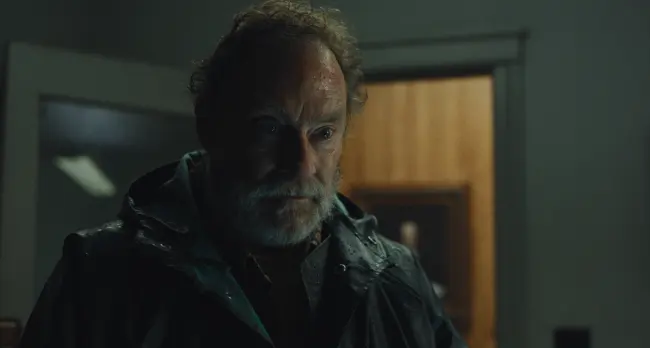
Widow’s Bay is the culmination of all that bizarre dues-paying. All that monkey licking. The knife to the John Thomas, the digital morph into a werewolf. It all adds up into how the audience perceives Root. One look at his character in the show, the grizzled old-timer Wyck, and you just know he has seen some gnarly things. So has the actor who brings him to life.
“He feels like he is the protector of the town, even though nobody’s listening to him — as well they shouldn’t,” Root adds. “He’s the town drunk.”
Still, Wyck knows things, which makes him both an ally and antagonist to Matthew Rhys’ Mayor Tom Loftis, who also knows things… but is in deep denial as he tries to take his haunted island town into the mainstream. “Here’s this guy coming in and saying, ‘Let’s bring more people and kids and have fun,’” Root says. “And it’s like, ‘No — let’s not do that because you have no idea what this island is about and what it’s been about not just for your lifetime but for centuries, literally centuries.”
His first appearance on Widow’s Bay deliberately calls to mind the introduction of another iconic fisherman, Robert Shaw’s Quint from Jaws, who was similarly viewed with barely concealed scorn by the everyday townsfolk. That town meeting was a last-minute addition by Widow’s Bay creator Katie Dippold, Root reveals.

“It was funny that we had shot that opening scene where Wyck is introduced and Katie was rethinking it by the end of the series saying, ‘We can introduce more characters maybe in that first scene than what we have in here right now,’” he says. “So the last scene I shot was that first scene.”
Root is the first to acknowledge that his many years in the supernatural trenches were good training for his work as Wyck. “I’m sure Katie would say that it’s absolutely true that all these things are elements of what’s in Widow’s Bay now, but it is somehow transmogrified into a really original take on horror,” he says. “Even though everything that you’ve ever watched is a part of it. It’s still an original thing, I think. And that’s a tribute to Katie and how well she writes.”
If you are going to create a show that is an amalgam of everything, it helps to have an actor like Root aboard — since the best way to describe him is: You know him from everything.

